Get all your news in one place.
100's of premium titles.
One app.
Start reading
Fit & Well
Fit & Well
Health
Sam Rider

Don’t start a workout until you've completed this three-minute breathing drill, says a pelvic floor expert and doctor of physical therapy

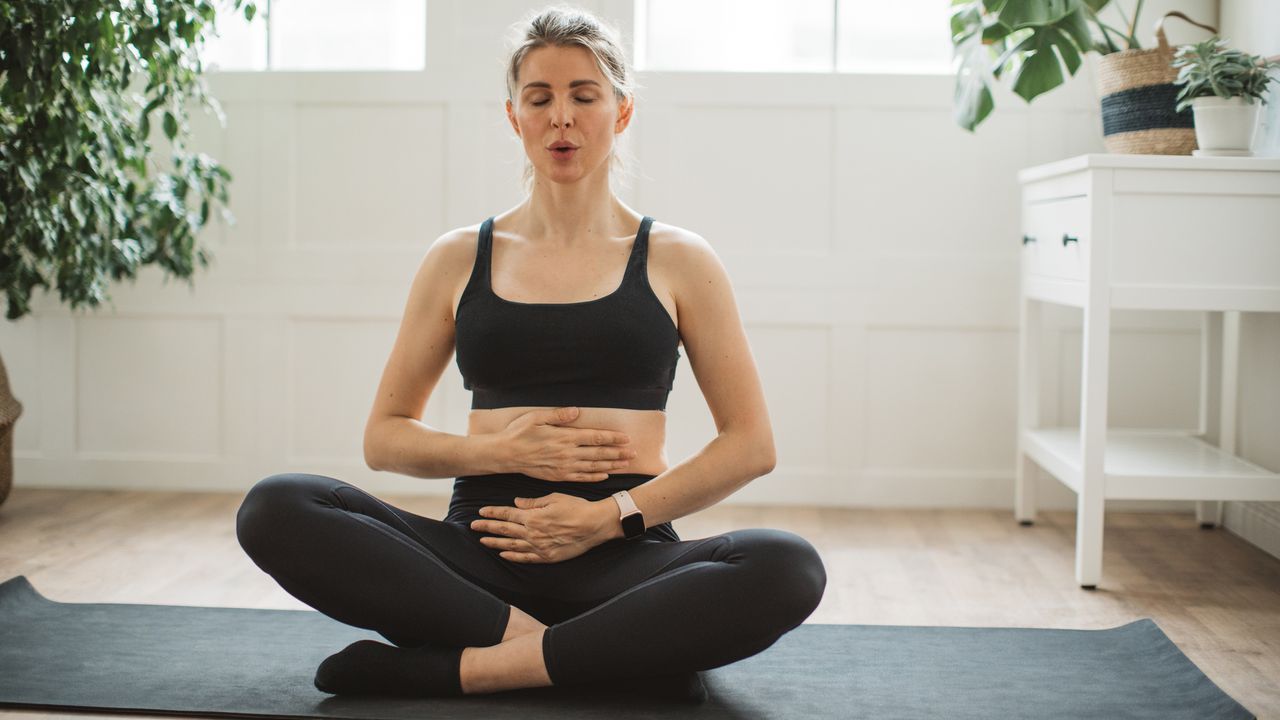
Woman sits cross legged on an exercie mat in a domestic setting with her hands on her belly and her lips pursed as she exhales.

Most strength programs for beginners or older adults make the same mistake, argues Dr Caroline Packard, a doctor of physical therapy with more than 15 years of clinical experience.

"They skip straight to the exercises and miss the piece of the puzzle that makes those exercises actually work," she tells Fit&Well.

"What I see in clinical practice is that beginners, or those coming back to movement after a long break, haven't just lost muscle, they've lost the foundational coordination between their breath, their deep core, and their movement patterns."

Without that foundation, Packard says, even simple movements like standing up from a chair, or climbing a set of steps, can feel challenging.

"The muscles are firing out of sequence. The core isn't managing pressure properly. And the body starts compensating in ways that quietly erode balance, strength and confidence over time," says Packard, who is the founder of Connect Pelvic Floor Fitness.

After navigating her own experience with pelvic floor dysfunction following pregnancy, Packard built Connect to serve as a training platform that treats the pelvic floor as the foundation of total-body strength.

This breathing exercise helps restore that foundation, allowing strength to be layered upon it.

"The sequence follows the same progression I use with every beginner client: start with breath, restore coordination, then load," says the mother of three.

Why you should start every workout with 360˚ diaphragmatic breathing

Packard recommends using this 360˚ diaphragmatic breathing exercise to initiate every workout, whether lifting weights or solely using your own bodyweight.

"This is where everything starts—and it's more important than it looks," she explains.

"The diaphragm and pelvic floor are part of the same pressure management system.

"When breathing mechanics are working correctly, the deep core activates automatically with every breath cycle.

"When they're not, every exercise downstream is working with a compromised foundation."

For adults who have spent years breathing into their chests, rather than bellies—which is most of us, she says—this three-minute exercise "is the reset the body needs before it can load effectively".

How to perform 360˚ diaphragmatic breathing with Dr Caroline Packard

  • Sit tall in your chair with your feet flat on the floor.
  • Rest your hands lightly on the sides of your ribcage.
  • Inhale slowly through your nose for four counts.
  • Feel the ribcage expand in the front, sides and back simultaneously, like an umbrella opening in all directions.
  • Exhale fully through the mouth for four counts, and feel the ribcage soften and draw inward.
  • Pause briefly after the exhale before your next breath.
  • That pause is where the deep core and pelvic floor complete their natural cycle.

"If your hands aren't moving outward on the inhale, keep breathing until you feel them expand," adds Packard.

"That outward movement is the signal that the diaphragm is doing its job."

Perform three sets of five slow breaths, resting 10 seconds between sets. It should take approximately three minutes to complete.

Sign up to read this article
Read news from 100's of titles, curated specifically for you.
Already a member? Sign in here
Related Stories
Top stories on inkl right now
One subscription that gives you access to news from hundreds of sites
Already a member? Sign in here
Our Picks
Fourteen days free
Download the app
One app. One membership.
100+ trusted global sources.







