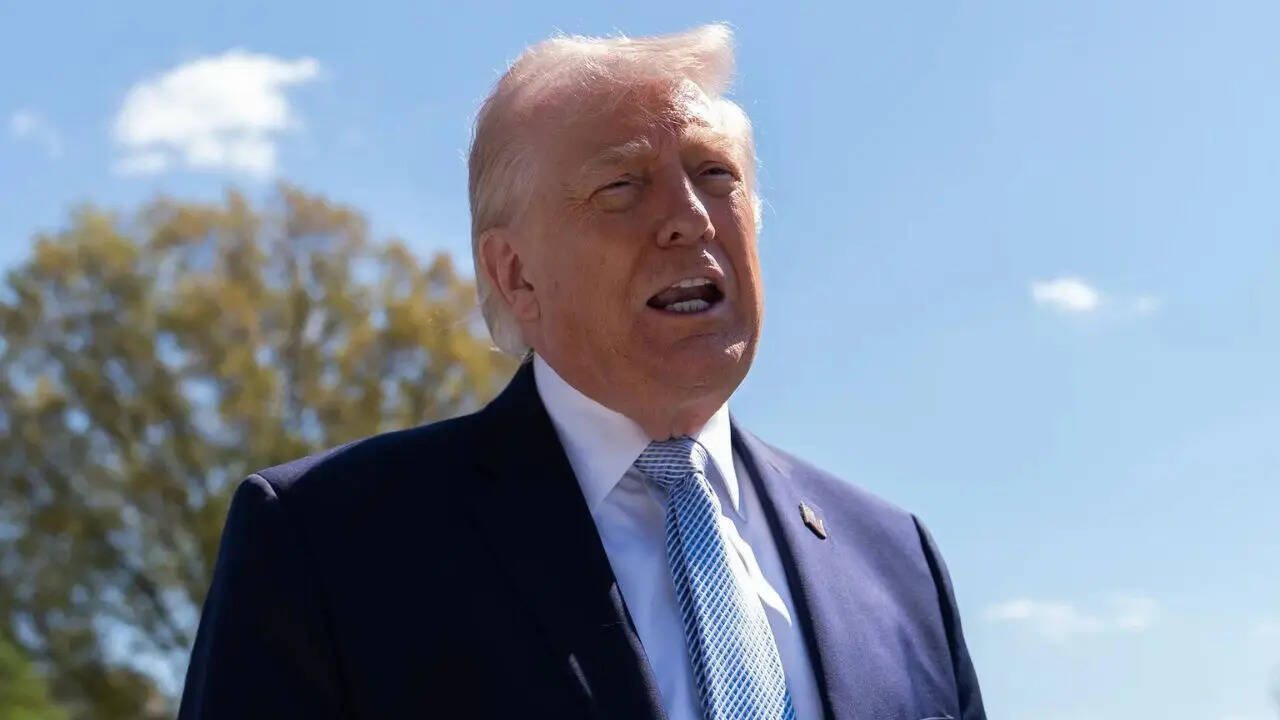
TOI Correspondent From Washington: In the elastic universe of Donald Trump, time is not measured in days or months or years, but in something far more mystical, “two weeks.” The Trumpian fortnight is a unit so versatile, so enduring, and so reliably undelivered that it has become less a deadline and more a state of mind -- it is a magical period of time that is perpetually beginning, never ending, and carries the structural integrity of cotton candy.
For years now, the MAGA boss has deployed the “two-week” timeline with the casual confidence of a man ordering a Big Mac. A new health care plan? Two weeks. A replacement for Obamacare? Two weeks. Evidence of election fraud? Two weeks. Gold Card? Two weeks.

The pattern is so consistent that veteran Washington watchers have come to treat “two weeks” not as a promise but as a polite conversational exit — the political and social equivalent of “Let’s get together sometime” or “I’ll circle back.” Only in Trump’s case, the circle rarely closes.
Consider the greatest hits.
There was the long-promised, never-seen “beautiful” health care plan, which Trump insisted repeatedly would be unveiled in two weeks. This refrain stretched across years, presidencies, and global pandemics, with the plan itself achieving almost mythical status — spoken of often, seen never. Then came the tax return saga.
At various points, Trump assured Americans that his returns would be released in two weeks, just as soon as audits concluded, or legal hurdles cleared, or perhaps when Mercury aligned with Mar-a-Lago. The returns did eventually emerge, though not on Trump’s timetable, and not within a fortnight.
More recently, Trump floated the idea of a “gold card” immigration initiative, promising details within — you guessed it — two weeks. Like many of its predecessors, the concept briefly lit up headlines before drifting into the vast archive of Trumpian tomorrows. The latest – the President’s pivot from "total civilization-ending" annihilation of Iran to a "two-week ceasefire."
The phenomenon has not gone unnoticed by late-night comedians, who have turned Trump’s temporal tic into a durable punchline. Jimmy Kimmel, among others, has repeatedly lampooned the habit, compiling montages of “two-week” promises that stretch longer than some government projects. "He says 'two weeks' the way a parent tells a kid they’ll go to Disney World 'next summer,'" Kimmel joked in a recent monologue. "It’s not a date on a calendar; it’s a polite way of saying 'Please go away and let me watch Fox News.'”
Political flunkeys suggest the explanation is less strategic than instinctive. Trump, they say, favors immediacy — the appearance of action without the burden of specificity. “Two weeks” is short enough to sound decisive, yet distant enough to avoid immediate accountability. It is, in effect, the Goldilocks of deadlines: not too soon, not too far, but just vague enough.
Critics argue that the habit reflects a broader governing style, one that prioritizes announcement over execution, momentum over follow-through. Supporters, meanwhile, often shrug it off as rhetorical flourish, part of the improvisational charm that has long defined Trump’s political persona. Either way, the result is the same: a growing catalog of initiatives that exist primarily in the future tense.
In Washington’s more cynical corners, “two weeks” has taken on a life of its own. It is invoked knowingly by lawmakers, staffers, and journalists alike a wink, a nod, a shared understanding that some deadlines are not meant to be kept.