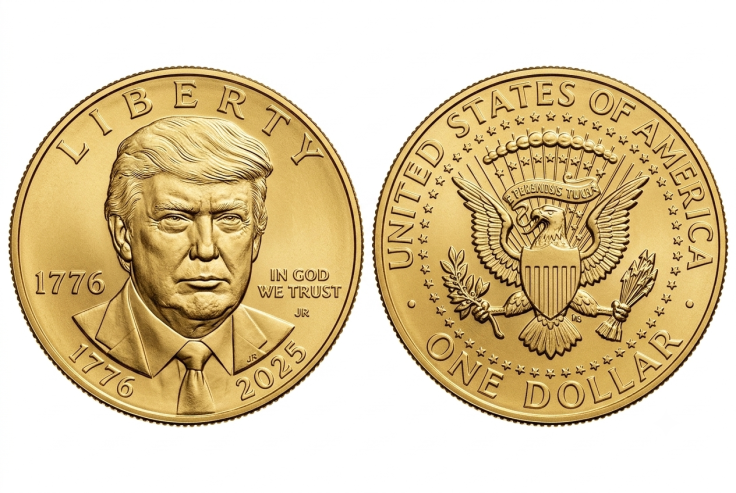
A new $1 coin bearing Donald Trump's face could enter circulation in the United States, after the Treasury turned to a little-known 250th-anniversary law to justify placing a living president on legal-tender currency. The design was unveiled by Treasury Secretary Scott Bessent as part of America's 2026 semiquincentennial programme.
Treasury officials say the coin is permitted under a 2020 coin-redesign statute that authorises special $1 pieces 'emblematic' of the country's 250th anniversary, even though older rules bar living individuals from appearing on standard currency.

Trump Gold Coin Tied to Semiquincentennial Law
At the heart of the plan is the Circulating Collectible Coin Redesign Act of 2020, passed by Congress and signed into law in January 2021. According to the legislation, the Treasury may mint $1 coins in 2026 with designs 'emblematic of the US semiquincentennial', alongside redesigned quarters and half‑dollars for the anniversary.
The administration's legal explanation also referred to an 1866 statute that established the convention of depicting only deceased individuals on US currency, a rule introduced to avoid monarch‑like imagery. Against that backdrop, officials are presenting the semiquincentennial law as a specific authority for anniversary‑themed $1 coins, with the Trump design treated as one of those issues.
Living President on $1 Coin Breaks with Norms
Draft images of the circulating $1 Trump coin show the president's profile on the heads side and a more dramatic pose on the tails side, set against the American flag. The Treasury's description says the reverse design features Trump raising a fist beneath a slogan, underscoring the political symbolism of the piece as well as its commemorative function.
This would make Trump one of the few living presidents in US history to appear on currency, drawing comparisons with Calvin Coolidge's 1926 commemorative half-dollar.
Separate 24-Karat Trump Gold Coin Approved
A federal arts commission has separately backed a 24-karat gold Trump coin for the anniversary. The US Commission of Fine Arts, whose members were appointed by Trump, unanimously approved a design showing the president with his hands on a desk, intended as a limited-run commemorative piece not meant for general circulation.
The approval clears the way for the Mint to begin production once specifications are finalised, though Treasury's sign-off also weighs input from the Citizens Coinage Advisory Committee, a separate statutory review body. Officials stress the gold coin falls under the Secretary's distinct authority to issue proof coins, not the semiquincentennial $1 law. The two are treated as entirely separate initiatives.
Critics Question Legal Logic and Symbolism
The $1 coin is part of a wider currency push that includes a redesigned $100 bill bearing Trump's signature, the first time a sitting president's autograph will appear on US paper money.
Oregon Senator Jeff Merkley and other Senate Democrats have urged Bessent to reject the $1 coin designs. In December 2025, Merkley and Nevada Senator Catherine Cortez Masto introduced the Change Corruption Act, which would ban any US currency bearing the likeness of a living or sitting president.
Historians such as Franklin Noll note the founders' reluctance to put officials on coins at all, fearing it would make them look like kings. Commissioner Chamberlain Harris of the Commission of Fine Arts has countered that it is 'appropriate to feature a current president' on a 250th-anniversary coin.
Treasury maintains that the 2020 law and the Secretary's discretionary powers make the $1 coin lawful. As the coins move closer to minting, the statute behind Trump's one-dollar coin is likely to stay at the centre of debate over how far presidents can go in shaping the currency that bears their image.