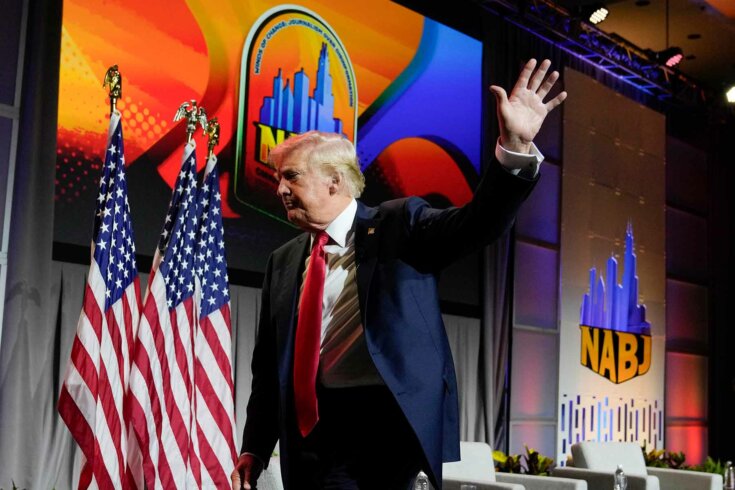
The shocking announcement came at the eleventh hour. Just two days before the US National Association of Black Journalists convention—the annual multi-day conference that brings together thousands of Black journalists and other media workers for panels, workshops, award ceremonies, and a job fair—organizers sent an email to the NABJ’s general membership announcing that former president Donald Trump would take part in a moderated conversation with journalists. They said Trump’s appearance was part of a long tradition of hosting former presidents and candidates to speak at the convention, including George W. Bush, Barack Obama, and Bill Clinton. They added that they’d extended a similar invitation to vice-president Kamala Harris, who, it was later revealed, was not able to attend in person but would provide a virtual address at a later date.
I was heading to the convention with an inaugural delegation of fellows from the Mary Ann Shadd Cary Fellowship for Black Journalists, and initially, I had no interest in going to Trump’s event. I had set up interviews with prospective employers during his scheduled appearance—some of the best news outlets and journalism schools in North America—and those seemed like a better use of my time than going to see an overtly racist, sexist, xenophobic, and autocratic former leader. After all, the NABJ convention was a time for rejuvenating, connecting, and bolstering journalists.