Get all your news in one place.
100's of premium titles.
One app.
Start reading
The Conversation
The Conversation
Politics
Homa Hosseinmardi, Associate Research Scientist in Computational Social Science, University of Pennsylvania

Don't be too quick to blame social media for America's polarization – cable news has a bigger effect, study finds

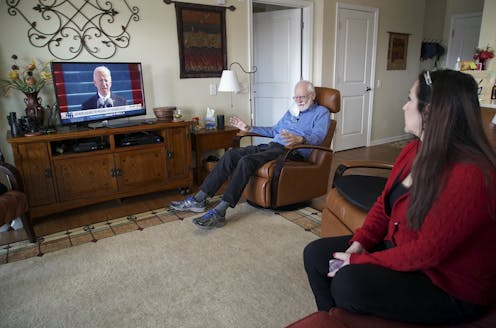
Joe Biden and Donald Trump supporters, like these two, are more likely to be polarized by TV news than online echo chambers. AP Photo/Allen G. Breed

The past two election cycles have seen an explosion of attention given to “echo chambers,” or communities where a narrow set of views makes people less likely to challenge their own opinions. Much of this concern has focused on the rise of social media, which has radically transformed the information ecosystem.

However, when scientists investigated social media echo chambers, they found surprisingly little evidence of them on a large scale – or at least none on a scale large enough to warrant the growing concerns. And yet, selective exposure to news does increase polarization. This suggested that these studies missed part of the picture of Americans’ news consumption patterns. Crucially, they did not factor in a major component of the average American’s experience of news: television.
Sign up to read this article
Read news from 100's of titles, curated specifically for you.
Already a member? Sign in here
Related Stories
Top stories on inkl right now
One subscription that gives you access to news from hundreds of sites
Already a member? Sign in here
Our Picks
Fourteen days free
Download the app
One app. One membership.
100+ trusted global sources.