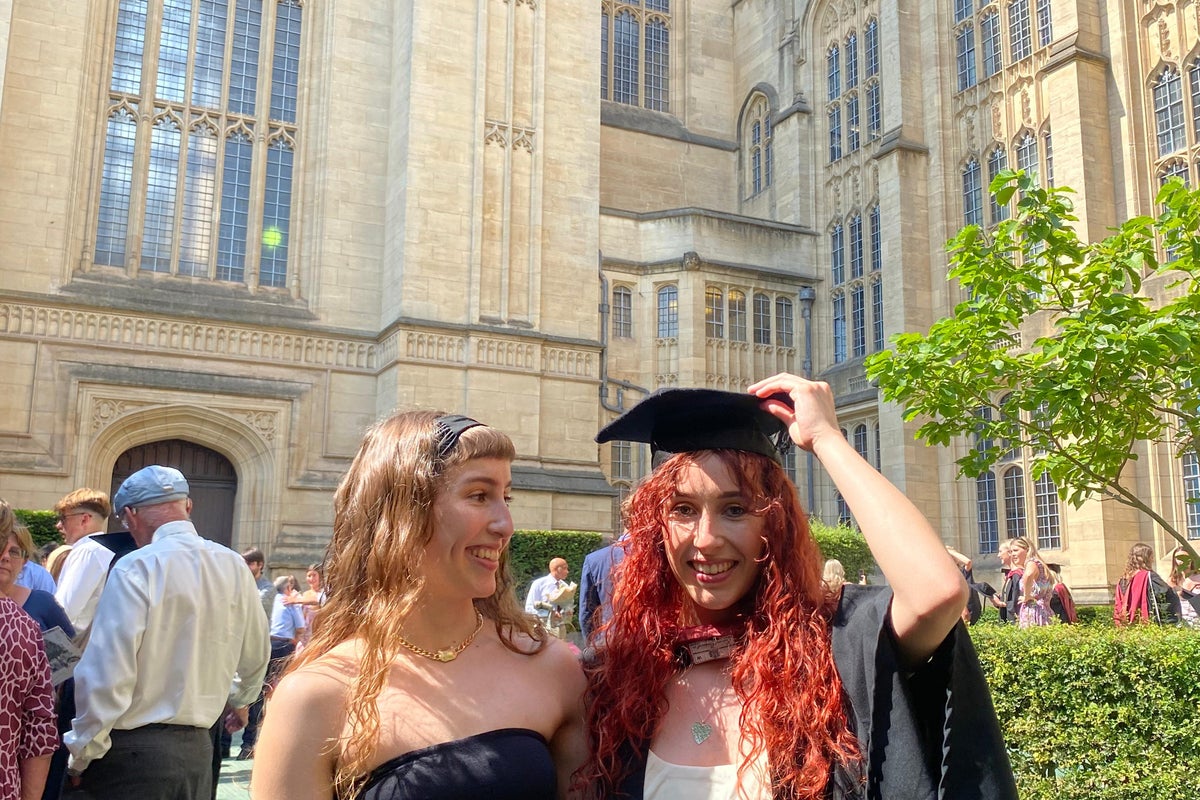
For decades, twin sisters Caitlin and Grace Leggett, from Cardiff, believed they were fraternal. It took a harrowing leukaemia diagnosis for Caitlin at the age of 23 to uncover the astonishing truth: they are, in fact, identical.
The 23-year-olds had always assumed they were dizygotic twins, formed from two distinct eggs fertilised by separate sperm. Growing up, their bond was exceptionally close, sharing a multitude of hobbies, including years of competitive athletics. Their academic paths also intertwined, both attending the University of Bristol – Caitlin studying Psychology and Grace Neuroscience, the latter coincidentally going on to complete a Master’s in stem cells and regeneration. They even shared a student house, remaining the best of friends.
After graduating, Caitlin had set her sights on joining the Army as an Intelligence Officer. Her medical assessment was scheduled for April 2025. However, in March of that year, a persistent rash emerged, resisting pharmacy creams. A visit to her GP led to blood tests, taken on 3 April 2025, as a potential virus was suspected.
The following night, at approximately 12.30 am on 4 April, Caitlin received an urgent call from an out-of-hours GP, instructing her to go straight to A&E. Though initially told to return the next morning, a subsequent call redirected her to the Llewellyn Teenage Cancer Trust unit at University Hospital of Wales in Cardiff. The gravity of the situation immediately became clear. At that appointment, she was diagnosed with acute myeloid leukaemia (AML), an aggressive cancer affecting white blood cells.

While the NHS lists symptoms such as paleness, fatigue, breathlessness, and unusual bruising, Caitlin experienced none of these. The unusual rash was her sole indicator that something was amiss. She was informed that her treatment would involve chemotherapy, followed by a stem cell transplant to replace cancerous cells with healthy ones.
Both Caitlin and Grace had registered as donors with DKMS’s stem cell register "years and years ago". Following Caitlin’s diagnosis, her entire family was tested for a match. Initially, Grace was identified as a suitable donor, given the high probability of sibling compatibility.
Grace underwent comprehensive checks at a Cardiff hospital. "I had to go to one of the hospitals in Cardiff and they did all the checks: my weight, they took around 15 little vials of blood to test for all different diseases and everything, checked heart rate and lungs," Grace explained. "Everything was fine, so they gave me a little pamphlet with all the information. And then I just had to wait."
A short while later, Caitlin received a call from her consultant. After reviewing Grace’s results and "triple checking", they realised that "every single marker that we’ve looked for is exactly the same, and we would expect different if you’re non-identical," Caitlin recounted, adding that the doctor concluded they were, in fact, monozygotic twins. The sisters had been told they developed in separate amniotic sacs, leading their parents to believe they were fraternal, though identical twins can, and often do, develop separately.
"I always wished I was an identical twin – I liked being a twin, but being an identical twin is a bit cooler," Grace said. "It’s really weird to think that I’m basically Caitlin!"
However, this joyous discovery brought an unforeseen setback for Caitlin’s treatment. Doctors advised that Grace could not donate her stem cells. For a transplant to be effective, the recipient’s body must recognise the donor cells as foreign, prompting a battle where the donor cells ideally overcome the leukaemia. With near-identical DNA, Caitlin explained, "the whole concept of the transplant wouldn’t work."

Caitlin underwent chemotherapy, thankfully experiencing "didn’t really get any side effects". Her stem cell transplant was initially planned for August 2025, with Grace as the anticipated donor. With that no longer an option, doctors sought an alternative donor from the register. An initial match was found, but that donor had to withdraw. In the interim, Caitlin discovered the leukaemia had spread to her skin.
This development led to the cancellation of the August transplant. Caitlin then participated in a clinical trial in Manchester to target the leukaemia in her skin. As the transplant date was incrementally pushed back, she was unable to receive further chemotherapy. The trial proved successful, and a new transplant date was set for December 2025 with another donor, chosen from three eligible partial matches.
Tragically, a week before this second transplant, the cancer returned to her skin. Doctors decided to proceed with the transplant regardless, necessitating additional full-body radiotherapy for Caitlin. "The radiation was probably the worst," Caitlin said, describing the initial day as particularly brutal. "I didn’t feel anything from chemo initially, but the first day of radiation, oh my God, I thought I was dying. It was crazy. I had, like, all the side effects on one day, but then by the second day, I got used to it, so I felt alright."

In December 2025, Caitlin finally received her stem cell transplant from an anonymous donor, which proved successful. She experienced minimal side effects, including an infection and some stomach issues, but noted it "wasn’t really too bad, compared to some other people."
Following the successful transplant, Caitlin is now on a new drug trial, with her treatment journey ongoing. Her bone marrow will be monitored monthly for three months; if clear, checks will reduce to quarterly, alongside regular clinical assessments and blood tests.
Both Grace and Caitlin are now fervent advocates for stem cell donation. According to DKMS, over 2,000 people in the UK annually require a blood stem cell transplant, yet only 7% of the eligible population are registered as potential donors.
"I just think that the same way with if you donate blood, at some point in the future, if I needed blood, I would want some to be available to me. So it’s the same kind of thing: If I need stem cells in the future, like a transplant, hopefully I would get some," Grace urged. "It takes maybe six hours maximum (to donate), and then for someone else, it changes their life. So I don’t see why you wouldn’t do it."

Caitlin added: "It can happen to anyone, really. Obviously I didn’t expect anything to happen to me… It literally could be anyone."
To learn more about DKMS and register as a stem cell donor, visit www.dkms.org.uk.
How Tourette’s causes involuntary outbursts
I had a stroke aged 26 – my heart would stop for 14 seconds
Pets can improve the health of older adults – but also strain their finances: poll
The common household items that carry hidden health risks
What is Tourette syndrome – as I Swear dominates at Baftas 2026
7 things to know about Tourette Syndrome – as I Swear wins three Baftas