Get all your news in one place.
100's of premium titles.
One app.
Start reading
Bangkok Post
Bangkok Post
Comment

Dissecting the threat of the 'blue regime'

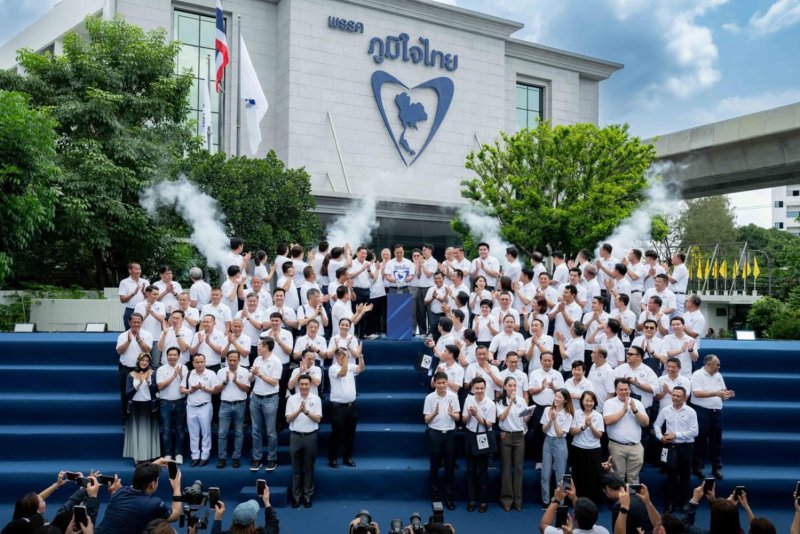
File photo dated April 6, 2025 shows the Bhumjaithai members taking a group photo at the party's head office, which features the party's new, all-blue logo. (Photo courtesy of Bhumjaithai Party)

Opposition leader and People's Party head Natthaphong Ruengpanyawut's reference to the "blue regime", and his sharp criticism of Prime Minister Anutin Charnvirakul for inviting members of the Privy Council to a water-shortage meeting on May 19 have sparked a backlash against his party and a heated debate on social media over who really represents the "blue regime" as the People's Party -- the "orange party" -- sees it.

On May 21, Mr Natthaphong criticised Mr Anutin for holding a meeting with nine privy councillors -- among them former prime minister Prayut Chan-o-cha -- at the Disaster Prevention and Mitigation Command to discuss responses to an anticipated severe drought. Mr Anutin later said the councillors had merely listened to a briefing by officials and offered no suggestions or advice.
Mr Natthaphong said the presence of privy councillors at a meeting with government officials might compromise the neutrality of the Privy Council, which represents the monarchy, and could contravene the principle of a democratic system with the King as head of state. The reputation of the monarchy, he said, might be tarnished if any decision taken at the meeting went wrong.

The following day marked the 12th anniversary of the May 22 coup led by Gen Prayut Chan-o-cha.

In a Facebook post, Mr Natthaphong claimed the coup-makers had, over the years, evolved into the "blue regime", which had continued to consolidate its power.

Under the "blue regime", he claimed, the Constitutional Court and the Senate had become submissive and had failed in their duty to protect democracy.

His remarks were further complicated by a May 23 Facebook post from Piyabutr Saengkanokkul, regarded as the mentor of the People's Party and its two defunct predecessors, Future Forward and Move Forward.

In it, Mr Piyabutr repeated his earlier proposal to dissolve the Privy Council, calling the King's advisory panel a legacy of the absolute monarchy, which was overthrown in 1932 by Khana Ratsadon -- a group of civil servants and military officers who staged a bloodless coup. The Privy Council was revived in 1947.

With the three events combined, by chance or design, it was hardly surprising that pro-monarchy elements read Mr Natthaphong's reference to the "blue regime" as the monarchy, given the party's well-known stance on the issue.

A group of 89 senators, who felt insulted by his claim the Senate answers to the "blue regime", came forward to deny the accusation and demand a public apology from the People's Party leader, who refused to budge.

In an interview with Thairath TV, Mr Natthaphong said he had not been referring to the monarchy, as most people assumed, but to the powers-that-be in Buri Ram -- widely understood to mean the Chidchob family.

This may be a thin excuse in the wake of the public backlash. But the theory that the Buri Ram powerhouse is the real "blue regime" should not be dismissed lightly.

Here are a few glaring examples of how powerful that powerhouse is.

The first is the alleged manipulation of the complex election of the senators through collusion, which resulted in several candidates appointed to or affiliated with the "blue regime" winning Senate seats.

What is the point of controlling the Senate? The Senate endorses the selection of members of all the charter-mandated independent bodies -- the Constitutional Court, the NACC, the Election Commission, the State Audit Commission, the Ombudsman and the National Human Rights Commission. Their term of office is seven years.

The second example is the Khao Kradong land scandal in Buri Ram. The land covers 5,083 rai belonging to the State Railway of Thailand (SRT) under a royal decree in 1919.

With the help of officials at the Land Department, title deeds were issued to local residents -- including the Chidchob family and alleged nominees -- who own 121 plots covering 288 rai, later developed into the Chang International Circuit for MotoGP races and the Chang Arena for football matches.

Both the Supreme Court and the Supreme Administrative Court have ruled the land belongs to the SRT, but the Land Department has refused to revoke the title deeds, claiming they were properly issued -- forcing the SRT to go to court if it wants the land back.

Why does the dispute persist, with the land still in the hands of the Chidchob family? Because for years both the Transport Ministry and the Interior Ministry -- which oversee the SRT and the Land Department respectively -- have done little to reclaim it.

Kicking the can down the road only lends weight to the perception that both ministries are controlled by the "blue regime".

The third example is the asset-concealment case involving Saksayam Chidchob, a member of the "blue regime".

He was disqualified from the transport portfolio by the Constitutional Court for concealing his shareholding in Buri Charoen Construction Limited Partnership. But when the case went to the NACC for a 10-year political ban, the anti-graft watchdog ruled that he had not intentionally concealed his assets.

Also, some NACC members were endorsed by the Senate -- several of whose members are themselves accused of being "blue" senators for their perceived ties to the regime.

So the conservative royalists' reading of Mr Natthaphong's reference to the "blue regime" may be wrong in this context. But because both camps share the same hostility towards the People's Party over its perceived anti-monarchy stance, the conservatives tend to overlook the real threat the "blue regime" poses.

The "blue regime" now has in its pocket Mr Anutin, leader of the Bhumjaithai Party; House speaker Sophon Zaram, a seven-time MP for Buri Ram; Senate speaker Mongkol Surasajja, a former governor of Buri Ram; and several independent organisations.

So what is its real objective? To keep its tight grip on power for as long as possible -- like its predecessors, the Thaksin regime and the three "Ps" (the coup-makers Prayut, Prawit and Pok) -- for its own vested interests.

All three regimes appear to share the same misconception: that their hold on power is permanent. Yet time has already proved the three "Ps" and the Thaksin regime badly wrong -- both have crumbled in disgrace.

Sadly, the "blue regime" does not appear to have learnt the lesson.

Sign up to read this article
Read news from 100's of titles, curated specifically for you.
Already a member? Sign in here
Related Stories
Top stories on inkl right now
One subscription that gives you access to news from hundreds of sites
Already a member? Sign in here
Our Picks
Fourteen days free
Download the app
One app. One membership.
100+ trusted global sources.