
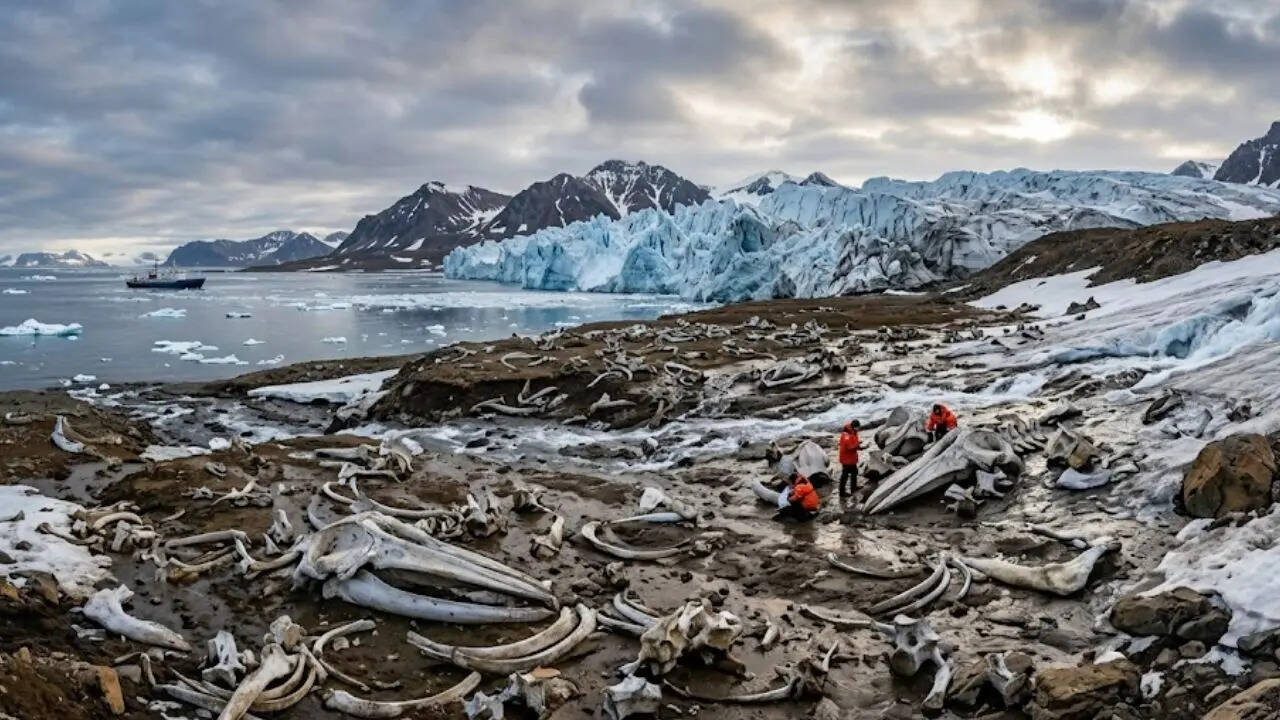
The rapid retreat of Arctic ice is revealing an extraordinary opportunity to gain insight into the Earth’s marine history through fossils. On Wilczek Island, which is found within the remote archipelago of Franz Josef Land, researchers have witnessed the rapid melting of a Russian glacier adjacent to the island, exposing an extensive graveyard of prehistoric whales. The graveyard was discovered during the ‘Arctic Floating University 2025’ expedition, and the subfossil remains have been preserved within the cryosphere’s active layer for thousands of years.
These fossils provide vital information about ancient sea-level changes and how cetaceans migrated to and from the region, allowing the Arctic and Antarctic Research Institute (AARI) to better reconstruct both of these phenomena. Furthermore, as glaciers continue to melt faster than they ever have previously, this biological record of ancient marine life provides a unique, but ultimately sobering, opportunity to study what has happened to marine life due to past environmental changes. These thawing remnants serve as a vital clock, offering scientists a fleeting window to decode the resilience of ancient ecosystems.













