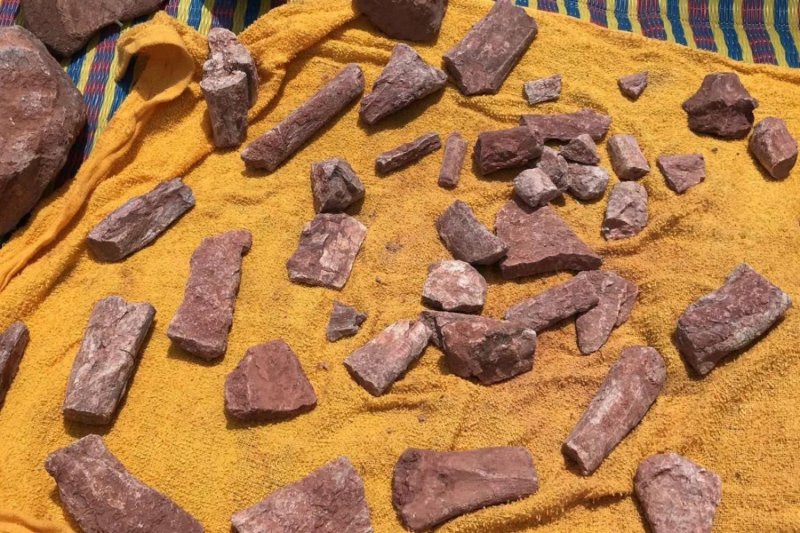
More than 100 dinosaur fossil fragments estimated to be over 130 million years old have been found in Chaiyaphum, raising hopes of identifying one of Thailand's oldest known carnivorous dinosaurs.
The discovery was announced after local resident Yodsanya Pitabut, 53, from Ban Mai Nong Daeng in Ban Khwao district, guided researchers to the site where he first spotted fossil fragments.
The excavation team was led by Sita Manitkoon, researcher at the Palaeontological Research and Education Centre at Mahasarakham University. He also led the study identifying Nagatitan chaiyaphumensis, the giant plant-eating dinosaur recently recognised as a new species and the largest dinosaur yet discovered in Thailand and Southeast Asia.
The survey also included Adulwit Kaweera, a geologist at the Khon Kaen Dinosaur Research Centre and Museum, and Ketsadaporn Krueapakdee, a geologist at the same centre, plus local administrative leaders and more than 10 villagers.
The fossils were uncovered in a cemetery west of Ban Mai Nong Daeng village after an excavator was brought in to level land for the construction of a crematorium.
Mr Yodsanya collected the first bone fragments and submitted them for examination. More than 100 fossil pieces have since been recovered, including vertebrae, leg bones, joints, ankle bones and toe bones.
Shark fin remains were also found at the site, providing additional evidence of the area's ancient environment.
Researchers will transport the specimens to the research centre for further analysis while continuing excavations beneath the limestone layers to determine the dinosaur's exact classification, said Mr Sita.
He said preliminary assessments indicate the fossil belongs to a carnivorous dinosaur, making it the fourth dinosaur discovered in Chaiyaphum and the oldest yet identified in the province, surpassing the 115-million-year-old Nagatitan chaiyaphumensis.
Local leaders hope the site will eventually become an internationally recognised learning centre and tourist attraction.