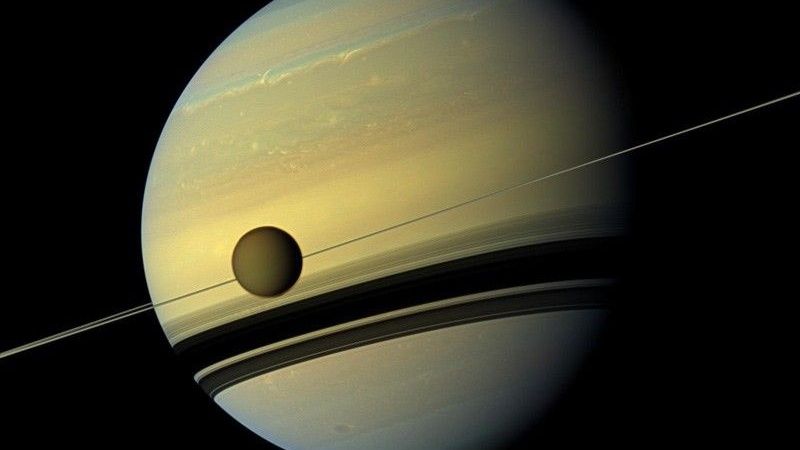
Saturn's largest moon, the smog-enshrouded Titan, could be the result of a dramatic merger between two other moons that initiated a cavalcade of effects — including the formation of Saturn's beautiful rings.
When the Cassini–Huygens mission arrived in the Saturnian system in 2004, it was greeted by a menagerie of mysterious moons with bizarre properties. Titan, the second largest moon in the solar system, is also the only moon in our cosmic neighborhood to sport an atmosphere, one redolent in organic molecules. Then, there's Hyperion, a battered and bruised body that looks like a giant pumice stone tumbling around Saturn. Meanwhile, the yin-yang world of Iapetus, with its two-toned hemispheres believed to result from passing through Saturn's E ring — which is formed by material spewed out from Enceladus's geysers — has the most inclined orbit of any of Saturn's main moons, angled at 15.5 degrees to Saturn's equatorial plane.