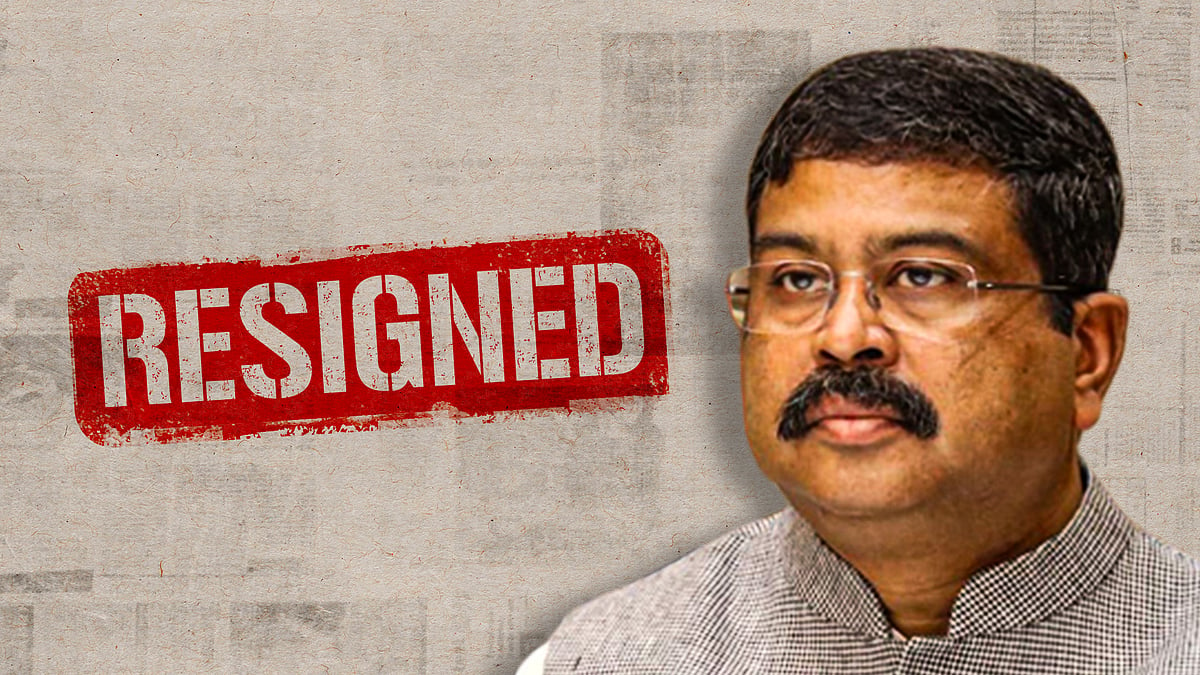
Union education minister Dharmendra Pradhan submitted his resignation to Prime Minister Narendra Modi on Saturday, a day after the Cockroach Janta Party (CJP)-led protests at Jantar Mantar demanded he be sacked over the NEET-UG 2026 paper leak.
In a letter addressed to “young friends” on X, Pradhan said he had always respected the aspirations of the country’s youth and took full responsibility from the outset for the “irregularities” that came to light in the NEET-UG exam held in May 2026, after which the government handed the matter to the CBI, cancelled the exam and ordered a re-examination, alongside a move to computer-based testing from next year. He said the re-examination was completed on June 21 and results declared on July 16 were “satisfactory”, but that “individuals holding responsible positions” had tried to mislead students during this period, which he said “caused me deep distress”.

Pradhan said his resignation was intended to prevent “anti-national forces from taking advantage of the protests” at Jantar Mantar, “preserve national unity”, and ensure no student’s future got “entangled in legal complexities” – allowing them to focus on their studies instead.
The government hasn’t formally accepted his resignation yet.
— Dharmendra Pradhan (@dpradhanbjp) July 25, 2026
The minister’s letter comes after a second round of talks on Friday between CJP spokespersons Saurav Das and Ashutosh Ranka and Union ministers JP Nadda and Jitendra Singh, held at the Constitution Club of India – a “neutral” venue the CJP had insisted on. Nadda had also met the two CJP leaders on July 20, the day of a Parliament march that saw police deploy lath-charge and tear gas to turn back protesters.
In a letter submitted at the meeting, addressed to Nadda, the CJP said its three demands – Pradhan’s resignation, monetary compensation for the families of students who died by suicide following the NEET-UG paper leak, and no legal action against protesters – were “non-negotiable”, according to a Hindustan Times report. The letter also called on the government, the Rapid Action Force chief and the Delhi Police commissioner to “publicly apologise” to students it said were assaulted during the July 20 march. It further sought a response to the CJP’s five-point charter on examination reforms, warning that the movement would “grow bigger and spread across the country” if its demands went unmet.
Speaking to reporters after the meeting, Ranka said Pradhan “needs to resign or he needs to be sacked”, adding that the government had sought until Saturday afternoon to respond.
“We have told them we can't wait a lot more time on this. If Pradhan does not leave his seat within the next 1-2 days, then one more national call for protest will be given. This one will be much bigger than July 20, and it will be national. We have explained all this and we think they have understood it, that everyone in the country only wants Dharmendra Pradhan's resignation. Nothing less will work for us,” said Ranka.
Reports had earlier indicated that the government would not concede on the demand for Pradhan’s resignation. According to an Indian Express report last night, a source present at a meeting of senior ministers was quoted as saying the government could not be seen “succumbing to the pressure of any protesting forces or groups”, warning that conceding once would invite similar demands for the removal of other ministers, or even the prime minister.
NTA overhaul, but the story remains incomplete
On Friday, the government dismissed 47 officials of the National Testing Agency (NTA), the body that conducts NEET, as part of what many among the mainstream media described as a major overhaul following the paper leak that triggered the protests. Unnamed “sources” cited in the report suggested further action against other officials could follow.
One issue, however, complicates the official narrative. In a Rajya Sabha reply to MP V Sivadasan two days prior, minister of state for education Sukanta Majumdar had stated that the NTA employs only 24 permanent officers, against 39 sanctioned posts, spanning ranks from Director General down to Senior Superintendent. Additionally, the NTA has 73 personnel on contract – including advisors, consultants and young professionals – and 124 more through outsourcing, covering roles such as data analysts and legal associates.
With only 24 permanent officers on the rolls, the dismissal of 47 officials raises the question of exactly who was let go – whether the number includes contractual staff, and if so, how many. Only the government can clarify this.
Modi pushes ministers towards Instagram, new paper leak bill
Separately, The Hindu reported that Prime Minister Modi has directed Cabinet colleagues to become more active on Instagram and engage directly with young people, a day after posting a vertical-format reel promising strict action against exam paper leak “mafias”.
Modi’s own Instagram following reportedly grew substantially following the video, in which he said fast-track court approvals for such cases had been cleared and would go before Cabinet before the Bill was tabled in Parliament’s second sitting week, from Monday.
Meanwhile, the Centre is set to introduce the Public Examinations (Prevention of Unfair Means) Amendment Bill, 2026, in Parliament on Monday.
The proposed amendments raise the minimum punishment for unfair means and paper leaks from three years to five, with a maximum sentence of 10 years and a fine of Rs 50 lakh; for organised paper-leak crimes, the minimum sentence rises to seven years with a Rs 10 crore fine. The Bill also provides for a Central government-constituted Special Task Force to investigate such cases, with investigations to be completed within two months, trials conducted on a day-to-day basis and concluded within three months of the chargesheet being filed, and appeals – as far as possible – decided within three months.
Police scrutiny and detentions
Mohammad Junaid, a Ghaziabad resident volunteering at the protest, alleged that the Uttar Pradesh Police detained his family members and seized their bank passbooks and PAN cards during a raid at his house, and that relatives in Meerut were also harassed, in what he claimed was retaliation for his role distributing free food and water at Jantar Mantar. Meerut Police denied carrying out any action against Junaid’s family.
Meanwhile, an Indian Express report described Delhi Police visiting restaurants and cafes near Jantar Mantar, using discarded food packaging recovered from the protest site to trace suppliers and ask them to stop free or bulk deliveries to protesters.
In classic military strategy you choke food supply lines of the enemy army. Here it is being done to young students at Jantar Mantar. What kind of mindset is this? Delhi police harassing restaurants by probing who is ordering for the students from all over India.
— M K Venu (@mkvenu1) July 25, 2026
Some eateries said they were asked to furnish proof of orders, including free consignments, while others said they were summoned to police stations. One restaurant owner, who said his south Delhi outlet had supplied roughly 800 food items daily to the protest site over three days, said officers visited while he was away and later summoned staff to a police station. A cafe employee said they took down a social media post offering shelter and refreshments to protesters “after the Delhi Police officers came to our premises”.
Food Alert | Jantar Mantar Protest
— Cockroach is Back (@Cockroachisback) July 25, 2026
We need food at the protest site right now!
Please send food to the Tolstoy Road entrance, Jantar Mantar
All supporters who wish to contribute — your help is needed and welcomed.
Small teams can do great things. All it takes is a subscription. Subscribe now and power Newslaundry’s work.
Newslaundry is a reader-supported, ad-free, independent news outlet based out of New Delhi. Support their journalism, here.