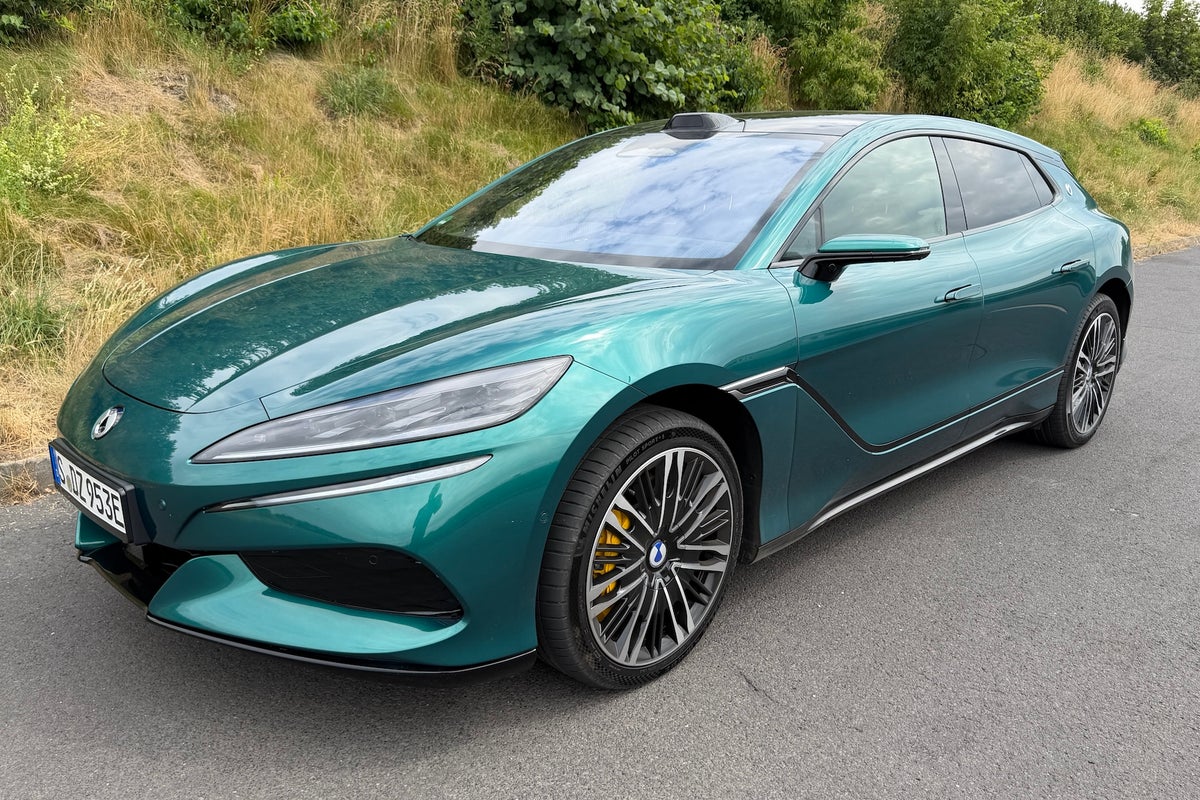
Denza is a name that’ll need explaining when it arrives in the UK. It’s BYD’s premium brand, positioned above the increasingly familiar BYD models and aimed squarely at the sort of buyers who might otherwise be looking at a Porsche Taycan, Porsche Panamera or Lotus Emeya.
Its opening act is the Z9 GT, a very large electric estate car with three motors, more than 1,100bhp, a claimed 0-62mph time of 2.7 seconds and technology that sounds as if it has been lifted from a science-fiction film. There is independent steering at each rear wheel, air suspension, a big battery, front and rear boots, screens everywhere and BYD’s new Flash Charging technology that, in China where I experienced it, can add a remarkable amount of energy in a matter of minutes. Flash Charging is coming to the UK this year, apparently.

The Z9 GT is also a serious statement of intent. It’s expected to cost more than £100,000, which puts it above the starting price of a Porsche Taycan in the UK. That is a brave place to begin for a brand with no premium history in Britain. A plug-in hybrid DM version will also be coming at a lower price, but it will still be a seriously expensive car.
Yet this is not a car that feels like an ambitious newcomer trying to blag its way into a posh hotel. The exterior has real presence, the paint quality and panel fit are superb and there is a proper sense that Denza has thrown everything it has at making the Z9 GT feel special.
There are bits of it that are very Chinese, too. The roof-mounted LiDAR unit sits on top of the windscreen like a little hat and does not exactly improve the look from outside, while the passenger gets their own large screen and there is technology everywhere you look. But the Z9 GT is not short of drama, and after spending time with it in China and driving it in Europe, it is a car that has seriously impressed me.
How we tested
I first experienced the Denza Z9 GT as a passenger in China when the car was driving itself. Then I got to drive the Z9 GT in Germany as part of German Car of the Year judging on town roads, faster routes and unrestricted autobahn sections, assessing performance, comfort, technology, space and usability.
Denza Z9 GT: £100,000 (estimated), Denza.com/uk
Independent rating: 7/10
- Pros: Seriously quick, excellent ride comfort, huge rear-seat space, superb build quality, game-changing Flash Charging tech
- Cons: Interior design lacks cohesion, boot is not especially large, four-wheel steering feels unsettling at high speed, lots of technology to learn, Denza badge has little recognition
Denza Z9 GT specs
- Price: £100,000 (estimated)
- Battery size: 122.5kWh
- Maximum claimed range: 372miles
- Miles per kWh: 3.0
- Charging : Up to 1,500kW Flash Charging – 10 to 97 per cent in a claimed nine minutes
Battery, range, charging, performance and drive
The Z9 GT EV uses a 122.5kWh, second-generation BYD Blade Battery, integrated into the structure of the car using the company’s Cell-to-Body construction. Denza claims up to 372 miles of range, which works out at around 3.0 miles/kWh.
That is a useful figure for something this large and powerful, although the really big battery story is not range, it’s charging. In China, the Z9 GT’s Flash Charging system can handle up to 1,500kW through a single connector. Denza says that can take the battery from 10 to 70 per cent in five minutes, or from 10 to 97 per cent in nine minutes, using the firm’s own charging equipment.
Those numbers are properly extraordinary, although UK charging specifications and infrastructure have yet to be confirmed. The car’s 11kW AC charging figure is more conventional, but it is the Flash Charging technology that could genuinely change how people think about long-distance EV travel once the right chargers are in place.
Performance is about as far from conventional as you can get. There is a 313bhp motor on the front axle and two 424bhp motors at the rear, for a combined 1,140bhp and 1,210Nm of torque. The result is 0-62mph in 2.7 seconds and a top speed of 167mph.
It is seriously quick. Pull the boost lever and the Z9 GT delivers a big shove, accompanied by a Tesla-style Starship display animation that makes the whole thing feel slightly surreal. It is not subtle, but it is a lot of fun.
At gentler speeds, the Z9 GT is impressive for a different reason. It rides comfortably, feels remarkably easy to place for something measuring 5,180mm long – that’s longer than a Range Rover – and has a surprisingly neat turning circle thanks to its independently steering rear wheels. The steering is a real highlight, too. It is precise, light enough when it needs to be and much more enjoyable than you might expect from a first attempt at this sort of premium performance car.
The active side bolsters of the front seats also tighten their grip as cornering forces build, helping to keep you in place as the tyres do their work. It all feels very clever.
The four-wheel steering is less convincing at derestricted autobahn speeds. At well above the UK motorway limit, the car felt a little floaty and as though it wanted to choose its own line. It was enough to make me back off, which is not what you want in a car with this much performance. The clever crab-walk function, where the car can move diagonally to aid with parking, is an impressive demonstration of what the system can do, but I would happily trade some of that theatre for a little more high-speed stability.
Interior, practicality and boot space
The Z9 GT is a big car, measuring 5,180mm long and with a 3,125mm wheelbase, so there is no shortage of room inside. Rear passengers get loads of space, with generous legroom, headroom and enough width for three people to sit across the back without feeling as though they are taking part in a long-distance game of elbow tennis.
There is also plenty of luxury kit. The front seats have electric adjustment, heating, ventilation and massage functions, while the rear seats get heating, ventilation, massage and extendable leg rests. There is a refrigerated compartment, four-zone fresh-air system, panoramic glass roof and a 53-litre front boot for charge cables or smaller bags.
The rear seat space is particularly impressive. The Z9 GT feels more like a chauffeur car in the back than a traditional performance estate, and there is much more room than in a Porsche Taycan. That could be a genuine attraction for buyers who want supercar-style pace but also need to carry adults in comfort.
The boot is less convincing. There is 495 litres of space with the rear seats up and 1,680 litres with them folded down, which is not disastrous, but the shape and packaging mean it doesn’t feel especially generous for a car of this size – the dog won’t be delighted in the back.
The cabin itself is where the Z9 GT is most divisive. The build quality is absolutely superb; materials feel expensive, the leather is high quality and there is a solid, carefully made feel to the whole car.
But the design is not quite special enough for a car costing this much. It is a strange mishmash of high-tech screens, touch-sensitive controls, old-fashioned-looking buttons whose functionality isn’t immediately obvious and an incoherent mix of textures and finishes. It is not ugly, but it is not cohesive or particularly elegant either.
Technology, stereo and infotainment
There is so much technology in the Z9 GT that you will need a good long lesson before you really understand the car. The main infotainment screen is a large, 17.3-inch display floating in the middle of the dashboard, joined by a 13.2-inch driver display, another 13.2-inch passenger screen and a 50-inch augmented-reality head-up display.
There are even optional displays in the doors for the digital side mirrors (that never work as well as traditional mirrors and sit slightly lower than expected), so there can be screens almost everywhere you look. The passenger screen is one of those typically Chinese features that feels slightly unnecessary until you start playing with it, but it does add even more to the whole theatre of the car.
The main screen works well and the system has Google integration for connected navigation and voice assistance. Denza’s DiLink software also includes an AI-powered digital assistant that can access the car’s own information and act rather like a digital owner’s manual.
There are 50W wireless charging pads for the front occupants and another for rear passengers, while the car gets a large, refrigerated compartment between the front seats. The doors also close automatically when you press the brake pedal, which is a nice touch and not something you get in a Porsche.
The audio system is a 20-speaker, 1,150W Devialet set-up with Dolby Atmos. It is a serious system in a car built to be very quiet, and it has the sort of depth and clarity you would expect from something at this price.
There is also a huge amount of driver-assistance technology, including the systems that allow the Z9 GT to park itself and even be moved remotely through the smartphone app. The car’s Vehicle Motion Control system links the braking, steering and suspension systems and is designed to help the Z9 GT remain stable in situations including a high-speed tyre blowout.
Prices and running costs
Denza hasn’t confirmed final UK pricing for the Z9 GT, but the expectation is that it will cost more than £100,000. That puts it in an awkward position. It is more expensive than the entry-level Porsche Taycan, while the Denza badge will need time to gain the sort of recognition and trust that Porsche has built over decades.
There is only one lavishly equipped trim level at launch, so buyers will mainly choose between the three-motor EV and the plug-in hybrid DM version that is due to follow. A rear-wheel-drive electric version with up to 500 miles of claimed range is also planned before the end of 2026.
The launch model’s 372-mile range is strong, while the Flash Charging technology could be a game-changer once compatible charging infrastructure arrives in the UK. Denza says customers will get a year of free Flash Charging, with an additional six months for early orders.
The car can tow up to 2,000kg and comes with carbon-ceramic brakes, dual-chamber air suspension and a huge standard equipment list. The bigger question is whether all that technology, performance and equipment is enough to persuade premium buyers to choose a Denza over a Porsche Taycan, Audi e-tron GT or Lotus Emeya.
The verdict: Denza Z9 GT
The Denza Z9 GT is a hugely impressive first attempt at a premium electric GT, with astonishing performance, clever charging and superb quality, but it still lacks the overall cohesion, ability and badge appeal of a Porsche Taycan and it really didn’t feel good at high speed.
Denza Z9 GT rivals
- Porsche Taycan
- Porsche Panamera
- Lotus Emeya
FAQs
How long does it take to charge?
The Denza Z9 GT uses BYD’s Flash Charging technology, which can deliver up to 1,500kW. Denza claims a 10 to 70 per cent charge in five minutes and 10 to 97 per cent in nine minutes using its own charging equipment. UK charging specifications and compatible public charging infrastructure have yet to be confirmed.
How much does the Denza Z9 GT cost - is it worth it?
Final UK prices have not been confirmed, but the Denza Z9 GT is expected to cost more than £100,000. It offers huge performance, a 122.5kWh battery, lots of rear-seat space, a lavish equipment list and some remarkable charging technology, but it will face established premium rivals from Porsche and Lotus.
Does Denza replace batteries for free?
The car uses BYD’s second-generation Blade Battery with lithium iron phosphate chemistry and Cell-to-Body construction, with an expected eight-year warranty on the battery.
Why trust us
Our team of motoring experts have decades of experience driving, reviewing and reporting on the latest EV cars, and our verdicts are reached with every kind of driver in mind. We thoroughly test drive every car we recommend, so you can be sure our verdicts are honest, unbiased and authentic.