Get all your news in one place.
100’s of premium titles.
One app.
Start reading
Euronews
Euronews
Babak Kamiar

Demonstrations in Iran: What are the possible scenarios?

Street protests in Tehran have entered their 13th consecutive day, while since Thursday night widespread — and in some cases near-total — internet shutdowns have reduced communication with inside Iran to a minimum.

The limited images and videos circulating through social media and messaging apps suggest that protests are spreading to several cities across the country. However, due to severe connectivity restrictions, independent verification of all reports is not possible.
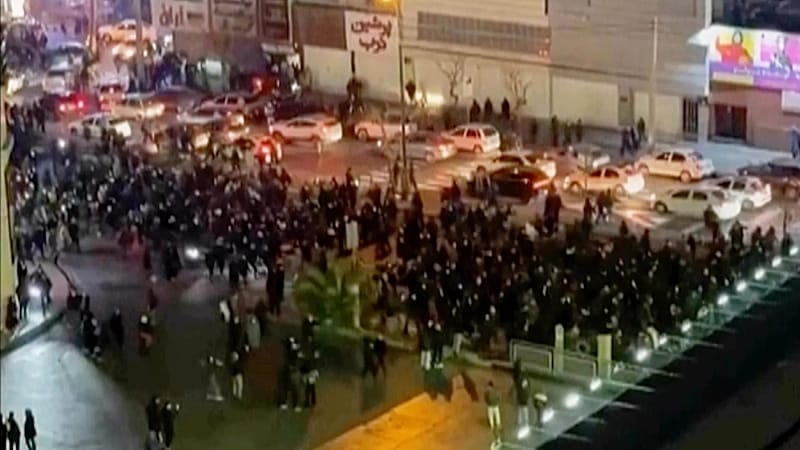
Images transmitted from Iran last night may remind a German audience of the days leading up to the fall of the Berlin Wall, while for many Iranians they evoke memories of the final days of the Shah Reza Pahlavi’s regime in 1979.

US President Donald Trump has described the events as “the biggest protests I’ve ever seen,” a remark that has received wide coverage in international media.

Given the speed of developments, the communications blackout, and the lack of a clear picture of the balance of power inside the country, analysts are outlining several main scenarios for the near future.

In this frame grab from video protesters block an intersection in Tehran, 8 January, 2026 (In this frame grab from video protesters block an intersection in Tehran, 8 January, 2026)

Escalation of security crackdown

One of the most prominent scenarios involves an escalation of repression. On Friday, Iran’s Supreme National Security Council issued a resolution announcing a “very decisive response” to the protests.

The council — the country’s highest security decision-making body — claimed that recent demonstrations had “deviated from legitimate public demands” and were being driven toward instability through “guidance and planning by Israel and the United States.”

While this official narrative diverges sharply from realities on the ground, it signals that the authorities are framing the situation as a national security threat.

Critics warn that such framing effectively paves the way for broader use of force, as protesters are no longer treated as dissatisfied citizens but as agents of an “enemy project”.

Iran’s Supreme Leader Ayatollah Ali Khamenei listens to a speaker in a meeting in Tehran, 20 October, 2025 (Iran’s Supreme Leader Ayatollah Ali Khamenei listens to a speaker in a meeting in Tehran, 20 October, 2025)

Meanwhile, the likelihood of harsher crackdowns, mass arrests, and even lethal force has increased. Although such measures may calm the streets in the short term, many analysts argue they would only deepen the regime’s legitimacy crisis and intensify accumulated grievances.

Images published on Friday suggest that a scenario similar to that previously observed in Sistan and Baluchestan may be repeating.

According to these images, security forces opened fire on protesters around Makki Mosque in Zahedan. This comes despite recent warnings from the Sunni Friday prayer leader of Zahedan — a critic of government policies — who had urged restraint and called for avoiding violence.

For many observers, ignoring these warnings signals the closure of mediation channels and a decisive shift toward purely security-based solutions.

Defections within state forces — or their further radicalisation

Erosion within the ranks of security and military forces represents one of the most critical scenarios.

Reports of large-scale protests in cities such as Mashhad — the birthplace of Iran’s Ayatollah Ali Khamenei — combined with Trump’s references to security forces fleeing, have drawn significant attention.

Economic hardship, growing awareness of the fate of similar regimes, and ongoing revelations about widespread corruption, elite lifestyles, and the presence of officials’ children in Western countries are all factors that could weaken loyalty within parts of the armed forces.

At the same time, some analysts believe last night’s developments mark a turning point. In their view, the Islamic Revolutionary Guard Corps (IRGC) may conclude that it has no option but to intervene fully.

A member of Iran's Revolutionary Guard stands in downtown Tehran, 24 June, 2025 (A member of Iran's Revolutionary Guard stands in downtown Tehran, 24 June, 2025)

While such a move could generate fear and intimidation in the short term, a prolonged confrontation could significantly increase the risk of defections among loyal forces.

Still, analysts argue that no fundamental shift in the balance of power has yet occurred.

Under any of the emerging scenarios, they suggest, it remains unlikely that the Islamic Republic would readily relinquish control — even if maintaining that control requires enduring prolonged instability and internal erosion.

Alongside physical repression, “internet warfare” has become a central element of the government’s response.

Some experts speculate that authorities may be using tactics such as jamming or targeted disruption of satellite communications or Starlink infrastructure, in addition to a full internet shutdown — methods previously employed against satellite television networks.

If accurate, this would signal Iran’s entry into a more advanced phase of communications control and a deliberate effort to fully isolate the country’s information space.

Such measures themselves may reflect the depth of the regime’s concern over the persistence and expansion of protests.

People wave Iranian flags during a ceremony at the Imam Khomeini grand mosque in Tehran, 1 January, 2026 (People wave Iranian flags during a ceremony at the Imam Khomeini grand mosque in Tehran, 1 January, 2026)

Trump, Pahlavi, and the possibility of a return to power

Trump’s remarks regarding Crown Prince Reza Pahlavi have added another layer of ambiguity to the crisis.

While Trump has described him as “a good guy,” reports suggest that — contrary to earlier indications — no direct meeting between the two is scheduled for next Tuesday at Mar-a-Lago.

Speculation over the cancellation ranges from legal considerations to efforts to avoid providing the Islamic Republic with justification for repression under claims of “foreign interference.”

Some observers, however, remain unconvinced by these explanations, given Trump’s track record.

Reza Pahlavi, the son of Iran's toppled Shah Mohammad Reza Pahlavi, speaks during a news conference in Paris, 23 June, 2025 (Reza Pahlavi, the son of Iran's toppled Shah Mohammad Reza Pahlavi, speaks during a news conference in Paris, 23 June, 2025)

Meanwhile, according to several analysts, the public response to the call issued by the son of Iran’s last shah has exceeded initial expectations.

In parts of the demonstrations, chants have directly targeted the apex of power in the Islamic Republic, while in numerous instances references to the restoration of monarchy or the Pahlavi name have been heard — a shift in protest rhetoric compared to previous cycles.

In contrast, Iran’s Supreme Leader Ali Khamenei reiterated on Friday that the system “will not back down.” In footage aired by state television, he again labelled protesters as “rioters,” claiming the demonstrations served Trump’s interests and were intended to please the US president. He also described protesters as “harmful individuals” to the country.

Internal reform and the 'Bonapartist' scenario

Until just days ago, this scenario was considered among the more plausible outcomes.

US President Donald Trump speaks to Republican lawmakers during their annual policy retreat in Washington, 6 January, 2026 (US President Donald Trump speaks to Republican lawmakers during their annual policy retreat in Washington, 6 January, 2026)

Given the high costs of regime change for the US, the Venezuelan experience following external intervention, and the fact that the continued existence of the Islamic Republic serves certain regional and global interests, the idea emerged that a figure from within the system might be tasked with reforms — stabilising the economy without fundamentally altering the power structure.

The key uncertainty has been identifying such a figure. Some pointed to former President Hassan Rouhani; others suggested the emergence of a lesser-known military figure — a “Napoleonic” saviour stepping in to restore order.

However, several experts dismissed Rouhani’s return as unrealistic, arguing that any attempt by him to reenter power would likely result in his removal by hardliners aligned with the ayatollah.

Trump’s recent remarks about Iran’s opposition — particularly Crown Prince Pahlavi — have influenced this equation.

Yet the broad public response to Pahlavi’s latest call, especially since Thursday, has significantly weakened this scenario, though it has not been eliminated entirely.

Protesters showing pictured of Crown Prince Reza Pahlavi at a demonstration in Berlin, 9 January, 2026 (Protesters showing pictured of Crown Prince Reza Pahlavi at a demonstration in Berlin, 9 January, 2026)

Neither Syria nor Venezuela?

Another scenario gaining traction involves the possible departure or flight of senior Islamic Republic figures, echoing elements of the Syrian model.

Reports have circulated about suspicious Russian flights, alleged transfers of gold from Iran, and speculation about a potential relocation of Khamenei and his family to Moscow.

Unconfirmed reports have also emerged regarding visa requests by the parliamentary speaker, Mohammad Bagher Ghalibaf, and his family for France, or the presence of Abbas Araghchi’s family during his trip to Lebanon.

By contrast, Venezuela’s experience under Nicolás Maduro indicates that, contrary to early expectations, the power structure has not collapsed and has so far remained intact.

Venezuelan President Nicolás Maduro appears in Manhattan federal court, 5 January, 2026 (Venezuelan President Nicolás Maduro appears in Manhattan federal court, 5 January, 2026)

This has led some observers to suggest that Trump’s primary objective may be the removal of Khamenei personally, followed by the assignment of authority to a figure within the system to manage the transition.

However, given the accelerating and expanding nature of the protests, it is unclear whether this scenario still carries the same weight.

A more prominent possibility now under discussion is a model that is neither Syria nor Venezuela, but one that results in the emergence of a leadership more closely aligned with the West.

Still, it remains uncertain what would follow the removal, death, or ouster of the Supreme Leader.

Would Iran face fragmentation, insecurity, or intensified ethnic and minority demands? Or could a “saviour” figure overcome the country’s deep structural crises?

Shops are closed during protests in Tehran's centuries-old main bazaar, 6 January, 2026 (Shops are closed during protests in Tehran's centuries-old main bazaar, 6 January, 2026)

In this context, questions also arise over how — and to what extent — promises of foreign investment and statements by figures such as Dara Khosrowshahi or Elon Musk might materialise.

Meanwhile, global powers such as China — and to a lesser extent Russia — are unlikely to remain passive and will almost certainly play a role in this historic recalibration.

Ultimately, if the signals transmitted from Tehran over the past hours reflect realities on the ground, the likelihood that the government will resort to higher levels of violence appears to be increasing.

However, with internet access largely cut off, these data points capture only a limited portion of voices within Iran, making it difficult to assess their full impact on protesters' decisions.

Sign up to read this article
Read news from 100’s of titles, curated specifically for you.
Already a member? Sign in here
Related Stories
Top stories on inkl right now
One subscription that gives you access to news from hundreds of sites
Already a member? Sign in here
Our Picks
Fourteen days free
Download the app
One app. One membership.
100+ trusted global sources.