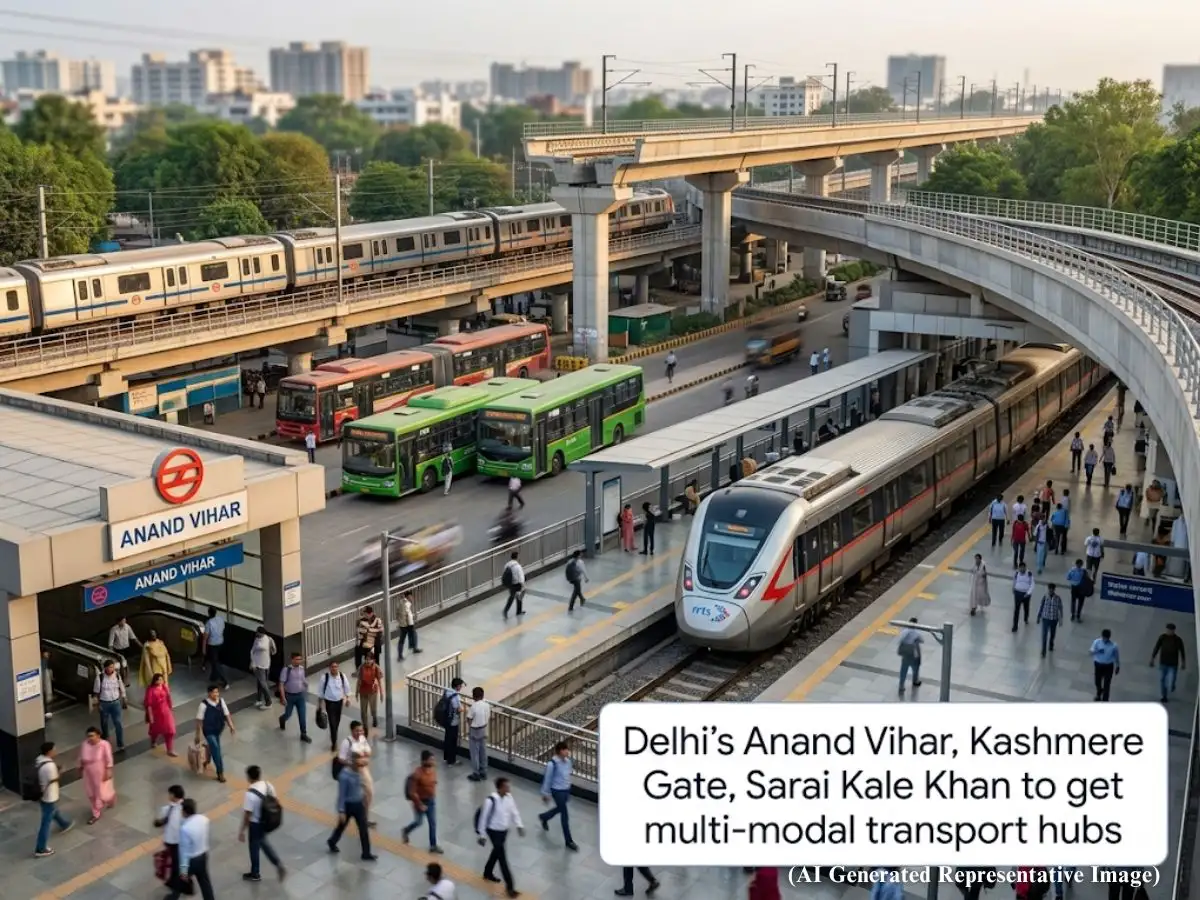
Delhi's three of its most congested and high-footfall transit zones, Anand Vihar-Karkardooma, Kashmere Gate, and Nizamuddin-Sarai Kale Khan, are set to be developed as integrated multi-modal transport hubs under the Delhi Development Authority's Master Plan Delhi 2047, according to a Times of India report.
The plan, approved by DDA but yet to be notified by the Ministry of Housing and Urban Affairs, proposes bringing metro, rail, bus, RRTS, para-transit, and non-motorised transport together under a single, coordinated framework at each of these locations.

Anand Vihar, Kashmere Gate, Sarai Kale Khan: Why These Three?
All three locations are already among Delhi's busiest transit intersections, each handling multiple modes of transport within close proximity. Anand Vihar handles one of the highest volumes of inter-state bus traffic in the country alongside metro and rail access. Kashmere Gate sits at the junction of multiple metro lines and inter-state bus terminals. Nizamuddin-Sarai Kale Khan connects rail, bus, and the under-expansion RRTS network.
MPD 2047 describes these as high footfall transit nodes having multiple modes located at a single location and says they shall be developed as multi-modal transport hubs with a comprehensive plan prepared jointly by all transit agencies concerned.
How Will Metro, Rail, Bus and RRTS Be Integrated?
According to officials cited in the TOI report, agencies involved in implementing the hubs will be allowed to amalgamate their land parcels and integrate multiple transport modes within the same building or complex.
Where land parcels are separated by railway tracks or roads, the plan allows integration through skywalks, subways, and pedestrian bridges, subject to necessary permissions.
Sources told TOI the hubs are intended to make transfers between transport modes easier through multi-level interchange facilities, retail podiums, and active public spaces. Cultural and public spaces are also planned within the hubs, aimed at improving safety, encouraging public interaction, and supporting economic activity around the transit nodes.
Will AI and Smart Systems Run Delhi's New Transport Hubs?
MPD 2047 calls for the deployment of Intelligent Transport Systems and AI-based passenger and traffic management systems at the hubs to enable data integration and improve enforcement, according to the report.
The plan also links future Transit-Oriented Development projects to the hubs directly. Any TOD project within a 500-metre radius of a transport hub will be considered for approval only if it is integrated with the comprehensive mobility plan under MPD 2047.
What Else Does MPD 2047 Propose for Delhi's Roads and Transport?
Beyond the three hubs, MPD 2047 proposes a significant expansion of Delhi's overall transport infrastructure. This includes 600 kilometres of new roads in land pooling zones, along with underpasses, elevated corridors, cross-corridors, junction improvements, and removal of bottlenecks across the road network.
For pedestrians and cyclists, the plan proposes a 52-kilometre cycle track along the Yamuna river and 150 kilometres of paved paths and linear green corridors linking parks, nature reserves, and residential areas into a continuous network.
The plan has been approved by DDA. Notification by the Ministry of Housing and Urban Affairs is pending.
(With Times of India inputs)