Get all your news in one place.
100's of premium titles.
One app.
Start reading
The Economic Times
The Economic Times
Trending Desk

Delhi Rs 2 crore contest: Govt is offering huge prize to India's youth for solving real problems. Check eligilibty, how to apply and other details

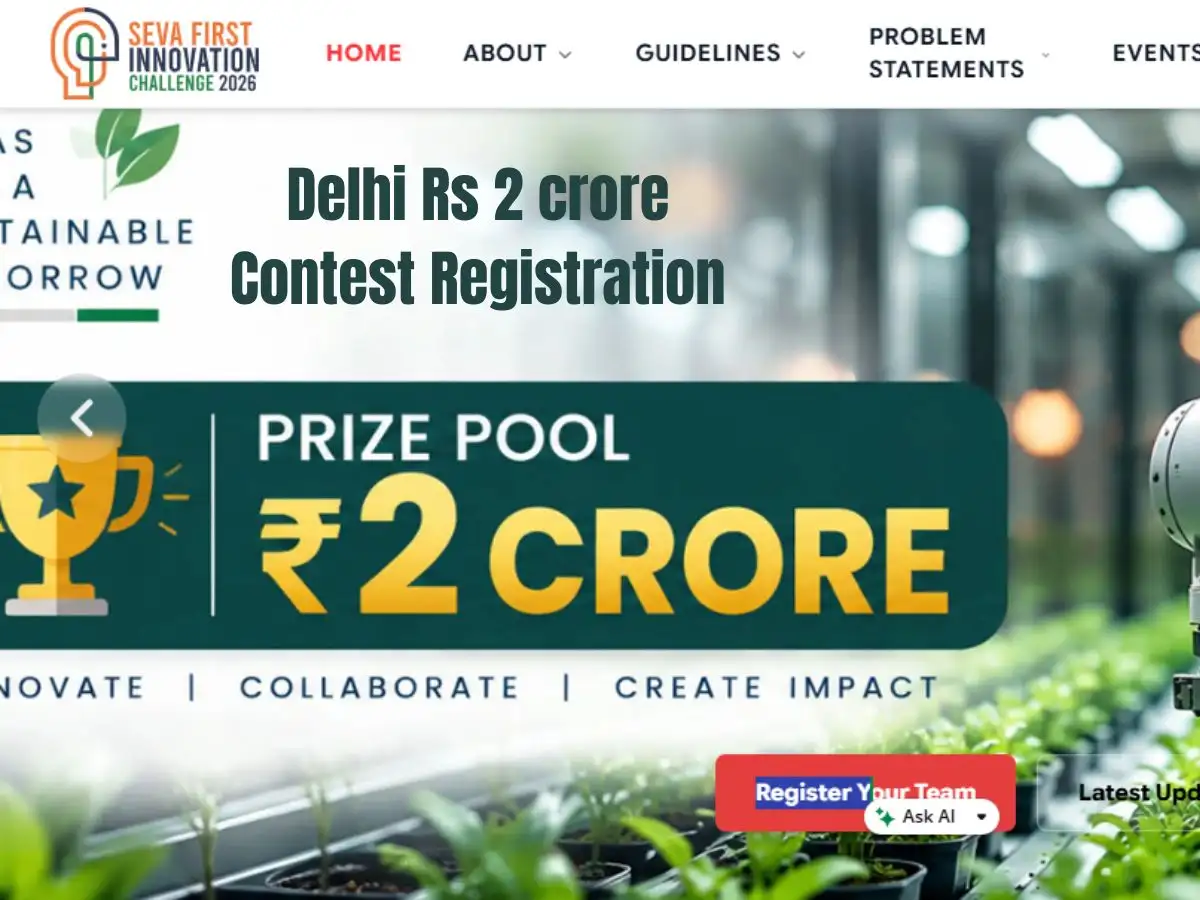
Delhi has launched a new youth innovation challenge with a ₹2 crore prize pool, giving students, researchers, startups and other eligible participants a chance to work on real-world problems and take their solutions from an idea to a tested prototype. The SEVA FIRST - Rashtriya Youth Innovation Challenge 2026 was launched at Delhi Technological University (DTU) on September 19 by Delhi Education Minister Ashish Sood. DTU is serving as the anchor university for the Northern Region.

The challenge is planned as a 100-day innovation journey. But this is not simply an idea-submission contest. Participants are expected to identify a problem, develop a solution, build or improve a prototype and demonstrate that it can work in a real setting.
What is SEVA FIRST Innovation Challenge 2026?

SEVA FIRST is a national youth innovation platform designed to encourage young people to solve practical problems in their communities and across the country. The challenge has a total prize pool of ₹2 crore. Participants can also get access to mentoring, experts, industry connections and facilities that can help them develop their ideas further.

The official challenge has two broad tracks:

  • National Level Innovation: Solutions aimed at major national priorities such as defence, space and national security, disaster management, AI, robotics, manufacturing, energy, environment, infrastructure and future mobility.
  • Local Community Level Innovation: Solutions addressing problems in areas such as agriculture, rural development, education, healthcare, urban problems, employment, women and child safety, transport, energy and tourism.

Who can apply for SEVA FIRST 2026?

The eligibility rules divide participants into three categories.

Category I: School and vocational students

Students from Class 10 onwards up to ITI level can participate individually or as teams, subject to institutional support.

Category II: Diploma and higher education

Students and teams from diploma, undergraduate, postgraduate and PhD programmes can participate. Both technical and non-technical institutions are covered.

Category III: Industry and government

The open category includes urban and rural industries, MSMEs, startups, R&D organisations and government laboratories. Participation can be individual or through collaborative teams. The official guidelines also state that individuals, groups and eligible organisations can participate, although specific problem statements may have additional requirements.

Which states and UTs are covered?

For the Northern Region, DTU is coordinating participation from:

  • Delhi
  • Haryana
  • Punjab
  • Jammu and Kashmir
  • Himachal Pradesh
  • Uttarakhand
  • Chandigarh
  • Ladakh

The challenge itself is national in scope, while DTU has been designated as the coordinating institution for this Northern Region.

What kind of problems can participants solve?

The challenge is deliberately wider than conventional startup ideas. Participants can work on national-level problems involving AI, robotics, defence, energy, environment, manufacturing, infrastructure and mobility.

For local community innovations, the focus includes agriculture and rural development, education, healthcare, urban issues, environment, sports, employment and livelihood, women and child safety, disaster management, transport, energy and tourism.

For the local track, participants can identify a problem in their own village, district or state and propose a solution. There are no fixed problem statements for this track.

How to apply for SEVA FIRST 2026?

The application journey on the official portal involves several steps.

Step 1: Check eligibility

Participants first need to identify the applicable participation category and regional requirements.

Step 2: Select an innovation track

Choose between National Level Innovation and Local Community Level Innovation.

Step 3: Select a theme

Pick the theme that matches the problem being addressed.

Step 4: Choose a problem statement

Participants can select an official problem statement where applicable. For the local innovation track, they can identify and propose their own relevant problem.

Step 5: Form a team

Participants can create a team and nominate a team leader.

Step 6: Submit the innovation proposal

The proposal needs to explain the problem, proposed solution, innovation or technology, beneficiaries, feasibility and expected impact. The official portal currently states that sign-in and sign-up will open once the official problem statements are released. So applicants should check the portal for the registration window rather than assuming registration is already open.

Official SEVA FIRST 2026 portal: sewafirstryic.dtu.ac.in

What format is required for the proposal?

Participants have to submit their innovation proposal in the prescribed 15-slide presentation format. The presentation is expected to cover the journey from identifying the problem to developing the innovation or prototype and explaining its potential impact. The official portal provides separate formats for national and regional themes.

Delhi Rs 2 crore Challenge SEVA FIRST 2026: Important dates

The challenge will move through several stages over roughly 100 days.

Stage Dates What happens
Ideate September 19 to October 1, 2026 Problem statements, orientation, registrations and idea submissions
Screen October 2 to October 11 Eligibility checks, scrutiny and shortlisting
Build & Evaluate October 12 to November 10 Mentoring, workshops, prototype development and technical evaluation
Validate & Test November 11 to November 19 Field trials, testing and validation
Final Select November 20 to November 26 Final reports, prototype demonstrations and jury evaluation
Results To be announced Grand finale, exhibition and award distribution

The dates are listed on the official SEVA FIRST timeline and may be supplemented by subsequent announcements from DTU.

What happens after an idea is shortlisted?

Shortlisted teams will move beyond the initial proposal stage. The programme includes expert consultations, mentoring, workshops, laboratory or maker-space access, prototype development and technical reviews. The next stage involves testing the prototype in relevant or actual environments. This can include performance measurements, safety and reliability checks, field demonstrations and user feedback. The emphasis is therefore on whether an innovation can move towards practical use, rather than remaining only a concept on paper.

DTU also announces rural technology programme

The launch also included the announcement of DTU's Rural Technology and Community Engagement Programme (RTCEP). Under the programme, engineering students are planned to visit villages from the 2027-28 academic session to identify local problems and work on technology-based solutions. The programme is intended to connect engineering education with rural development and community needs.

For young innovators with an idea that addresses a problem they see around them, SEVA FIRST offers a route that goes beyond a competition entry. The stated objective is to take solutions through ideation, prototyping, testing and eventually towards implementation.

Sign up to read this article
Read news from 100's of titles, curated specifically for you.
Already a member? Sign in here
Related Stories
Top stories on inkl right now
One subscription that gives you access to news from hundreds of sites
Already a member? Sign in here
Our Picks
Fourteen days free
Download the app
One app. One membership.
100+ trusted global sources.