Get all your news in one place.
100's of premium titles.
One app.
Start reading
The Conversation
The Conversation
Neeraja Chinchalkar, PhD student, Earth and Planetary Science and Exploration, Western University

Cubic zirconia only forms under extreme temperatures, like those produced when an asteroid impacts Earth

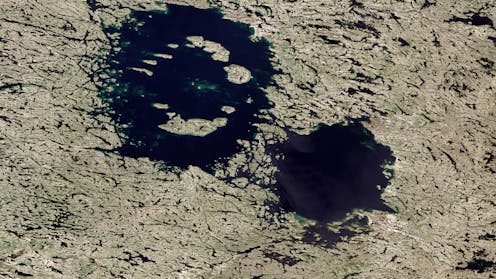
A satellite image of the Clearwater Lakes, the site of two large asteroid impacts that struck Earth about 290 million years ago (NASA Earth Observatory)

When high-velocity asteroids land on the Earth, they can form a meteor impact crater. Such collisions have occurred throughout Earth’s history and still occur on other planetary bodies today.

While most asteroid impacts on Earth happened millions of years ago, their remnants are still preserved across the Earth’s surface. Impact-affected rocks experience intense heat and pressure during the impact.

Sign up to read this article
Read news from 100's of titles, curated specifically for you.
Already a member? Sign in here
Related Stories
Top stories on inkl right now
One subscription that gives you access to news from hundreds of sites
Already a member? Sign in here
Our Picks
Fourteen days free
Download the app
One app. One membership.
100+ trusted global sources.