Get all your news in one place.
100’s of premium titles.
One app.
Start reading
Reason
Reason
Liz Wolfe

Cuba Libre

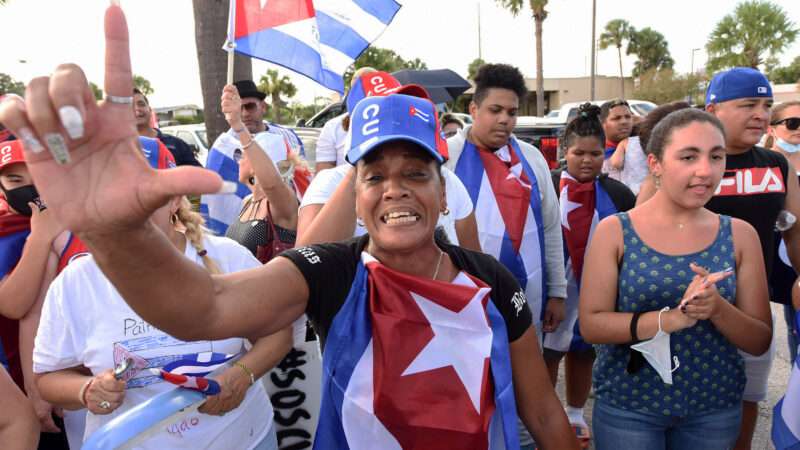
Is Cuba next? "I don't think we need [to take] any action," said President Donald Trump on Sunday. Without the regime of Venezuelan dictator Nicolás Maduro and a steady supply of oil, "Cuba looks like it's ready to fall."

"I'm not going to talk to you about what our future steps are going to be," Secretary of State Marco Rubio told Meet the Press that same day. But at a press conference following the capture of Maduro in Venezuela on Saturday, he had said, "If I lived in Havana and I was in the government, I'd be concerned."

"I don't think it's any mystery that we are not big fans of the Cuban regime, who, by the way, are the ones that were propping up Maduro," said Rubio on Sunday. No kidding.

"It was Cubans that guarded Maduro," he added. "He was not guarded by Venezuelan bodyguards. He had Cuban bodyguards."

The thought seems to be that, having orchestrated the downfall of the Venezuelan dictator, the Trump administration now stands ready to destabilize the Cuban regime and transition its governance. Or that the economic pain felt by Cuba will be intense enough that the regime will fall on its own.

"To keep the lights on and cars running, Cuba has long been dependent on Venezuelan oil supplies, for which it has exchanged security and medical personnel in a sympathetic contract with leftist allies in Caracas," notes The Washington Post. Now the unholy alliance is over, and the beast will be starved. But it's not the first time Cuba's experienced a cutoff. When the Soviet Union fell in 1991, the island experienced what's known as período especial, a time of severe economic depression that left lasting marks.

Other people are less confident that the Venezuela situation is going to destabilize Cuba to such a high degree. "Cutting off the oil deliveries is going to put a huge squeeze on the humanitarian situation" in Cuba, Juan Gonzalez, part of the Biden administration's national security staff, told the Post, "but I don't think the regime is going to cry uncle."

Meanwhile, in Venezuela, the transition has been bumpy. Delcy Rodríguez—the vice president since 2018—has been appointed leader, instead of the exiled María Corina Machado, the opposition leader who is widely regarded as having the true mandate of the people, or Edmundo González, whose presidential election victory in 2024 was stolen by Maduro.

"It's unclear whether [Delcy] Rodríguez will become a reformer who leads the country from Chavismo toward democracy or an authoritarian consolidator with American backing," wrote César Báez for Reason. 

"Rodríguez will have little incentive to open up the country's political system. More than a dozen powerful officials and military figures have been, like Maduro, indicted in U.S. courts," reports The Atlantic's Michael Albertus. "They face dim prospects if they hand over power without securing guarantees of immunity. Their most logical move is to dig in—and publicly, that's exactly what they have done. Rodríguez has forcefully denounced the U.S. intervention and asserted that Maduro remains Venezuela's rightful leader. Other officials have circled the wagons."


Tax me, daddy: "I've got to tell you, I have not even thought about it once," said Nvidia CEO Jensen Huang, the world's ninth-richest person, about the tax on billionaires being considered by the state of California. "We chose to live in Silicon Valley, and whatever taxes I guess they would like to apply, so be it. I'm perfectly fine with it."

"Under a proposed ballot initiative in the state, billionaires would face a one-time 5% levy to cover funding shortages for health care, food assistance and education," reports Bloomberg. "The proposal, which still needs to gather enough signatures to appear on the November 2026 ballot, would apply to people who reside in the state as of Jan. 1."

It's like California wants to drive rich people out. Also, note the classic politician-brained response, which would work in no other industry: We failed to balance the budget, so therefore, instead of doing better or working harder to rectify the problem, we will simply stick our grubby little hands into people's pockets to absolve us of our fiscal sins.


Scenes from New York: My son, Solomon Peter (called Sol), was born on December 26 but has been in the NICU since birth due to various complications. It's looking like he will be there for a while, so I'm returning from maternity leave for a few weeks to write this newsletter to preserve my leave for when he's actually released from the hospital. (Thank God for remote work, which allows me to do a lot of this work from his bedside; and for Reason, which has been very gracious in giving me all kinds of flexibility during this hard time.) It's been a trying few weeks for my family and your prayers are very appreciated.


QUICK HITS

  • Yeltsin moments!

  • Speaking of grocery stores, the Zohran Mamdani apologists are totally (predictably) wrong:

  • "A small fleet of ships booked by Chevron Corp. is sailing to Venezuela as the company emerges as the only exporter of the country's oil following the ouster of President Nicolas Maduro by US forces," reports Bloomberg. "Chevron is poised to export more Venezuelan oil this month than last, with at least 11 ships scheduled to arrive in the Venezuelan government-controlled ports of Jose and Bajo Grande, according to preliminary data compiled by Bloomberg….The 11 Chevron-chartered vessels scheduled to arrive in January would be the highest since October when 12 tankers loaded." Chevron, of course, is the only American company currently approved to export crude oil from Venezuela given the sanctions. Venezuelan state-owned company, PDVSA, has put its operations on hold for a fifth day, leaving Chinese purchasers in a precarious spot.
  • "No two countries with Trump-branded properties have ever fought a war against each other," notes Jim Geraghty at The Washington Post in "How a 'Trump Tower Copenhagen' could deter Greenland conquest."
  • "Keeper's goal is to understand its users so well that it can connect them with their soul mates on the first try. And it has instituted a bounty of its own in order to 'align incentives' between the company and its users. Singles who sign up for its $50,000 Marriage Bounty plan pay an introduction fee for each match, then the balance of the sum if a match leads to a long-term relationship," writes Amanda Hess for The New York Times. "The application, which can take hours to complete, asks users for their height, ancestral background, SAT score and their feelings about entrepreneurs. They can chose from an exhaustive list of political affiliations (conservative or progressive, Zionist or anti-Zionist, neoliberal or neo-Nazi) and select their partner's 'ideal' ethnicity. The system can assess their cheekbone prominence, jaw strength or body-fat percentage from a scanned photo, and analyze their application to estimate an IQ score." Call me old-fashioned, but the Silicon Valley attempts at love-hacking always sound utterly ridiculous.

The post Cuba Libre appeared first on Reason.com.

Sign up to read this article
Read news from 100’s of titles, curated specifically for you.
Already a member? Sign in here
Related Stories
Top stories on inkl right now
One subscription that gives you access to news from hundreds of sites
Already a member? Sign in here
Our Picks
Fourteen days free
Download the app
One app. One membership.
100+ trusted global sources.