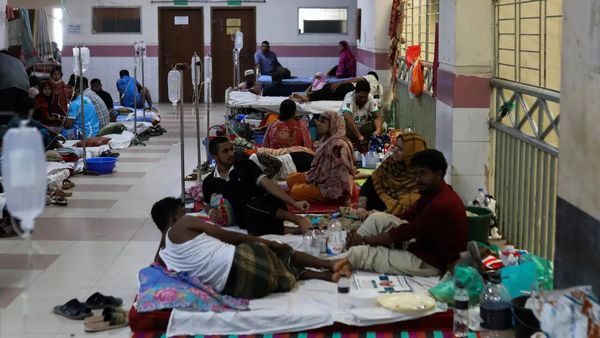
Operations are being cancelled across England as Covid causes “major disruption” inside the NHS, the country’s top surgeon has said, as doctors and health leaders say the government’s backlog targets look increasingly unachievable.
Six million people are on the waiting list for NHS hospital care, including more than 23,000 who have waited more than two years. The NHS in England is due to publish its latest waiting times data on Thursday.
Boris Johnson said in February that he had launched “the biggest catch-up programme in the history of the health service”, but in the same month he dropped every domestic Covid restriction. Now record-high Covid rates are wreaking havoc with the ability of the NHS to catch up with surgery that was delayed or cancelled before and during the pandemic.
More than 28,000 staff are off work every day due to Covid, recent figures show, while more than 20,000 patients are in hospital with Covid, which has dramatically reduced the number of beds and space available for planned surgery patients.
“Unfortunately, Covid-19 continues to cause major disruption in the NHS, with high staff absences in recent weeks,” Prof Neil Mortensen, the president of the Royal College of Surgeons of England, told the Guardian.
“We have heard that planned surgery is being cancelled again in different parts of the country due to staff being off sick with the virus. This is understandably frustrating for surgical teams who want to help their patients by getting planned surgery up and running again. It’s also very distressing for patients who need a planned operation.”
Ministers promised to eliminate all waits of more than two years by July this year, all 18-month waits by 2023, and all one-year waits by March 2025, but NHS staff say Covid is already derailing their efforts to meet those promises.
Chris Hopson, the chief executive of NHS Providers, said pressure was “piling up” on the NHS across England from “a triple Covid-related whammy” of staff absences, high numbers of people in hospital with Covid and delays in discharging patients as Covid hits social care services.
“This means that the NHS hasn’t been able consistently to hit top speed on backlog recovery, as we were hoping to, coming out of winter,” he said. “Some trusts are now processing more elective cases than they were before Covid hit, with some running at 105% to 108% of pre-Covid activity. But others, with higher Covid impacts, are some way behind that. This will impact on the NHS’s ability to meet the targets we agreed.”
The British Medical Association accused the government of failing to grasp how serious a threat Covid poses to the NHS, the backlog targets and to wider society.
It said that unless ministers brought in measures to bring down infection rates, such as masks on public transport and in confined spaces, and ventilation and air filtration in public and work settings, pressures on the NHS would escalate further, staff absence rates would rise further and millions of patients would wait longer for treatment.
A survey of its members found 87% of doctors said the government’s pledges to reduce the waiting lists for elective care using the existing workforce were mostly or entirely unachievable.
“The government is burying its head in the sand to the immediate threat of the virus to our healthcare services,” said Dr Chaand Nagpaul, the BMA’s chair of council. “It is clear that the result of the government’s ‘living with Covid’ strategy is failing to allow us to live with Covid.”
One hospital chief executive told the Guardian that ministers’ targets were “incredibly challenging”. A second said: “These targets are not realistic at all because of staff shortages, which existed before Covid and are being compounded by the number of people still reporting sick, and also staff burnout.”
Meanwhile, a data analysis by the Press Association published on Thursday revealed that dozens of patients have been waiting for more than three years. At least nine have been on the NHS waiting list for more than four years.
Matthew Taylor, the chief executive of the NHS Confederation, which represents the whole healthcare system, said the ongoing impact of Covid was now interfering with the ability of the NHS to tackle the backlog, and there should be “a healthy dose of realism” about what staff could achieve.
NHS England said staff “continue to pull out all the stops” to tackle the backlog, and were also “adopting creative innovations” to ensure patients get the care they need.