From yesterday's decision (which strikes me as correct) in Accountability Now USA v. Griess, by Judge Randolph Moss (D.D.C.):
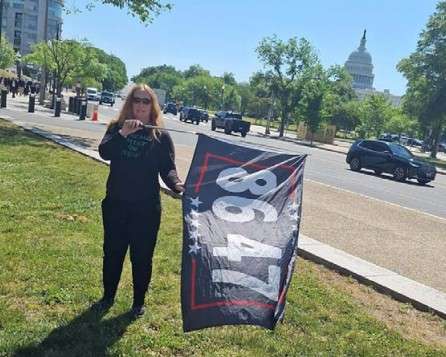
Plaintiff, an unincorporated association that maintains a 24/7 demonstration calling for the impeachment and removal of President Donald Trump on National Park Service ("NPS") land, moves for an emergency order temporarily restraining the Superintendent of the National Mall and Memorial Parks Kevin Griess and the Secretary of the Interior Doug Burgum or their delegees "from taking enforcement action against them because of their display of a flag with the legend '8647.'" For the reasons that follow, the Court will grant Plaintiff's motion….
The parties' disagreement … turns on whether Plaintiff's display of the "8647" flag constitutes protected speech, as Plaintiff asserts, or a "true threat" to the life or safety of the President (or an incitement to violence), as Defendants maintain. At oral argument, both sides agreed that context is dispositive. Not every use of the slang phrase "86" constitutes a threat of violence; to the contrary, it is most often used to mean that an item is no longer available or that someone or something should be removed, ejected, or thrown out. But it can, in some contexts, mean "to kill." …
"True threats of violence, everyone agrees, lie outside the bounds of the First Amendment's protection." "'True threats' encompass those statements where the speaker means to communicate a serious expression of an intent to commit an act of unlawful violence to a particular individual or group of individuals." "The 'true' in that term distinguishes what is at issue from jests, 'hyperbole,' or other statements that when taken in context do not convey a real possibility that violence will follow." …
The Court starts with the premise that the word "86" is a slang term with no single meaning. According to Merriam-Webster, "Eighty-six is slang meaning 'to throw out,' 'to get rid of,' or 'to refuse service to.'" The phrase "comes from 1930s soda-counter slang meaning that an item was sold out[,]" and may have been used because it rhymes with "nix." It was first used as a noun to refer "to an item … that had been sold out," but by the 1950s, the term was used as a verb, at first meaning " 'to refuse to serve a customer,' … later meaning " 'to get rid of; to throw out,' " and still later coming to mean " 'shut out' or 'rejected.'" Merriam-Webster further notes that a recent extension of these meanings has included "'to kill,'" although the dictionary declines to endorse that meaning "due to its relative recency and sparseness of use." According to Merriam-Webster, "[t]he most common meaning of eighty-six encountered today is the one that is closer to its service industry roots." …