

Trump Accounts officially launch July 4, giving families a new way to save and invest for a child's future.
Created under President Donald Trump's One Big Beautiful Bill, the accounts are designed to support long-term wealth building and can be used for a variety of future goals, including higher education and homeownership.
At first glance, Trump Accounts and 529 college savings plans may seem similar. Both allow families to invest on behalf of a child, but they are designed for different purposes and come with different tax rules, contribution limits and withdrawal requirements. Here's how the two accounts compare.
Who can open a Trump Account?
Any child under age 18 with a valid Social Security number can have a Trump Account established on their behalf. Children born between Jan. 1, 2025, and Dec. 31, 2028 may qualify for the program's $1,000 federal contribution if they meet the program's eligibility requirements.
Children who do not qualify for the federal contribution may still have a Trump Account opened and funded by parents, grandparents, relatives or others.
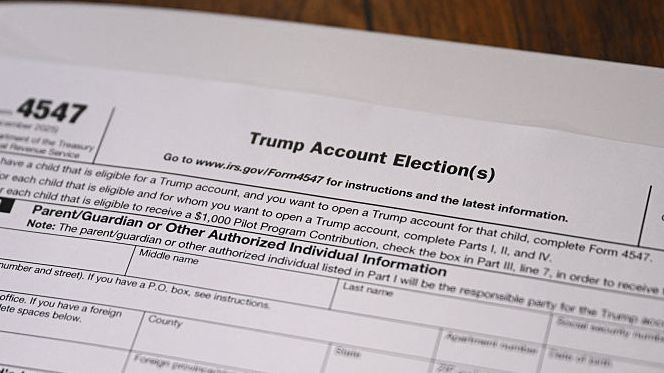
Parents, legal guardians and other authorized individuals can establish a Trump Account for an eligible child by completing IRS Form 4547. The same form is also used to request the $1,000 pilot program contribution for eligible children.
After the election is submitted and processed, the Treasury Department will provide instructions for activating the account. Families can then manage the account through the Trump Accounts website or mobile app.
The adult who establishes the account serves as the responsible party while the child is a minor. Control of the account generally transfers to the beneficiary when the growth period ends and the account transitions to traditional IRA rules.
Trump Account: Tax implications
When opening a savings account for a child or grandchild, tax treatment is a major factor. One limitation of Trump Accounts is that contributions are not tax-deductible, similar to 529 plans at the federal level, though many states do offer tax incentives for 529 contributions.
Unlike 529 plans, which are specifically designed for education savings, Trump Accounts are intended as broader long-term investment accounts for children. Contributions are made with after-tax dollars, and investment earnings grow on a tax-deferred basis while the money remains in the account.
Under current IRS guidance, Trump Accounts eventually transition to treatment similar to a traditional IRA. At that point, distributions may be subject to ordinary income tax, and withdrawals taken before age 59½ could be subject to a 10% additional tax unless an IRA exception applies.
States may also tax Trump Account distributions, depending on local rules. And unlike 529 plans, which allow tax-free withdrawals for qualified education expenses, Trump Accounts do not offer tax-free treatment. Earnings withdrawn from a Trump Account are taxed as ordinary income, even when used for education expenses.
However, because the account is treated similarly to a traditional IRA, certain withdrawals, such as those for higher education expenses or a first-time home purchase, may qualify for penalty-free treatment, although they remain taxable.
For families whose primary goal is saving for college, this difference may be significant. While 529 plans generally reward education spending with tax-free withdrawals, Trump Accounts offer greater flexibility but may result in taxes being owed when money is withdrawn.
Trump Accounts vs other college savings
One of the best ways to determine if a Trump Account would be the right approach for your family is to compare it to other options:
Accounts |
Max annual contribution |
Federal tax benefit for contributions |
State tax benefit for contributions |
Taxes on withdrawals |
Choose your investments |
|---|---|---|---|---|---|
Trump Accounts |
$5,000 |
No |
No |
Ordinary income tax; penalty may apply (treated like a traditional IRA) |
No (investments are restricted) |
529 plans |
$19,000 single / $38,000 married before gift-tax reporting rules generally apply |
No |
Yes (varies by state) |
Federal and often state tax-exempt for qualified expenses |
Yes |
Coverdell Education Savings Account |
$2,000 |
No |
Yes (varies by state) |
Federal and often state tax-exempt for qualified expenses |
Yes |
Families focused primarily on paying for college may find a 529 plan the most attractive option because of its tax advantages and higher contribution limits.
Families who value flexibility or have a child eligible for the Trump Account's $1,000 federal contribution may choose to use a Trump Account alongside a 529 plan rather than rely on either account alone.
Coverdell ESAs remain an option for families who want greater investment control, although their lower contribution limits make them less practical for many households.
Trump Accounts: Pros and cons
Whether a Trump Account makes sense for your family depends on your goals, risk tolerance and need for flexibility. Consider the following pros and cons.
Pros:
- $1,000 federal contribution for eligible children born between Jan. 1, 2025, and Dec. 31, 2028
- Families can contribute up to $5,000 annually
- Because Trump Accounts eventually transition to treatment similar to a traditional IRA, certain IRA exceptions may allow penalty-free withdrawals for expenses such as higher education or a first-time home purchase, although taxes may still apply
Cons:
- Families cannot choose their investment options during the account's growth phase
- Withdrawals may be subject to federal and state income taxes
- Early withdrawals may be subject to a 10% penalty unless an IRA exception applies
- Tax and withdrawal rules are more complex than those associated with a typical 529 plan
Choosing the right account for your child's future
Trump Accounts offer eligible children a $1,000 federal contribution and a new way to build long-term savings. However, families focused primarily on college may find that a 529 plan remains the stronger option thanks to its higher contribution limits, broader investment choices and tax-free withdrawals for qualified education expenses.
That doesn't mean families have to choose one account over the other. For newborns eligible for the federal contribution, a Trump Account can provide a government-funded head start, while a 529 plan can remain the primary vehicle for college savings.