
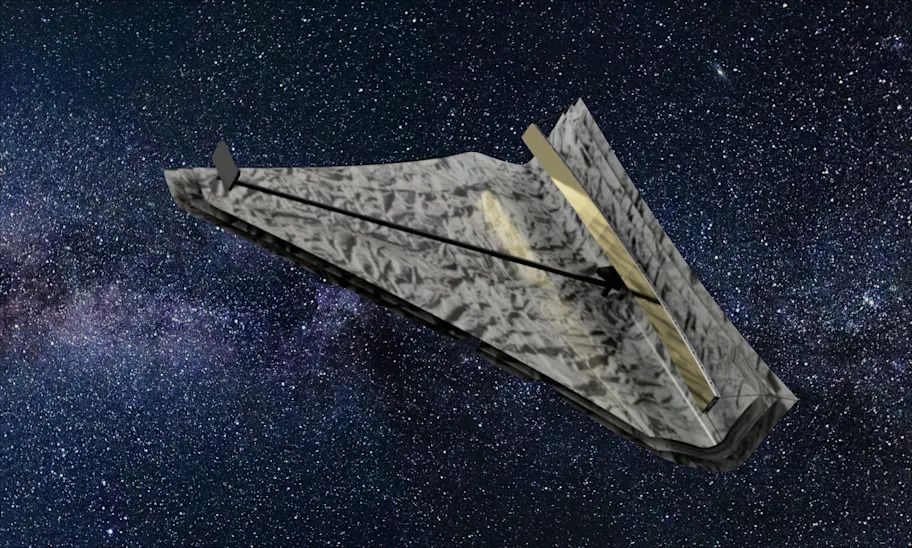
To resolve nearby Earth-like exoplanets, a new telescope design that is rectangular rather than circular may be necessary, according to a new study that explores what the next great space telescope might look like.
"We show that it is possible to find nearby, Earth-like planets orbiting sun-like stars with a telescope that is about the same size as the James Webb Space Telescope[(JWST], operating at roughly the same infrared wavelength as JWST, with a mirror that is a one by 20 meter [65.6 by 3.3 foot] rectangle instead of a circle 6.5 meters [21.3 feet] in diameter," Heidi Newberg, who is a professor of astrophysics at Rensselaer Polytechnic Institute in New York, wrote in an editorial about the concept.