What happened at Cop27: day eight
Here’s a summary of key events at Cop27 on Tuesday:
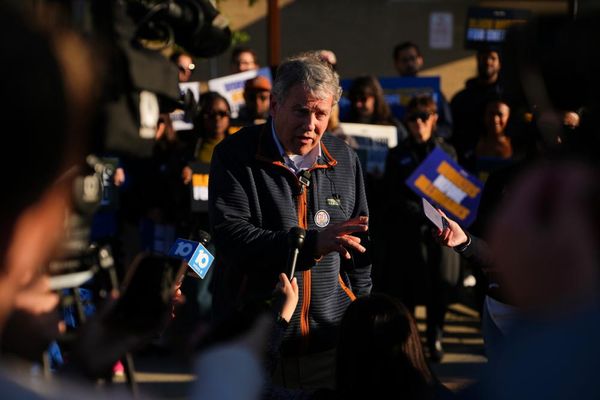
• The Cop talks have been dominated by fears that countries are backsliding on their commitments to tackle the climate crisis, as the first tentative drafts started to emerge of key potential decisions. The situation is still highly fluid, but pledges on 1.5C, on funding for adaptation, and on the $100bn that was pledged to be delivered by rich countries by 2020 are being picked over.
• The British-Egyptian political prisoner Alaa Abd el-Fattah has broken his hunger strike, his sister has confirmed. Sanaa Seif, who spoke at Cop27 last week, tweeted that she had received a letter from her brother, which said he would “explain everything” on Thursday when his family visits.
• Indonesia, the world’s 5th largest greenhouse gas emitter, will be helped with $20bn (about £17bn) of public and private finance to shut coal power plants, the US, Japan and partners have announced. Experts called for transparency and respect for human rights to be built into the deal.
• The Guardian and more than 30 international media titles in more than 20 countries have published a joint editorial calling for radical thinking on how to fund climate action. Katharine Viner, the editor-in-chief of the Guardian, which led the initiative, said: “With Cop27 taking place in Egypt, we wanted to publish an ambitious editorial that highlights how strongly many different news organisations, and our readers, feel about the climate crisis.”
Thank you for reading the Guardian’s Cop27 blog – it is closing now. I’m Natalie Hanman, the Guardian’s head of environment, and we will be back here with all the latest twists and turns of the negotiations when the summit resumes on Wednesday. To share tips, ideas or feedback, please contact me on [email protected] or @nataliehanman
Updated
‘All of you are war criminals’: activist disrupts Russian event at Cop27
The Russian Federation’s event at Cop27 was dramatic, write Damian Carrington and Nina Lakhani, and notable for two things: the shouts of “war criminals” and the complete absence of any discussion of the nation’s oil and gas production. The latter is despite Russia being the second biggest oil and gas producer in the world, and carbon emissions from fossil fuels being the overwhelming cause of the climate crisis.
The event began with protesters repeatedly shouting “you are war criminals”, before being swiftly removed from the room. “The event is about the climate agenda, not the political agenda,” the chair said. However, in the 75 minutes that followed, the role of fossil fuels was not mentioned by the six men who comprised the panel.
Sergei Anoprienko, the deputy environment minister, spoke first about the economic damage being caused by melting permafrost and about eliminating refuse landfill sites. Kirill Komarov, from the state-owned nuclear company Rosatom, spoke at length about Russia’s nuclear power capabilities. He said “the arguments against nuclear are very often coloured politically and are emotional”, and that a floating nuclear power plant in a remote peninsula had allowed “children to see for the first time that snow can be white”.
A scientific adviser to the Russian president, Vladimir Putin, talked about monitoring greenhouse gases and a special breed of poplar tree that could absorb more carbon as it grew.
Also on the panel was Vyacheslav Fetisov, the UN Environment Programme’s goodwill ambassador for Russia, a deputy in the Russian Duma and a former ice hockey star, who spoke about the need to preserve access to water. He also railed against the sanctions imposed on Russia after it invaded Ukraine: “We are ready to cooperate but we are hit with sanctions, which includes green and energy-saving technology. I don’t understand.”
As the event turned to questions, the BBC’s climate editor Justin Rowlatt approached the stage with a camera operator, asking: “Are you going to pay for the environmental damage you have caused in Ukraine?”, as a result of the invasion, but was quickly removed from the room.
The final question from the audience was what Russia thought about India’s proposal to include the need to “phase down all fossil fuels” in Cop27’s final decision text, rather than just “phase down coal” as was in the Glasgow pact agreed at Cop26. This produced the gnomic response: “Coal is still alive, so let us wait.”
The panellists had described Russia as a “climate responsible” nation. But the event provided little evidence of that.
Asked later why she had disrupted the event, the Ukrainian activist Svitlana Romanko, from Razom We Stand, said: “I am glad that I named evil by name and I was able to tell them what all Ukrainians would like to tell them if they were here. You are a terrorist state, you are genociding, torturing and killing us daily for nine months, your oil and gas are killing us. You are war criminals, you must not be here but in international court.”
Updated