
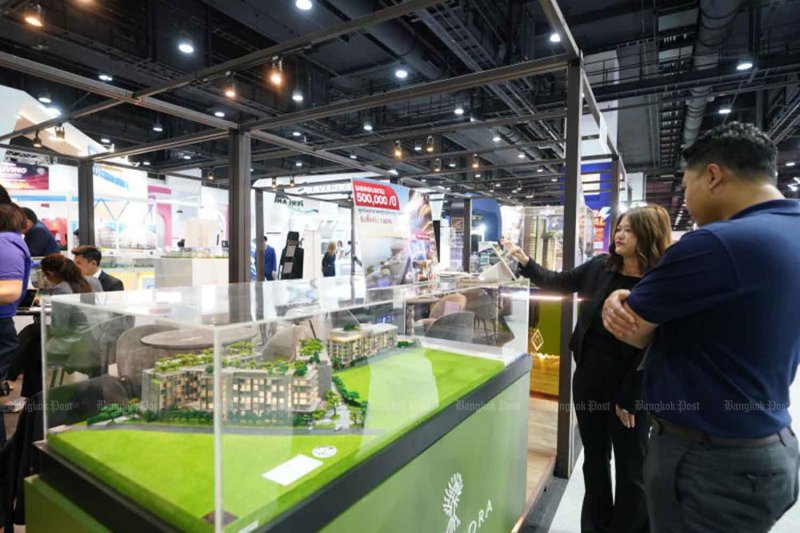
Bangkok's condominium market is on course for another record-low year for new supply launches as developers continue delaying investment amid weak purchasing power, high mortgage rejection rates and subdued foreign demand.
Tritecha Tangmatitham, managing director of SET-listed developer Supalai, said condominium launches this year are likely to fall below last year's level, which was already the lowest in a decade.

"Last year was the lowest level of new condominium launches in 10 years," he said. "This year will likely be even lower."
He said market sentiment remains fragile despite Thailand's economy continuing to expand, as consumers remain concerned about economic uncertainty, prolonged geopolitical conflicts and difficulties in obtaining housing loans.
Mortgage rejection has also become a growing obstacle. Supalai's rejection rate has risen to 17% this year from 15% last year, although it remains below the industry average.
Mr Tritecha said many prospective buyers underestimate the impact of "buy now, pay later" spending and delayed repayments, believing that small instalments would not affect mortgage applications.
"Banks count everything," he said. "Even small late payments affect borrowers' credit discipline, making it harder to obtain housing loans."
As a result, developers are prioritising the sale of completed inventory rather than launching new projects.
Although Supalai still plans to launch about 25 projects worth roughly 32 billion baht this year, close to its original target, any delays would mainly be due to project preparation and construction timing rather than a change in market strategy, he said.
Despite the current slowdown, Mr Tritecha remains optimistic about the long-term condominium market.
He said new supply has been constrained for several years because developers have sharply reduced land acquisitions, while banks have become more cautious about providing project financing.
Many lenders now require developers to secure presales of around 70% before extending construction loans, making it difficult for many companies to launch new projects.
He said only two condominium projects entered the environmental impact assessment approval process this year, compared with 12-14 projects annually in previous years.
"Demand has weakened, but not nearly as much as supply," Mr Tritecha said. "Eventually, the market will face a shortage of new condominium supply."
Surachet Kongcheep, head of research at property consultancy Cushman & Wakefield Thailand, also expects new condominium launches this year to remain below 20,000 units.
"Developers have become increasingly cautious as local purchasing power weakens and Chinese demand, once the largest foreign buyer group in Bangkok's condominium market, continues to decline without being fully replaced by buyers from other countries," he said.
According to Cushman & Wakefield, 2,332 condominium units were launched in Greater Bangkok during the second quarter of 2026, down 67% from 7,169 units in the first quarter.
Although first-half launches totalled about 9,500 units, up 42% from the same period last year, the increase reflected a stronger first quarter before developers sharply scaled back launches in the second quarter.
Mr Surachet said many developers are now focusing on selling existing inventory, with some disposing of completed units in bulk to improve cash flow.
Others have postponed new projects after struggling to sell completed condominiums or having to settle construction payments with contractors using completed units instead of cash.
"The market environment has completely changed," he said. "In previous downturns, developers could stimulate demand by launching cheaper products. Today, affordable units also struggle because many buyers cannot obtain mortgages."
He said downside risks remain, particularly from ongoing geopolitical conflicts, including tensions in the Middle East, which could further weaken buyer confidence during the second half of the year.







