Get all your news in one place.
100's of premium titles.
One app.
Start reading
Digital Camera World
Sebastian Oakley

Color photography as we know it is a lie – and this 135-year-old process proves it!

Lippmann photography.

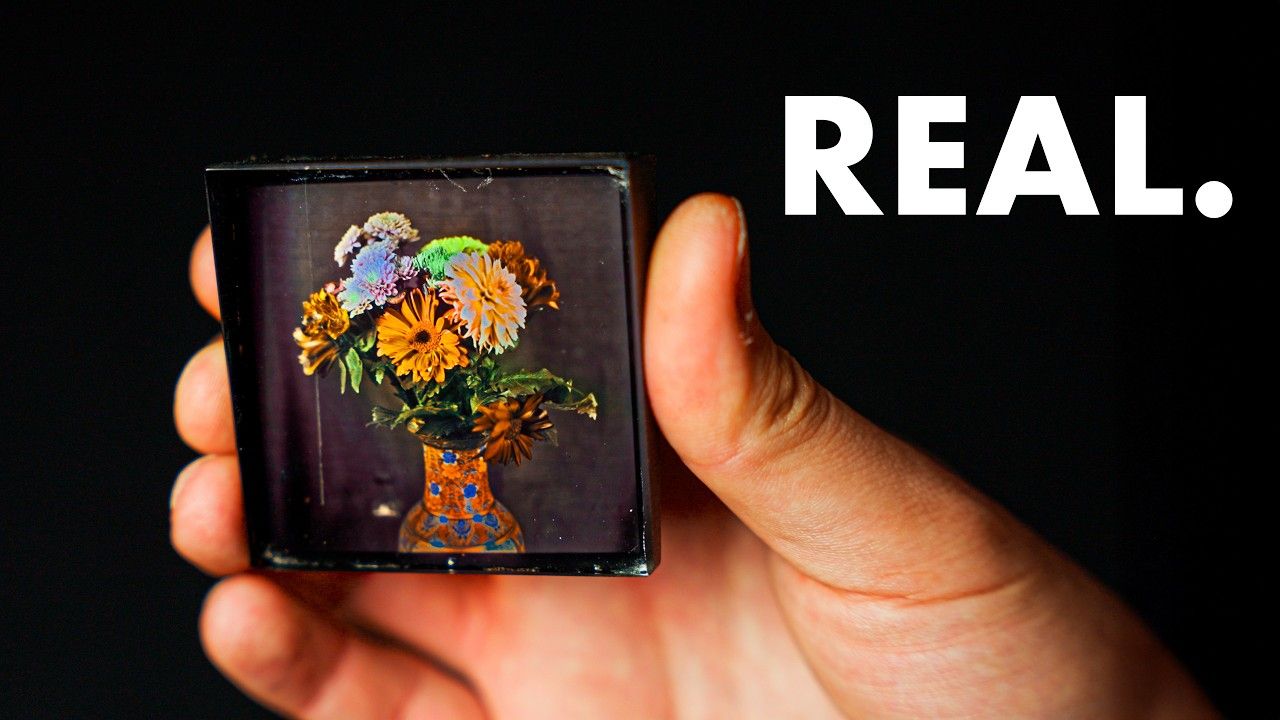
Color photography has always sold itself as a faithful record of the world, but a fascinating 135-year-old process suggests that the pictures we have trusted for generations may not be quite as honest as they appear – and YouTuber Steve Mould has lifted the lid on the Victorian-era process.

The technique is called the Lippmann Process, and it sits somewhere between a photograph and a hologram. At first glance, a Lippmann plate can look like an ordinary black-and-white image – but when viewed at the right angle, color suddenly bursts from the surface.

(Image credit: Steve Mould)

The remarkable part is that this color is not created with dyes, pigments or the usual red, green and blue trickery used in modern screens and cameras. Instead, it comes from the physical structure of the plate itself.

That is why the process makes such a provocative case against conventional color photography. When we photograph something yellow, for example, a camera does not usually reproduce that exact yellow wavelength back to our eyes.

Instead, screens and prints often use combinations of red and green wavelengths that our brains interpret as yellow. For most people, the difference is invisible – but scientifically speaking, it is not the same thing.

(Image credit: Steve Mould)

Lippmann plates work differently; they record color information through interference patterns created inside a photographic emulsion.

During exposure, light passes through the plate, reflects from a mirror-like surface and forms standing waves. These waves leave behind microscopic layers of metallic silver in gelatin, with the spacing between those layers corresponding to the wavelengths of light in the original scene.

When white light is later shone onto the plate, those tiny silver layers act like a built-in diffraction grating. The result is structural color, similar in principle to the shimmer of a soap bubble, the rainbow on a DVD, the wings of a morpho butterfly, or even the color-shifting skin of a chameleon.

The color is not painted onto the image; the structure of the photograph itself physically rebuilds it.

The result is arguably one of the most truthful forms of color photography ever created. Rather than simply fooling the human eye with red, green, and blue substitutions, a Lippmann plate can reflect a far richer and more complex spread of wavelengths.

In theory, that means the image is closer to the original light that was present when the photograph was made.

ABOVE: Watch Steve Mould's excellent video for yourself

Of course, there is a reason that the process never replaced standard color photography. Lippmann plates are difficult to make, exposure times can run into minutes, the viewing angle is limited and reproducing them is almost impossible.

They are beautiful, but they are not practical in the way that film, digital sensors, prints and screens have become practical.

Even so, Lippmann photography remains a fascinating reminder that photography has never been quite as simple as “capturing what we see.”

Modern color photography may be convenient, flexible and convincing, but this forgotten process shows that there was once another path: one where color was not simulated, but physically encoded into the photograph itself.

You might also like…

The Lippmann process does beg the question, what is color science and why is it so important to your camera? My colleague James says that the Hasselblad X2D II 100C has the best colors of any camera – but on the other hand, you could ditch it completely and try one of the best cameras for black-and-white photography!

Sign up to read this article
Read news from 100's of titles, curated specifically for you.
Already a member? Sign in here
Related Stories
Top stories on inkl right now
One subscription that gives you access to news from hundreds of sites
Already a member? Sign in here
Our Picks
Fourteen days free
Download the app
One app. One membership.
100+ trusted global sources.