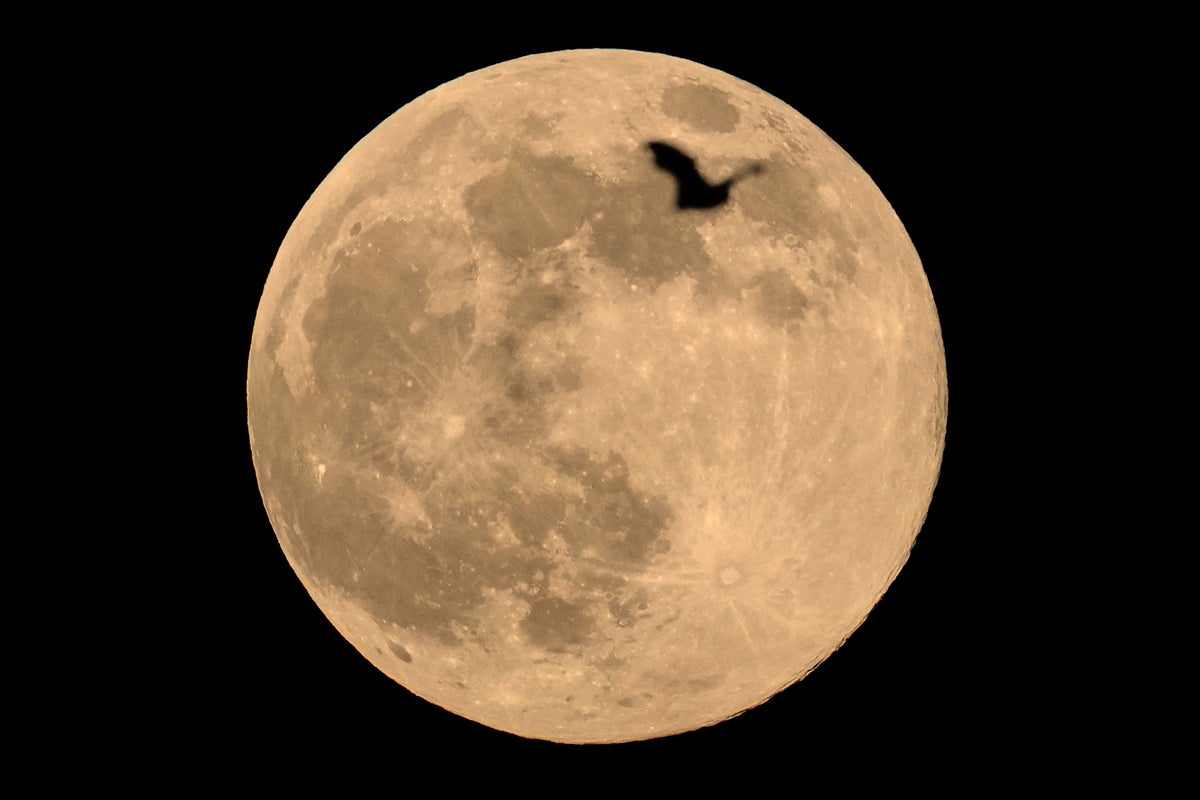
The final supermoon of the year will also reach higher in the sky than any other full Moon of the year, reaching its peak on Thursday evening.
December’s full Moon, known as the Cold Moon, is the third of four consecutive supermoons, making it appear bigger and brighter.

The Moon’s orbit around the Earth isn’t a perfect circle so it gets nearer and farther as it swings around.
When a full Moon is closer to Earth in its orbit, a so-called supermoon happens. It makes the Moon look up to 14 per cent bigger and 30 per cent brighter than the faintest Moon of the year, according to Nasa.
“A supermoon occurs when a full Moon coincides with the Moon’s closest approach to Earth in its elliptical orbit, a point known as perigee,” the US space agency noted in a blog post.
“During every 27-day orbit around Earth, the Moon reaches both its perigee, about 226,000 miles (363,300 km) from Earth, and its farthest point, or apogee, about 251,000 miles (405,500 km) from Earth.”

Supermoons happen a few times a year in clusters, taking advantage of the sweet spot in the moon's elliptical orbit.
The supermoon can be glimpsed in clear night skies without any special equipment. But it can be tough to discern the subtle change with the naked eye.
The latest forecast from the Met Office suggests there will be relatively good visibility for people in England, with clear skies across most of the country at the time the full Moon peaks at 11:14pm (GMT).

Whether a supermoon or not, the Moon also appears bigger when it's close to the horizon because of what's called the Moon Illusion. It's a strange visual trick that experts can't yet explain.
"When you have a supermoon, that effect is just slightly more striking,” said astronomer William Alston with the University of Hertfordshire.
Tides could be slightly higher during a supermoon because the Moon is closer to Earth, but again, the difference isn’t very noticeable.
There will be another supermoon – the last in this series – on 3 January. The next supermoon after that will not be until 24 November, 2026.
Additional reporting from agencies.
NASA uses Death Valley to test next-gen drone tech for flights across Mars
SpaceX cleared to redevelop Cape Canaveral launchpad for Starship operations
UK probe detects highest level of solar radiation spike in 20 years
Russia accidentally destroys its only way of sending astronauts to space
Stunning ‘cosmic butterfly’ captured on telescope after schoolchildren chose target
Lightning on Mars? Scientists capture crackling sounds on red planet