Get all your news in one place.
100's of premium titles.
One app.
Start reading
The Economic Times
The Economic Times

Code Name Silver: The Indian spy who played 5 sides in World War II

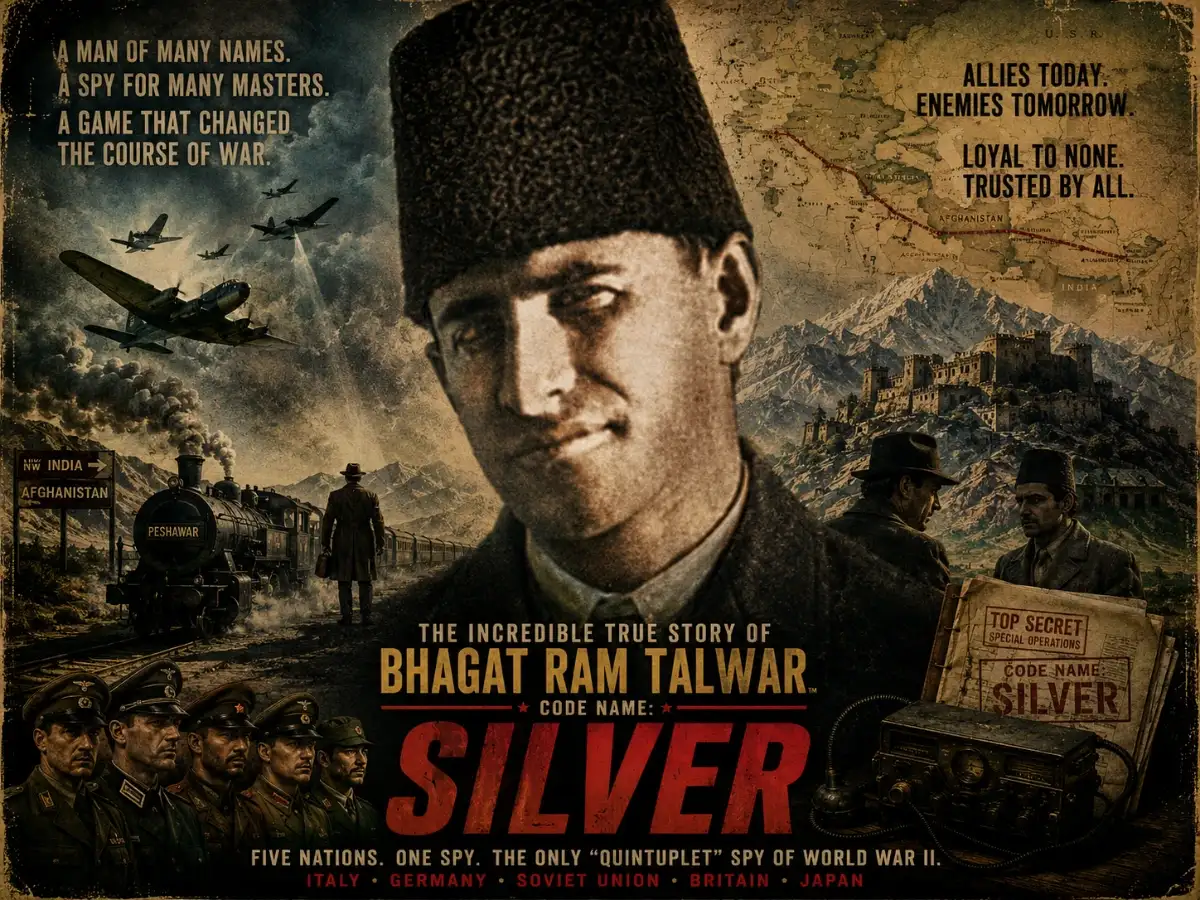
Bhagat Ram Talwar occupies an unusual place in both the history of India's freedom movement and the secret history of World War II. He helped Netaji Subhas Chandra Bose escape from British India in 1941 and guided him through the frontier region into Afghanistan. Within a few years, he was running espionage operations that involved the Germans, Italians, Soviets, British and Japanese. His British handler was Peter Fleming, the wartime intelligence officer whose brother Ian Fleming would later create James Bond, modelled after Peter.

Also Read| The jockey who rebelled: How a girl ran a secret radio station
Had British journalist and author Mihir Bose not tracked scattered intelligence records, Bhagat Ram Talwar might have remained a footnote in the story of Subhas Chandra Bose's escape from India. Instead, Bose's 2017 book 'The Indian Spy: The True Story of the Most Remarkable Secret Agent of World War II', which was published in the UK as 'Silver: The Spy Who Fooled the Nazis', reconstructed the extraordinary career of a man who moved through the intelligence networks of five countries -- hence, the 'quintuplet' spy -- during World War II.

However, Talwar's legacy remains controversial. While he is known for fooling the Nazis for the British, many point to him allying with the British while remaining close to Bose's wider network.

The Netaji episode

Talwar's association with Netaji has ensured that his wartime activities continue to attract scrutiny. There is little dispute about his role in helping Bose travel from the North-West Frontier into Afghanistan after the latter's escape from house detention in Calcutta. Contemporary accounts and later memoirs place Talwar at the centre of the operation. Talwar's help in helping netaji get out of India ultimately led to a big resistance movement culminating in the formation of the Indian National Army (INA).

The controversy concerns what happened afterwards. According to Mihir Bose, Talwar's loyalties shifted as the war evolved. Initially he used his access to Italian and German intelligence networks while privately holding communist sympathies. After Germany invaded the Soviet Union, he began working with Soviet intelligence. In 1942 he was also taken on by the British through Peter Fleming. From that point onward, Talwar was feeding information to multiple intelligence services at the same time.

Mihir Bose writes in his book: "So when Bose nominated Khan [after escaping from Kabul] as his agent to work with the Italians, Quaroni [Italian ambassador in Kabul with whom Talwar connected Netaji] seized the opportunity. A few months later Khan was taken over by Italy’s Axis partner, Germany. But while Khan took money from both the Italians and the Germans he was no fascist, in fact a communist, and from the beginning was deceiving both countries. While initially this deception game was virtually a freelance effort, once Hitler had unleashed Operation Barbarossa, his invasion of the Soviet Union, Khan worked with the Russians to continue to fool the Nazis. Later still he worked for the British, who gave him the name Silver."

Also Read| How INA's 'youngest' operative disguised herself as a boy to gather intelligence from the British

This account raises questions about his relationship with Bose. Bose was trying to secure Axis support for India's independence struggle. Talwar, meanwhile, was supplying information to powers that had an interest in monitoring or frustrating those efforts. Netaji never realised the extent of Talwar's intelligence activities.

Peter Fleming and the Silver network

One of the most intriguing parts of Talwar's story begins in 1942 when he came under the supervision of Peter Fleming. Fleming was already a well-known writer, adventurer and intelligence officer. He was also the elder brother of Ian Fleming, who would later create James Bond.

Operating from British intelligence headquarters in Delhi, Peter Fleming turned Talwar into one of Britain's most valuable wartime assets. It was Fleming who gave him the codename "Silver". By then Talwar had already established credibility with German intelligence. Rather than shutting down those connections, the British chose to exploit them.

The Germans trusted Talwar enough to provide him with a radio transmitter that allowed direct communication with the Abwehr headquarters in Berlin. Using that equipment, Talwar transmitted reports that were often prepared with British knowledge. The Germans believed they were receiving intelligence from a trusted operative in the region. In reality, many of the reports were designed to mislead them about military and political developments.

Talwar repeatedly travelled between Peshawar and Kabul carrying information, money and instructions. Mihir Bose notes that he made dozens of hazardous crossings through difficult terrain during the war. German confidence in him became so great that they awarded him the Iron Cross and channelled substantial funds through his operations, unaware that the man they considered an asset was working against them.

The spy who defies description

Though Bhagat Ram Talwar was a highly complicated character, his nationalist origins are beyond doubt. Talwar was born in 1908 in Ghalla Dher in the North-West Frontier Province, a region that produced many anti-colonial activists and political radicals during the late colonial period. He came from a Hindu Pathan family that had already paid a heavy price in the struggle against British rule.

The defining event of his early life was the execution of his elder brother Hari Kishan Talwar. In December 1930, Hari Kishan attempted to assassinate Sir Geoffrey de Montmorency, the Governor of Punjab, during a function at Lahore University but the governor survived. Hari Kishan was arrested, tried and hanged on 9 June 1931. His execution turned him into a nationalist martyr in revolutionary circles and profoundly influenced the younger Bhagat Ram.

Like many politically active young men of the Frontier, Talwar was drawn towards radical politics. He became associated with Khan Abdul Ghaffar Khan's Red Shirt movement and later gravitated towards communist networks operating in the region. By the late 1930s, he had developed links with activists of the Kirti Communist Party.

What survives today is the picture of a man who operated in a world where ideology, espionage and personal judgement frequently overlapped amid highly risky life-threatening moves. He remains one of the most unusual figures produced by the freedom movement: a frontier revolutionary, a communist sympathiser, Bose's guide to Kabul and the wartime agent known as Silver, who fooled the Nazis for the British.

Sign up to read this article
Read news from 100's of titles, curated specifically for you.
Already a member? Sign in here
Related Stories
Top stories on inkl right now
Our Picks
Fourteen days free
Download the app
One app. One membership.
100+ trusted global sources.