When it comes to the driver market, Cobra has carved out a distinct niche for marrying high-level innovation with striking aesthetics. With the release of the new Optm lineup, it is doubling down on stability by introducing a new metric to the lexicon of club design: POI (Product of Inertia).

WATCH: Joe and Sam test all the new Cobra Optm drivers in the Performance Lab
I recently took the Optm X model - the mid-spin, high-forgiveness option in the range, into the testing bay and onto the course to see how these claims translate to performance relative to the best golf drivers in the game.

The headline story for the Optm family is the shift from focusing solely on MOI (Moment of Inertia) to optimizing "POI."
According to Cobra, this new approach accounts for club rotation across all three axes - horizontal, vertical, and the "toe up or down" Z-axis - rather than just resistance to twisting on a single plane.
By using AI and supercomputing to optimize mass placement, Cobra claims to have reduced this POI by over 50% compared to previous designs. The goal is to dramatically reduce the gear effect on mishits, tightening dispersion by up to 23%.

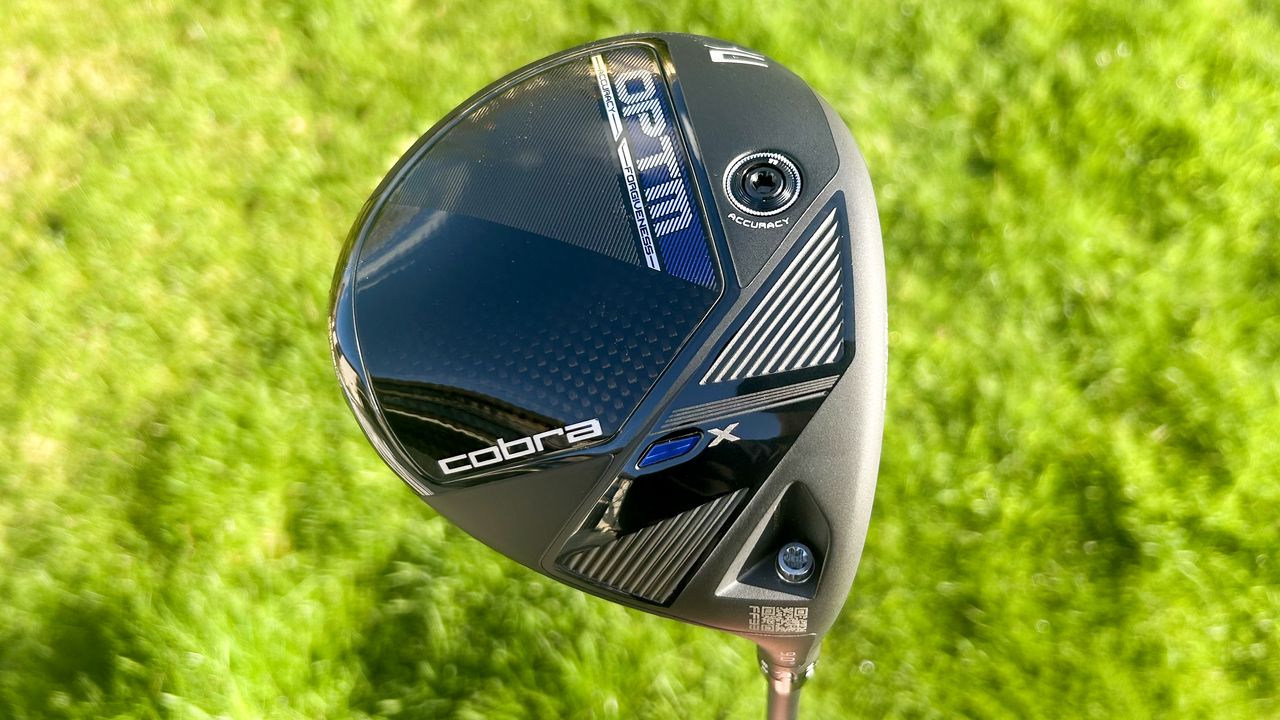
The Optm X specifically is designed to balance accuracy and forgiveness in a footprint slightly larger than the lower-spinning LS model. It features an advanced descending weight system with two adjustable weights (11g and 3g) that can be positioned in the back for neutral flight or the toe for a fade-biased flight.
Returning tech includes the H.O.T. Face Technology, a forged insert designed to maximize ball speeds across the face, and the FutureFit33 hosel, offering extensive loft and lie adjustability while keeping the face square via the SmartPad.
Pulling the headcover off, fans of Cobra will immediately enjoy the familiar aesthetic styling. It looks undeniably premium, sporting a gloss black carbon crown that feels modern and aggressive, along with a subtle use of color.

At address, Cobra drivers have in recent years leaned toward a distinct shape, and the Optm X is no exception.
While I don’t personally love the more triangular shape that Cobra often produces in the playing position, I must admit the execution here is pretty good. The crown is clean and "unfussy," which I really like; it frames the ball well without the distraction of overly busy graphics or alignment aids.
I put the Optm X through its paces on a Foresight Sports GC3 launch monitor to gather some ball data, and the results depicted a club that is a fairly solid all-round performer without really being outstanding in any single category. The ball speeds were competitive, and the spin rates sat comfortably in that mid-range window expected of an "X" model.

Anecdotally, during the testing session, the driver proved to be reasonably forgiving on mishits. The "POI" reduction story seems to have some merit regarding stability, as the clubhead felt stable through impact, even on some pretty poor strikes. However, it wasn't necessarily more forgiving than its predecessor, the DS-Adapt X or even the Darkspeed X, in my hands. It was, however, relatively easy to launch.

The Cobra Optm X is a perfectly decent driver that purchasers will not be disappointed with, especially given the RRP once again sits slightly under the new drivers from the big four companies. It checks all the boxes for a modern driver: clean looks, solid stability, and a premium adjustable hosel system.
However, if you are currently gaming one of its immediate predecessors and are looking for substantial gains in distance or dispersion, you will likely not find them here. It is an evolution rather than a revolution - a reliable fairway finder that performs well but doesn't radically change the game.
The Cobra Optm X driver will be retailing for £479/$599.