Get all your news in one place.
100's of premium titles.
One app.
Start reading
The Independent UK
The Independent UK
National
Rebecca Speare-Cole

Climate resilient coffee varieties helping Kenyan farmers to protect UK brews

Harmful diseases and pests such as coffee berry disease have been hitting yields (Anthony Odamo/Fairtrade/PA) -

Kenyan farmers who supply coffee to UK brands and supermarkets have been switching to new varieties to help protect yields from devastating climate impacts.

Producers in the East African nation say increasingly volatile rain patterns as well as a host of diseases and pests, spurred on by human-driven climate change, are hitting production.

For decades, farmers from Mutira Coffee Cooperative in the foothills of Mount Kenya could make a living harvesting several traditional strains of arabica coffee – known as SL28, SL24, Blue Mountain and K7.

These plants thrived under predictable weather patterns that featured a longer rainy season from April to July followed by another shorter period from October to November.

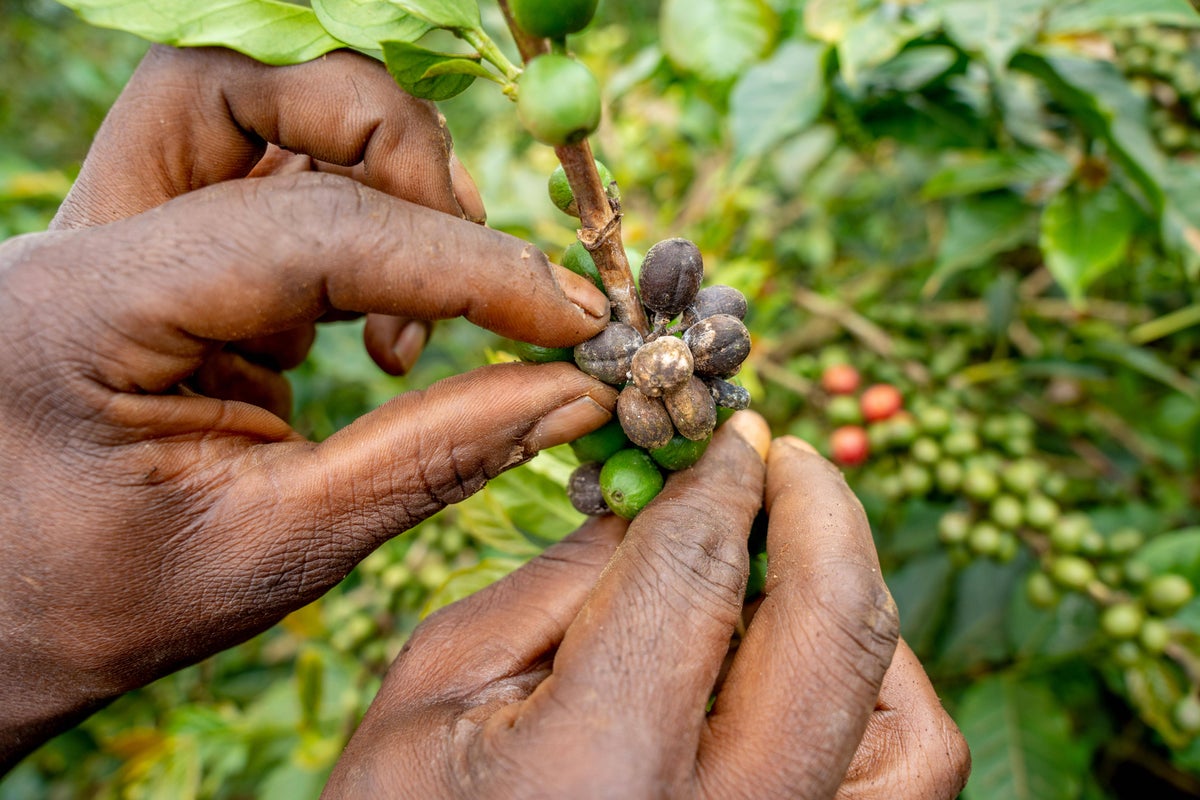
Eunice Kabui examines coffee cherries on her farm. (Anthony Odamo/Fairtrade)

But having come under pressure from fluctuating conditions and diseases in recent years, they have all but stopped producing the same quantity and quality of coffee as they once did.

Martin Kinyua, chief executive of Mutira, which supplies Fairtrade-certified coffee to UK retailers such as Tesco, Morrisons and Taylors, said: “Climate change is one of the biggest challenges that we are facing as a cooperative society as well as smallholder farmers.

“It has really affected us in terms of the cost that we use to repair (the damage) and train our farmers on climate adaptation practices.”

As part of its response, the cooperative has been encouraging its nearly 5,500 members to switch to newer arabica varieties that are genetically more resistant to diseases, offering them seedlings from its nursery at a subsidised price.

Many are now farming the genetically more resilient “Ruiru 11” and “Batian” strains, which were developed by the government’s Coffee Research Institute and released for cultivation in 1995 and 2010 respectively.

Eunice Kabui’s coffee farm in the foothills of Mount Kenya. (Anthony Odamo/Fairtrade)

While this has helped to sustain yields, some farmers told the Press Association that climate impacts are still hitting their already scarce incomes at the same time that input costs are skyrocketing – largely because of the Middle East conflict.

Eunice Kabui, a 73-year-old Mutira farmer, is among those who changed varieties after her farm was devastated by leaf rust and coffee berry disease (CBD), both of which can prevent the healthy development of the “cherries” that contain coffee beans.

She told PA that coffee farming used to yield a more prosperous income when she began with the traditional SL28 variety in the 1970s.

“Now due to climate changes, sometimes there is too much sun, excess rainfall and at times too cold,” she said.

“It brings a lot of troubles.”

Leaf rust on Frederick Muriuki’s farm in Kirinyaga. (Anthony Odamo/Fairtrade)

After switching to Ruiru 11 on her farm a few years ago, she said the plants are “doing good” and the farm “doesn’t have as many diseases”.

On Peter Nijirain’s hillside farm, heavy rains in recent years caused soil erosion and disease spread, badly affecting his SL28 stems.

With Mutira’s support, the 62-year-old was able to terrace his sloped fields to safeguard them from floods and switch to Ruiru 11.

“After changing coffee variety, even with climate change, we have a constant rate of yields,” he said.

Peter Njiraine has built terraces to protect his coffee farm from soil erosion caused by flooding. (Anthony Odamo/Fairtrade)

However, both farmers said they are still facing other climate-driven challenges, especially harmful pests, such as spider mites, borer insects and coffee thrips, which can thrive under prolonged periods of dry, hot, cold or wet weather.

This means the need to use pesticides more frequently at a time that the costs is rising sharply is eating further into their incomes so that they struggle to invest in their farm.

“The money is not enough,” Mr Nijiraine said.

According to Mutira, farmers’ profits have fallen 20% in the last two years amid the surging input costs.

Coffee cherries are sorted for processing at Mutira’s Kagumo headquarters in Kirinyaga county, Kenya. (Anthony Odamo/Fairtrade)

For many farmers, buying the new variety to help protect their crops involves “an extra mile, an extra cost” that they cannot cover, Mr Kinyua said.

Frederick Mariuki, 60, has been harvesting cherries from SL28 stems for 25 years but he said his yields have been devastated by climate change.

“The pests have multiplied while leaf rust and CBD have become rampant,” he said. “There are so many other diseases. Some you can’t even tell which one they are”.

While Mr Mariuki expected to harvest 1,500kg this year, he said he has only managed to gather 900kg.

Frederick Muriuki at his home in Kirinyaga county, Kenya. (Anthony Odamo/Fairtrade)

With much of his income going towards servicing loans as well as pesticides, the farmer said he is not only struggling to meet the cost of production but he is also unable to sufficiently pay for food, healthcare and school for his family.

“This is the worst year,” he said. “The loss has put me in financial distress.”

Managers at Mutira said around 60% of its members are in a similar position to Mr Mariuki, with many unable to get a living income from coffee production, especially without diversifying into other products, such as macadamia, avocadoes, dairy, tea or poultry.

The cooperative has been using the premium payments it receives from selling 2% of its coffee on Fairtrade terms to support producers with climate adaptation measures and income generating projects.

The money has helped pay for agronomists to educate farmers on best practices, such as planting trees for shade, as well as solar driers, which are polytunnel-like structures that protect drying beans from wetter conditions at its factories.

Solar driers that have been installed at Mutira’s factory in Kagumo. (Anthony Odamo/Fairtrade)

But Mr Kinyua said the cooperative cannot sufficiently support members with the soaring input costs and predicts that many smallholder producers will drop out of coffee farming over the next 20 years if profitability continues to decline in the face of climate change.

He called on all industry players – consumers, wholesalers, supply chain brokers and retailers – to buy coffee in ways that provide fairer prices to farmers and safeguards sustainable production for the future.

“To produce one cup of coffee, it costs a lot. It is expensive. It is time-consuming. It requires a lot of sacrifice,” he said.

“Being fair is making sure that the small-scale farmer gets the best price for the work that he has done.”

Sign up to read this article
Read news from 100's of titles, curated specifically for you.
Already a member? Sign in here
Related Stories
Top stories on inkl right now
One subscription that gives you access to news from hundreds of sites
Already a member? Sign in here
Our Picks
Fourteen days free
Download the app
One app. One membership.
100+ trusted global sources.