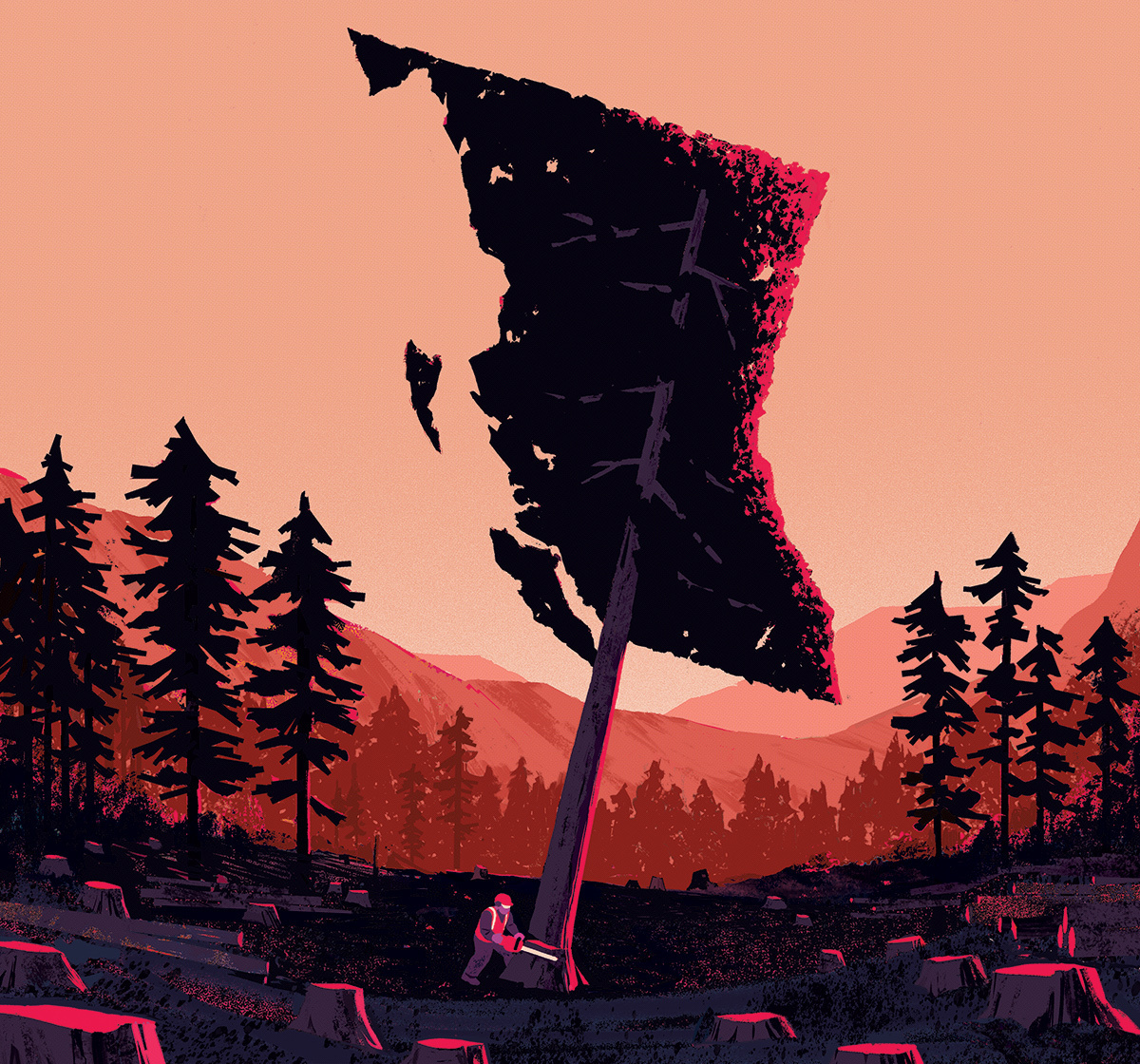
In 2019, British Columbia’s logging industry generated $13 billion for the province, according to the BC Council of Forest Industries. In 2020, however, timber companies responded to COVID-19 uncertainty by cutting production. It turned out to be an overcorrection. Home renovations and new construction both quickly increased, and mills struggled to catch up to the demand. The price of lumber per board foot skyrocketed 254 percent from pre-pandemic levels. Stumpage fees—the price timber companies pay the provincial government to harvest trees on Crown land—followed suit, hitting $94.54 per cubic metre in 2021, triple the price of the previous spring. While demand is exceptionally high, so is the cost of doing business in the province.
This cost is exacerbated by a storm of threats closing in from every direction, a worse state of affairs for logging than at any time in the provincial industry’s history. In the interior of BC, the mountain pine beetle continues to kill millions of hectares of forest by burrowing into needle-bearing evergreens and turning them a foreboding shade of red. The past five years have seen three of the province’s worst fire seasons in recorded history. On the ground, the view is dire too, made evident by the anti-old-growth-logging blockades and arrests around the Fairy Creek watershed, on Vancouver Island. Last November, the province finally announced its intent to defer the logging of 2.6 million hectares of some of the most at-risk old growth for about two years. The announcement was met with a scramble among some of the 204 consulted First Nations, who stated that they needed more time to decide how best to manage their territories, along with outcries from the logging sector about lost employment.