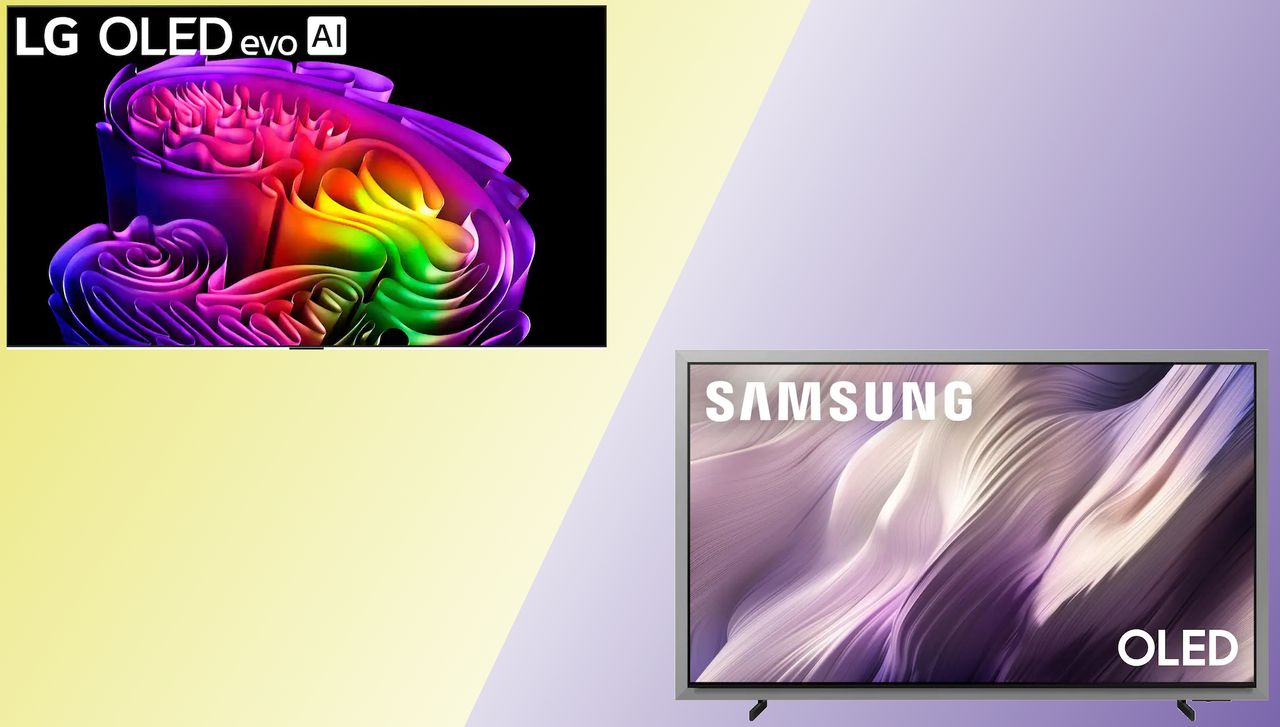
Among 2026 OLEDs, two sets stand above the rest: the LG G6 and Samsung S95H. These top-shelf TVs harness high-end hardware for brighter, punchier performance than that of entry-level and mid-range OLEDs. They’re also stuffed with features for gaming, streaming and beyond.
You can’t go wrong with either option. While we’re still in the process of formally testing these two sets, both are likely to end up on our list of the best OLED TVs of the year, which puts them on a crash-course with our round-up of the best TVs, period.

That said, there are some key differences between the G6 and S95H that are worth highlighting. Before you plunk down your credit card, let’s take a look at your candidates.
The G6 and S95H achieve an elevated OLED picture in different ways
As top-tier models, the G6 and S95H set themselves apart from lower-end OLED TVs with higher-performing hardware. Both technologies aim to improve brightness, color and other aspects of picture quality, but how they get there is entirely different.
Want to learn more?
Dive deeper into OLED tech with my WOLED vs QD-OLED explainer.
The G6 leverages LG Display's newest RGB Tandem OLED panel. Its unique structure allows for higher brightness, in both highlight detail and across the whole image. This panel also delivers more voluminous color than what we typically see with standard WOLED panels (like the one found on the LG C6).
The newest version of RGB Tandem OLED is guided by LG's processing. Together, these hardware and software elements make up a feature that LG is calling Hyper Radiant Color Technology.
The S95H, on the other hand, makes use of Samsung Display's quantum dot-enhanced OLED (QD-OLED) panel in its 55-, 65- and 77-inch variants. (Interestingly, the 83-inch S95H taps LG Display's RGB Tandem OLED panel.)
Both the LG G6 and S95H offer some of the brightest OLED performance to date.
As the name suggests, the S95H leverages quantum dots for brighter, purer color than standard WOLED displays. On average, they also tend to be brighter than garden-variety, non-RGB Tandem panels, too.
Currently, the only TV technology that matches or exceeds the color volume measurements we've taken to date is RGB LED. This makes QD-OLED TVs like the Samsung S95H a great pick for people who are chasing eye-popping color.
Here's the main takeaway: Thanks to their advanced engineering, both the LG G6 and S95H offer some of the brightest OLED performance to date. However, due to the inherent benefits of quantum-dot color, I expect the S95H to offer better HDR color volume than the LG G6.
Based on past performance, it's also likely that the G6's white highlight brightness will be slightly higher than the S95H during HDR content.
The G6 and S95H offer unique designs
One of the most noticeable differences between these sets can be seen in each brand’s distinct approach to designing a flagship-level OLED TV. To a certain extent, the G6 and S95H put design front and center, each offering a unique spin on high-end luxury.
Like its predecessors, the LG G6 is designed with wall-mounting in mind. Its panel isn’t quite as wafer-thin as other LG OLEDs, but the added depth allows a uniform profile that sits flush against the wall. There’s barely a bezel, and an elegant, metallic finish wraps around the outside of the TV.
You can attach a stand to the G6 and forgo wall-mounting altogether, but you’ll need to purchase the G6's stand separately. Out of the box, the G6 comes with a flush wall mount.
Samsung's top OLED is also designed for wall-mounting, but the S95H features one of the boldest design elements for a TV that I’ve come across in years: a wide, metal frame, upon which the OLED screen appears to float.
When I spent an afternoon with the all-new S95H (seen above), it was wall-mounted in a living room-like staging area to emphasize the frame. While it won’t be everyone's cup of tea, it's worth noting how much more natural the S95H's framed display appears in a wall-mounting configuration compared to a table-top setup.
On that note, there are a pair of narrow feet included with the S95H, should you opt to place it on a media console or credenza. Just be aware of the fact that the metal frame is non-negotiable.
Another non-negotiable design element? For a third year in a row, Samsung's flagship OLED screen is sporting a matte-style, glare-free finish. The G6 features a glossy screen, though LG has gone to great lengths to tamp down on glare with a robust, anti-reflective coating.
This means that the debate between matte or glossy OLED screens will continue into 2026. I find that Samsung's glare-free finish does a remarkably good job at blunting the impact of direct glare, but with an average amount of ambient light in play, the matte-style screen also raises the TV's black levels, limiting visual depth.
The G6's screen is no slouch when it comes to limiting direct glare, but it's not quite as adept as the S95H. Nevertheless, in average lighting conditions, the G6's glossy screen creates a deeper, inkier look.
Dolby Vision and other HDR formats
Like all Samsung TVs, the S95H does not support Dolby Vision, an enhanced HDR format that leverages dynamic metadata to optimize the picture on a frame-by-frame basis, thus keeping with the creator's intent. Instead, the S95H supports HDR10+, a royalty-free alternative that works in a similar fashion. The LG G6, however, does support Dolby Vision.
Another thing to note: The S95H is one of the first Samsung TVs to arrive with HDR10+ Advanced. In the coming years, his new HDR format is set to compete with Dolby Vision 2. However, the LG G6 does not support Dolby Vision 2.
LG G6 vs Samsung S95H: outlook
There are other differences between these two TVs, of course. They're built around entirely different software experiences, for instance, each offering its own user experience.
But beyond that, they're quite similar. Both flagship OLEDs come with arguably the most thorough selection of gaming features money can buy, and even in a side-by-side comparison, their individual performance is jaw-droppingly good.
Choosing between the LG G6 and Samsung S95H comes down to three questions:
1. Which TV's design is better for your home?
2. Do you care about the S95H's added color volume?
3. Do you need Dolby Vision support on your next TV?
If you can answer these questions for yourself, you're well on your way to choosing between these two incredible TVs.