Get all your news in one place.
100's of premium titles.
One app.
Start reading
Bangkok Post
Bangkok Post
National

Chinese student rescued from 'virtual kidnapping'

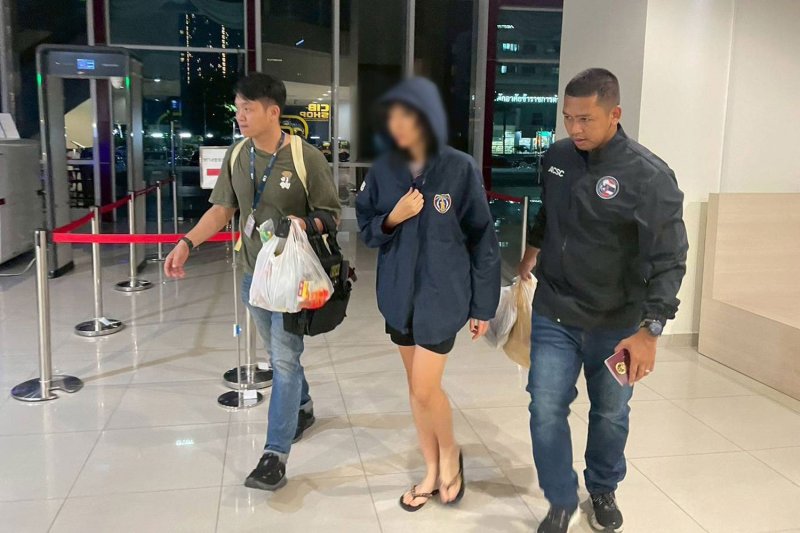
Police escort the 21-year-old Chinese woman, victim of a "virtual kidnapping", from a hotel in Samut Prakan. Criminals had tried to extort 12.5 million baht from her Chinese family. (Photo supplied/ Wassayos Ngamkham)

Thai police have rescued a 21-year-old Chinese student from a "virtual kidnapping" orchestrated by a transnational criminal network that attempted to extort 12.5 million baht from her family.

The young woman, identified by police only as Ms Wang, is a Chinese student studying in Hong Kong.

Her father received threatening messages via WeChat from an unidentified man claiming that his daughter had been abducted, deputy national police chief Pol Gen Chatchai Pitaneelaboot told reporters on Wednesday.

He was sent photographs showing his daughter bound with ropes and appearing to have been assaulted, along with a ransolm demand for HK$3 million, about 12.5 million baht. The family instead filed a complaint with Hong Kong police.

Hong Kong authorities later contacted Thailand's Anti-Cyber Scam Centre and the Central Investigation Bureau. This led to the Anti-Trafficking in Persons Division, sub-division 1, launching an urgent investigation, Pol Gen Thatchai said.

Pol Col Korkiat Wuthijamnong, superintendent of sub-division 1 of the Anti-Trafficking in Persons Division and head of the rescue team, said investigators learned that the scammers had earlier deceived the young woman into requesting money from her father on the pretext it was needed as proof of financial support for overseas studies.

Believing the claim, her father transferred more than HK$1.4 million, about 5.8 million baht, into his daughter's Bank of China account. The funds were subsequently dispersed through a network of mule accounts controlled by the scammers, Pol Col Korkiat said.

On May 31, the woman travelled alone from Hong Kong to Thailand and checked into a hotel in Bangkok's Lat Krabang district on June 1. (continues below)

The Chinese woman is found inside a hotel room when police came to help her. (Photo supplied/Wassayos Ngamkham)

The officers examined CCTV footage and other evidence that showed she had stayed alone in the hotel and that no one else had entered or left the room. Investigators also discovered she had hired a car and driver to take her shopping, and bought rope, straps, a knife, body paint and red lipstick.

Those items were used to stage fake injuries seen in photographs and videos that were then sent to the scammers, who used them to pressure the woman's family into paying the demanded ransom.

Further investigation revealed that Ms Wang had later moved to another hotel in Bang Phli district of Samut Prakan province, where she checked in using a fake passport image provided online by the scammers. The officers traced her location, intervened and escorted her to safety.

Pol Col Korkiat said the criminals manipulatd her and her family psychologically. It was not uncommon for scammers to pose as government officials and falsely claim that victims were implicated in criminal cases.

The scammers then instruct their victims to cut off contact with their families, go into hiding and stage their own kidnapping, before sending fabricated videos and images to relatives and demanding money.

"The criminals are not physically present with the victim. This is what is known as a virtual kidnapping," he said.

Pol Gen Thatchai said the case highlighted the increasingly sophisticated tactics used by transnational criminal gangs.

"Although no actual kidnapping took place, the emotional distress and financial losses suffered by the family were very real," he said.

He said that in some cases victims are persuaded to travel to neighbouring countries, where they may be at risk from human traffickers or forced criminal activity.

Thai police were working closely with Hong Kong authorities to identify and prosecute members of the call-centre scam network involved in the case, the deputy national police chief said.

He said people needed to remain vigilant against these criminals. Anyone contacted by individuals claiming to be a government official and demanding money transfers or instructing them to cut off communication with their family should verify the information immediately.

People could seek assistance or report suspicious activity by calling the Anti-Human Trafficking Centre's 24-hour hotline at 1599.

Deputy national police chief Pol Gen Chatchai Pitaneelaboot, second from left, leads senior police to announce a police operation that led to the rescue of the 21-year-old Chinese woman. (Photo supplied/Wassayos Ngamkham)
Sign up to read this article
Read news from 100's of titles, curated specifically for you.
Already a member? Sign in here
Related Stories
Top stories on inkl right now
One subscription that gives you access to news from hundreds of sites
Already a member? Sign in here
Our Picks
Fourteen days free
Download the app
One app. One membership.
100+ trusted global sources.