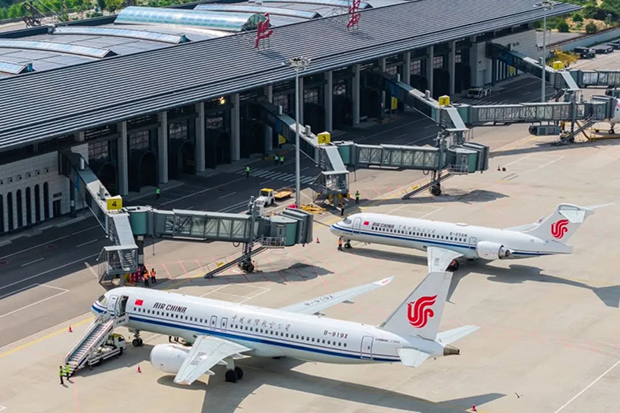
China's narrowbody C919 model is still on Malaysia Airlines' radar, but Western certification remains the "preferred milestone" before consideration, according to a top executive, who added opportunities could present themselves in 2035 or beyond.
In an interview with the South China Morning Post, Bryan Foong, chief executive officer of airline business at Malaysia Aviation Group (MAG), expressed optimism that the C919, assembled by the Commercial Aircraft Corporation of China (Comac), would eventually receive a crucial safety endorsement from the European regulator.

"I have no doubt that Comac will eventually receive European Union Aviation Safety Agency (EASA) certification - and hopefully with the [US] Federal Aviation Administration as well," Foong said. "We need the certification to be ready and be accepted by Malaysia and other countries that we fly to."
He explained that expectations for the C919's certification by Western aviation regulators would grow in tandem with China's aviation cooperation and economic ties with Malaysia, and more broadly, members of the Association of Southeast Asian Nations (Asean).
Western certification, he noted, would be "preferred" for the carrier to operate a C919, as many countries would "rely on" the safety assessment of the aircraft by the two Western agencies.
Billed as an alternative to mainline models like the Boeing 737 and Airbus A320, the C919 has been in the lengthy EASA certification process over the past several years, and embarked on its first commercial flight in May 2023.
The jet, powered by Western engines, has yet to land its first overseas order. The SCMP reported in January that European test pilots had begun flying the single-aisle jet in Shanghai, a critical step in its ongoing evaluation.
Nevertheless, Foong said that the C919 would likely have missed Malaysia Airlines' current fleet renewal cycle.
"It is a credible fleet option but it needs a bit more maturity. For us, in terms of where we are, we began fleet renewal evaluations two to three years ago," he said. "At that time, the C919 was not ready, it missed the window."
"[We] will not be ordering narrowbody aircraft until maybe 2035 … because our orders are all committed," Foong added, saying that there could be more opportunities for Comac during the next cycle.
Malaysia Airlines has been aggressively modernising its fleet. Over the past three years, it has split multibillion-dollar orders between Airbus and Boeing. But rather than buying planes from Comac, it placed orders for Boeing's 737 series.
However, Malaysian officials and another dominant carrier in the country have talked up C919's prospects since last year.
Malaysian Transport Minister Anthony Loke said in September that purchases by foreign airlines would boost confidence in the Chinese planes, urging Comac to be more aggressive in raising its international standing.
During the same month, Tony Fernandes, the CEO of Capital A - the investment holding company that controls AirAsia - confirmed in remarks made in Hong Kong the airline was in discussions to purchase planes from Comac. "We're in active discussions," said Fernandes, although he stopped short of saying when he thought a deal would happen.
Asked about any communications between Malaysia Airlines and Comac, Foong said routine contacts were maintained but there were no active discussions about orders.
He stressed the carrier would continue to evaluate the C919's performance and profitability and that Comac would need to build and expand a ground support network for maintenance and repair operations across Southeast Asia.
Comac has established a representative office in Singapore to tap into the burgeoning Asean market, while its regional C909 jet has already joined the fleets of airlines in Vietnam, Laos and Cambodia.
On serving the Chinese market, Foong said Malaysia Airlines aimed to grow Kuala Lumpur into a transit hub serving Chinese passengers heading for Australia, New Zealand and even India.
The carrier launched a Shenzhen service this month to tap into the summer travel peak, Foong added, citing demand from the Greater Bay Area, where it also flies to Hong Kong and Guangzhou.