BENGALURU: China Friday demonstrated recovery of an orbital-class rocket booster, joining a small group of space players pursuing reusable launch systems. For India, the milestone comes as Isro’s reusable Next Generation Launch Vehicle (NGLV) still remains years away from a demonstration flight.
Get breaking news anytime, anywhere. Download the TOI app now!

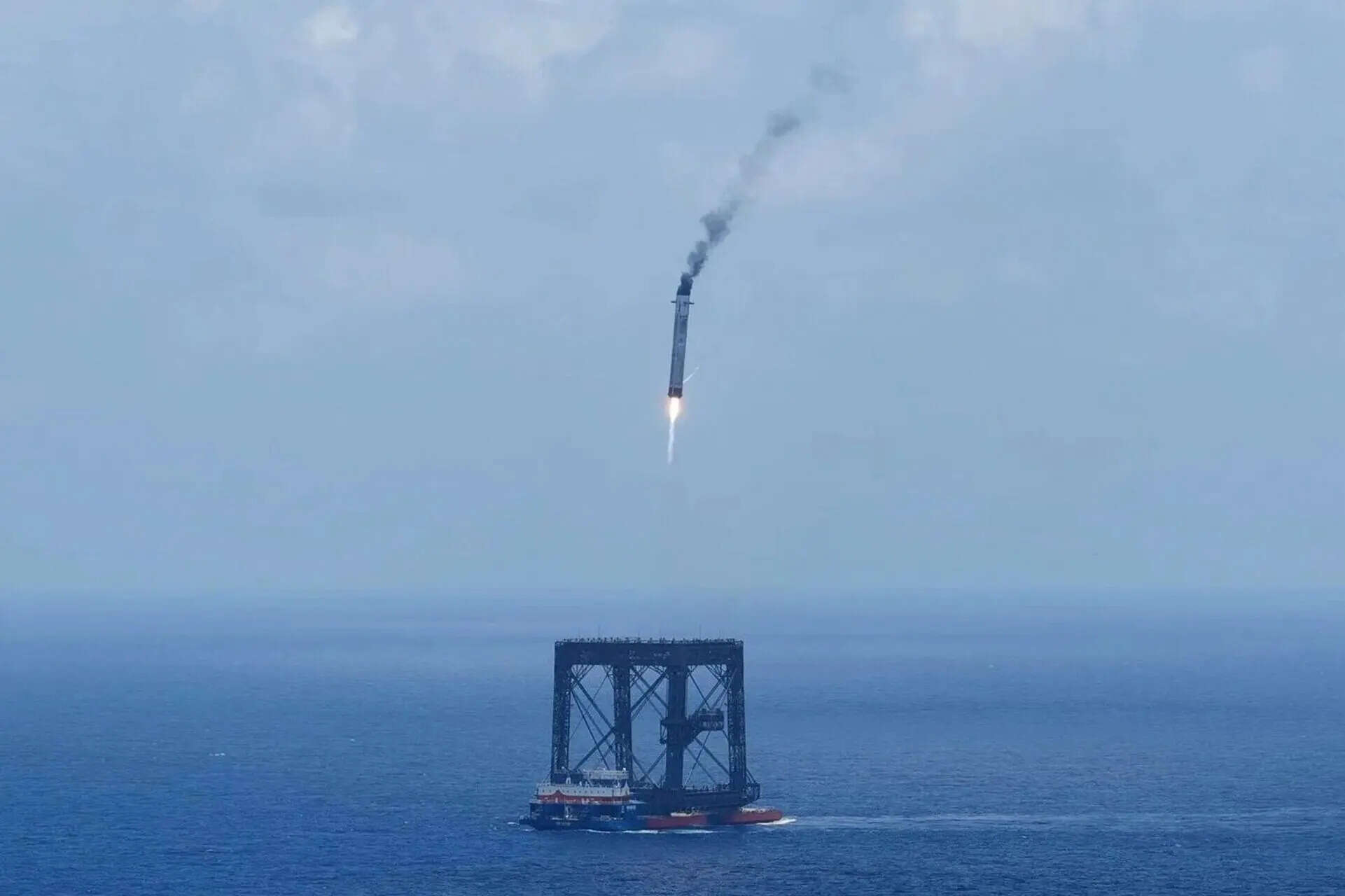
China demonstrated the technology by recovering the first-stage booster of its Long March-10B after a vertical powered descent — carried out off the coast of Hainan. Quoting the China Manned Space Agency (CMSA), Chinese state media said the stage is expected to fly again later this year, marking the country’s most advanced demonstration of reusable launch technology so far.
The achievement narrows, though does not eliminate, the gap with global leaders. SpaceX remains the benchmark, having routinely recovered and reflown Falcon-9 boosters for nearly a decade, fundamentally changing launch economics.
Blue Origin is also working on a reusable first stage of its heavy-lift New Glenn rocket. China’s latest success shows that reusable orbital launch systems are no longer confined to the US and are becoming an essential capability for major space powers pursuing ambitious commercial and lunar programmes.
Still in design
For India, the development provides a useful marker of where its own reusable launch ambitions stand. While Isro chairman V Narayanan did not respond to queries from TOI, analysis of the latest information from the space agency shows that the development of NGLV, described as a “partially reusable, human rated & commercially viable” launcher “has been initiated”.
The three-stage vehicle is being designed to carry up to 30 tonnes to low-Earth orbit, with two variants planned, with and without solid strap-on boosters. As per Isro, the first stage will be “configured for recovery through vertical landing and reusability”, placing it broadly in line with the recovery approach pioneered by Falcon-9 and now being pursued by China. The NGLV programme has moved beyond the conceptual stage, but hasn’t fully entered the final design and testing stage.
“...Overall vehicle specifications have been released, stage configurations finalised, mission requirements and trajectory design completed, wind tunnel models designed, preliminary 3D models generated and preliminary design of the LOX-methane “LME-1100” engine completed,” as per Isro. It has also issued an expression of interest (EoI) for industry to manufacture the methane engines, while avionics design reviews and infrastructure planning are progressing.
RLV-TD demo
Earlier, India’s Reusable Launch Vehicle-Technology Demonstrator (RLV-TD) proved autonomous runway landing technologies using a winged test vehicle, but NGLV will mark the country’s first attempt at recovering a rocket stage through vertical landing.
The race matters because the first stage is the costliest part of a launch vehicle. Recovering and reusing it can substantially reduce launch costs, increase launch frequency and support everything from commercial satellite constellations to human spaceflight and lunar exploration. What SpaceX demonstrated could become economically viable, other major space programmes are now seeking to replicate.
China’s achievement shows how quickly reusable launch systems are becoming the norm rather than the exception, and India is committed to that future through NGLV. The challenge now is converting years of design, testing and subsystem development into an operational reusable launcher capable of competing in an increasingly cost-conscious global launch market.