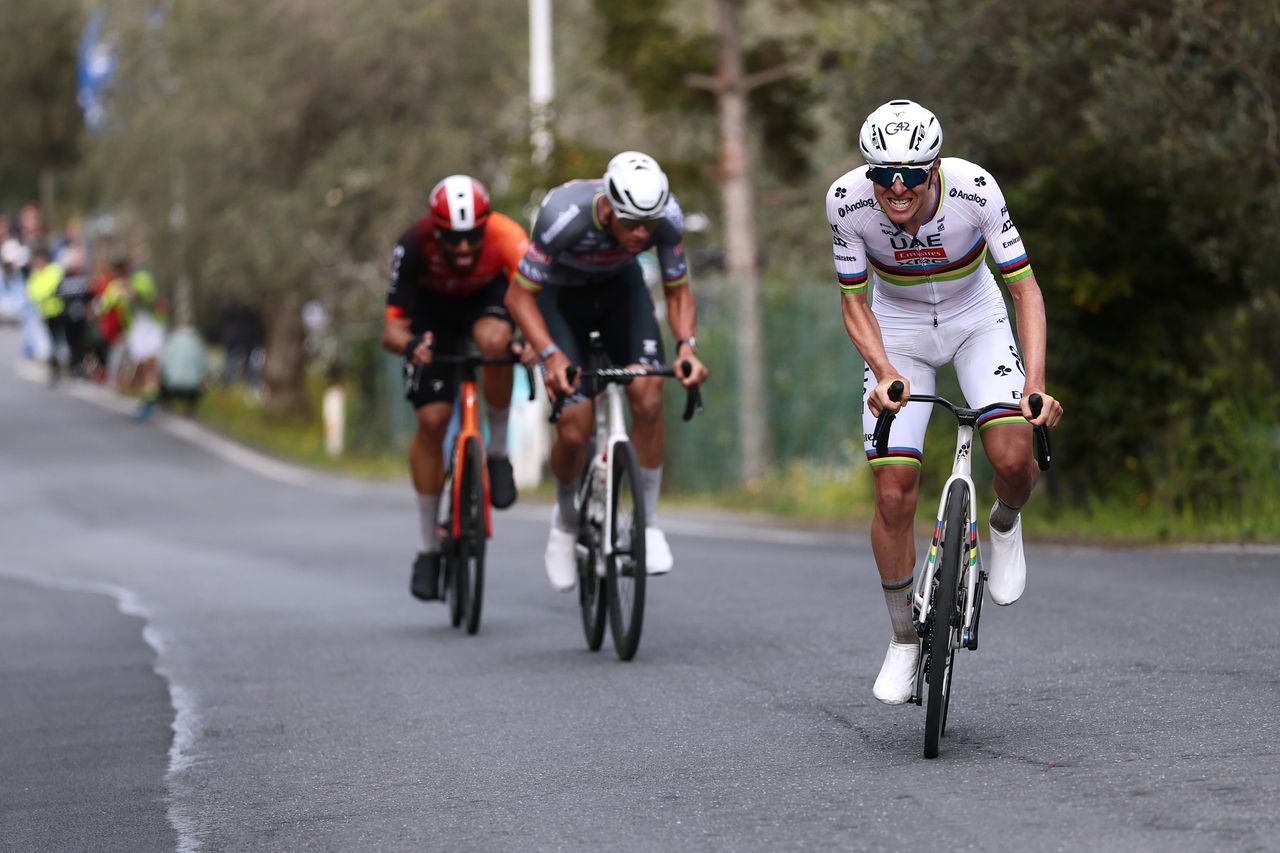
Milan-San Remo has remained a vital ambition of Tadej Pogačar's, likely ever since he realised he could, in theory, win it ahead of the Classics specialists and sprinters if everything were to go perfectly across the 300km of racing.
The nature of the route, which comes fully to life in the final 30km on the Cipressa (5.6km at 4.1%) and Poggio (3.7km at 3.1%) climbs, and really lacks elevation gain for much of the opening 240km outside of the Passo del Turchino, has always made it a challenge for the four-time Tour de France winner to make a difference.

He's attacked both climbs with full commitment in the past four years, but has never been able to get away solo on either. That's even with his team blowing the race to pieces on the Cipressa last season and leaving just him, Mathieu van der Poel and Filippo Ganna ahead before the Poggio in unprecedented fashion.
Will 2026 finally be his year? Even Van der Poel has said it's "only a matter of time" before the world champion adds his name to the list of champions in San Remo, but the build-up to Saturday's race has ignited ample discussion over just how he will be able to do it.
Eddy Merckx has told him to use the Poggio, a forecast headwind is making another Cipressa assault look less likely to stay away, and it does still seem as though perfection will be the only way he conquers "the hardest Monument to win."
Taking a look back through Pogačar's latest four previous appearances at Milan-San Remo – without his 2020 debut, which ended in 12th in a chasing group sprint – it's important to note where UAE missed the mark and how they can try to right those minor mistakes in this latest attempt.
Pogačar's failed attempts at Milan-San Remo
2022

Pogačar arrived at Milan-San Remo 2022 off the back of his best season yet, having successfully defended his Tour de France crown and won his first two Monuments at Il Lombardia and Liège-Bastogne-Liège in 2021.
Ready to take on the race, it was indeed his UAE team who would try to move it away from the 'sprinter's Monument', and that started, of course, at the Cipressa.
They didn't lead into the base of the iconic ascent, which became a common trend in subsequent years, with Bahrain-Victorious and then Jumbo-Visma taking over for Matej Mohorič and Wout van Aert, respectively.
Jan Polanc moved to the front and started to up the pace for Pogačar, but it was an infernal tempo set by Davide Formolo that really started to rip things up. It was described on commentary as "the most selective ascent in years" by Rob Hatch, but none of his main rivals were really put into difficulty yet.
Formolo split things and ruined a lot of sprinters' days, but it wasn't a full lead-out, just a stinging of the legs by UAE.
As they approached the Poggio, Visma took over the lead through Christophe Laporte and Van Aert, and Pogačar had to be moved up by Diego Ulissi before mounting his first attack of the final climb.
8.2km to go is when he went, and he made four big bursts in total to try and get away, but former winner Van Aert was always in his wheel to neutralise him. Eventually, he did enter the descent in second, but with Søren Kragh Andersen in front and Van der Poel and Van Aert on his wheel.
As Mohorič caught and passed the leaders, starting his death-defying bid for glory on the descent, Pogačar could not match the risks of his compatriot and had to settle for fifth in the small group sprint behind. He'd shown his intent, but neither he nor UAE had the firepower to explode away on such short climbs, for now.
2023

He returned a year later for more, but again, the Cipressa didn't start perfectly for UAE as Ineos Grenadiers held control at the base. Six hundred metres in and with 26.5km to go, however, UAE had moved up with four riders left to support the Slovenian: Ulissi, Tim Wellens, Matteo Trentin and Felix Großschartner.
They paced hard on the front in a line, but it wasn't the all-out assault we came to see last season, with the pressure only really doing for the pure sprinters and not putting too much pressure on their main rivals.
Ineos Grenadiers ended up taking over for the descent, and it was Bahrain Victorious who overtook them at the bottom of the Poggio to lead out the final ascent. Again, this meant that 1.2km of the climb were taken on without UAE putting on the pressure, and it wasn't until 8km to go that Formolo's replacement for the day, Wellens, moved to the front for Pogačar.
When Pogačar attacked with 6.6km to go, it was the usual suspects following him, Kragh Andersen on his wheel and Ganna, Van Aert and Van der Poel quickly getting into action as well. The Dane dropped after doing his job for the latter, and eventually, the four riders were clear, leading to the iconic images of them, but not the image Pogačar would have wanted.
Having failed to get away again on the Poggio, Pogačar's race was as good as run, and with 5.5km to go, a massive Van der Poel counter-attack left him and the other three unable to respond. The Dutchman would descend brilliantly and ride solo to the finish, with the race's primary animator, Pogačar, improving his best result in fourth, but without what he came for.
2024

A third year in a row of trying to tame the beast that is Milan-San Remo saw UAE again really try to tear things up on the Cipressa, but after being in the perfect spot with 33km to go, their positioning fell to pieces in the next 6km of the approach.
EF Education-EasyPost and Ineos led the bunch onto the climb, and though Pogačar was eventually brought to the front, he only had Alessandro Covi for company initially, who began to wind up the pace.
Help wasn't too far away in the form of Isaac del Toro and Wellens, but they had to waste key energy moving up through the wheels, which could have been saved if they were positioned better.
Once the young Del Toro hit the front, his effort was long, but ran out of punch quickly, and the bunch swelled on the front as he faded, perhaps paying for his efforts to move up and then having to pace. Wellens took over at 23.5km to go, but he was the only teammate left.
Pogačar did get him to briefly up the tempo, but it became clear he would need him for the Poggio, and once the descent was completed, Tudor and Ineos had moved into the front positions for the likes of Trentin and Ganna.
Wellens didn't see the front again until a kilometre of the Poggio had been raced, launching a full lead-out for Pogačar to try and attack away once more. Once more, 6.6km to go was where he went, but Van der Poel had already hitched himself onto the back wheel and responded well.
He stopped his surge when everyone was still in play behind, which prompted a brief move from former winner Jasper Stuyven, and this provided the perfect moment for Pogačar to counter, launching up the inside with Van der Poel sat around seventh wheel in the group.
To this day, it's as much separation as he's ever managed to eke out on the Poggio, but behind him was an in-form Van der Poel who wasn't going to watch the race go up the road. An incredible effort saw him blast across and all but completely catch the Slovenian before he rounded the final corner and onto the descent.
With the favourites cancelling each other out, a bigger group returned at the base, and a sprint was likely. Others like Mohorič and Tom Pidcock tried to attack away, but Van der Poel chased them all, knowing his sprinter, Jasper Philipsen, had made it over in the group.
Once they opened up, Pogačar chanced his luck in the finale, but was unable to come over the top of his two close friends, Philipsen and Michael Matthews. He'd almost done it this time, but again Van der Poel was the thorn in his side, even without winning it himself in the end.
2025

Last year will long stand out as one of the most unique editions in history, with UAE getting the Cipressa lead-out as close to perfect as they have yet, but again, they didn't lead onto the base of it in first.
EF and Ineos had that position locked off, with Alpecin and Van der Poel brilliantly placed too. A crash at the base also rippled through the peloton, so not everyone was in team order.
UAE did take over through Wellens with 26.9km to go, but Pogačar was hardly in view around 20 wheels behind his Belgian teammate.
He was moved up by a new colleague, Narváez, but with one cog in the well-oiled machine missing – Del Toro. He was not in position and left the Ecuadorian with two jobs to do: move up his leader and then do the final lead-out.
Once Wellens pulled off, there was no direct transition into Narváez as they still had around four riders to come past. As they hit the front with 3.8km of the climb left to complete, his all-out pull lasted 1:30, and Pogačar launched just after the right-hand hairpin with 24.6km to go.
Ganna was closest, but Van der sensed the danger of an unprecedented solo win and moved onto his rival's wheel. He attacked again 1.5 km from the top, which did distance the Italian, but still didn't do for the Dutchman.
He and UAE had done something unseen at San Remo and blown the race to pieces on the Cipressa as they had been threatening to do for years, but he wasn't alone as they might have hoped – once more, he would have to try on the Poggio.
Attacking at the base of the 3.7km ascent got rid of Ganna, but Van der Poel was ever-present, latching onto all the subsequent moves he tried approaching the top, and even countering him with 600 metres to go.
The three came back together in the final kilometre after the descent, but Pogačar was always going to be the underdog in the sprint, and Van der Poel's savvy racecraft, even under massive fatigue, saw him surge away in the sprint with an early, surprise kick.
The Slovenian would finish third for the second year running, but he was close to an historic solo move, and would know there could have been more room to drop Van der Poel on Cipressa had their positioning been perfect and Del Toro not missed his mark.
How they utilise their team to win it in 2026
Wellens and Narváez are the key missing pieces from the 2026 startlist for UAE, but they are still fielding a very strong team to try and finally bring Pogačar one of the two one-day wins he wants most, alongside Paris-Roubaix.
Isaac del Toro is the most luxurious domestique of all, as a top-five favourite for the race in his own right. If UAE follow a similar blueprint to last year, his job is almost certainly to be that final lead-out on the Cipressa which Pogačar will attack off the back of.
Predicted headwinds in the run for home make a Cipressa solo move even less likely to stick than it already is, so Del Toro's talents could well be saved for the Poggio. In any case, he should be the world champion's right-hand man.
There's also a world in which he and Pogačar roll attacks on the Poggio to try and sting the legs of Van der Poel and company, before one of the pair attacks away. He's much more experienced and stronger than in his previous two experiences, so big things should be expected of the Mexican on Saturday.
After his stunning burst at Strade Bianche, a lot will be expected of Jan Christen and his punch, and he should be the second-last rider in the train in front of Del Toro. A full pace lead-out from Christen could really hurt the bunch before Del Toro does more damage, but he has raced an awful lot already in 2026, so he may be missing a gear or two.
If the Swiss rider isn't on his best day, either Brandon McNulty or Felix Großschartner could fill in, with the American still an underrated one-day racer, and the Austrian being able to really light up a climb on his day.
McNulty has never raced San Remo before, and the Austrian has only been there twice in 2020 and 2023, which is to their disadvantage, but Pogačar does make their work simpler, knowing that it will all be about positioning him and upping the pace when he calls for it, be that on Cipressa or Poggio.
Florian Vermeersch should be on positioning duty as Matteo Trentin would have been in previous years. Whether UAE want to use the Cipressa or the Poggio to launch, he should be in front of Pogačar at the key moments, as the most likely to get him to the base of either climb in a prime position.
His climbing may not be good enough to really lead things out as a Wellens would have, but he could prove vital for his leader in the fight for wheels.
Trusted Slovenian Domen Novak will likely do a lot of the early work on the 300km day, but he has played a critical role in Monument successes for his compatriot over the years, notably at Liège-Bastogne-Liège, so don't be surprised if he ends up as the third or second last man in the climbing train.
It's not UAE's first-string Classics team by any means, but there is enough there to feasibly get Pogačar ahead, who, more importantly, is seemingly getting stronger than ever each and every time he races.
He's got those previous failed attempts to draw from as experience, so he knows well where this race has gone wrong in the past – is 2026 finally the year he gets ahead on either climb without a Van der Poel with him? Seven hours and 300km on Saturday will reveal all.
Get unlimited access to our unrivalled 2026 Spring Classics coverage with a Cyclingnews subscription. We'll bring you breaking news, reports, and analysis from some of the biggest races on the calendar, including Milan-San Remo, Paris-Roubaix and the Tour of Flanders. Find out more.