
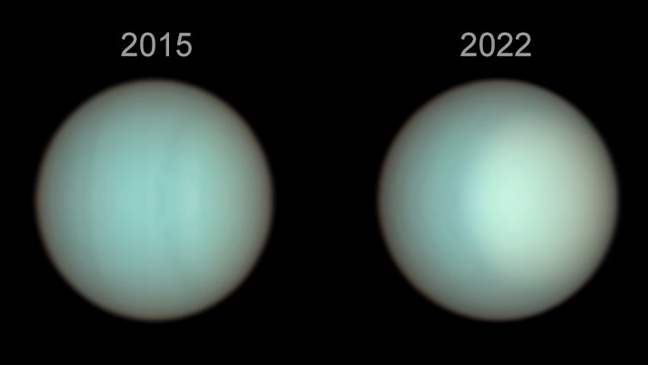
An analysis of two decades of data from NASA's Hubble Space Telescope has provided fresh insights into the complex atmospheric changes on Uranus that are largely driven by the effects of the sun's radiation.
Uranus, the seventh planet from the sun, is unique for its extreme axial tilt, with its equator and orbit making nearly at a right angle — likely the result of a collision with an Earth-size object long ago. This tilt causes the planet's poles to experience prolonged, dark winters and bright summers, leading to dramatic seasonal shifts, especially at the northern and southern poles. Despite these extreme traits, however, Uranus remains one of the least understood planets in our solar system, largely because it was only visited by a single spacecraft nearly 40 years ago, Voyager 2 — and that sole encounter coincided with an exceptional solar event, further complicating our understanding of the distant ice giant.