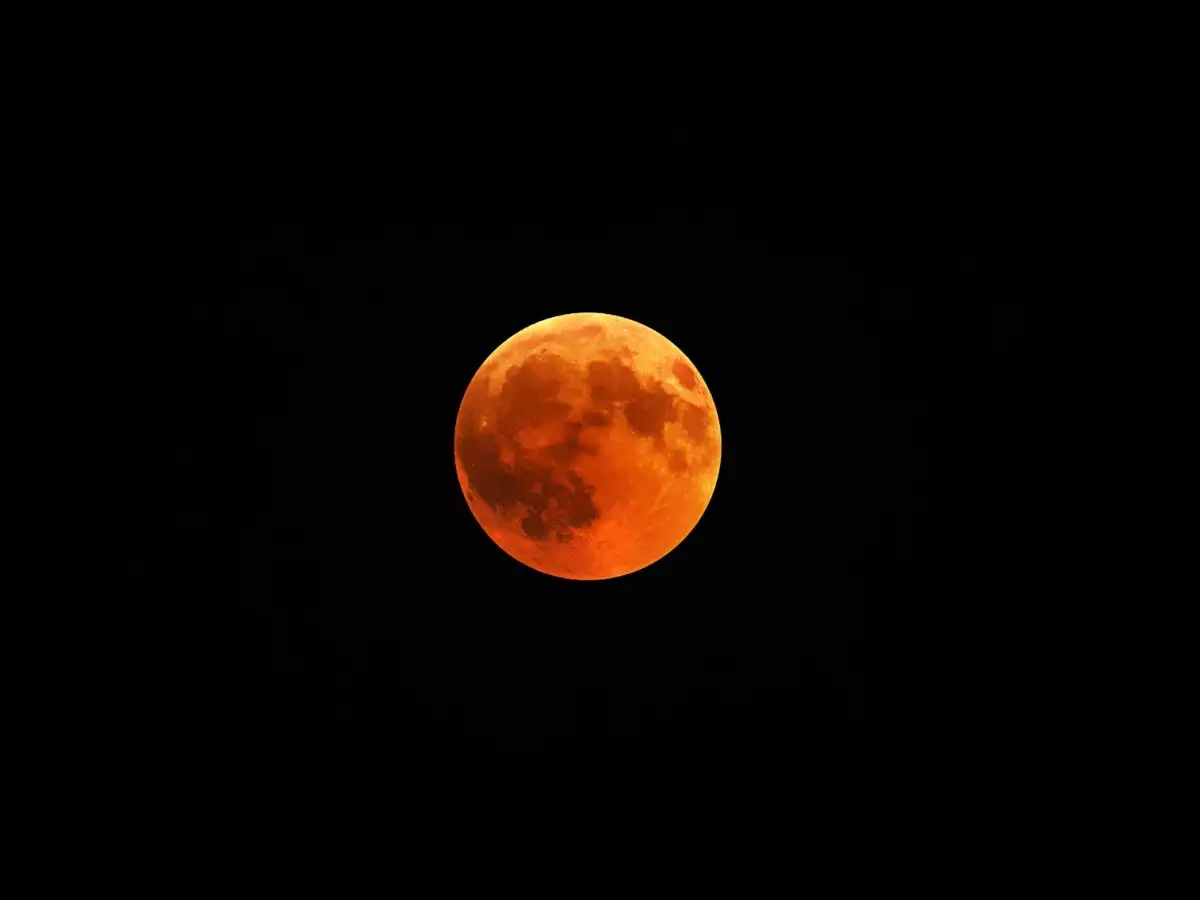
The Lunar Eclipse 2026, or Chandra Grahan, will occur on Friday, August 28. At the peak of the eclipse, the Moon will move through most of the Earth's central dark shadow, resulting in a deep partial lunar eclipse. However, there is an important point for Indian skywatchers, the eclipse will not be visible from India.
The eclipse will take place across August 27 and August 28, depending on the local time zone. When the astronomical phases are converted to Indian Standard Time (IST), the event will occur during the morning of August 28.

Lunar Eclipse 2026 Date and Time in India
According to the astronomical timings in IST, the different stages of the lunar eclipse will occur at the following times:
Penumbral eclipse begins: 6:55 AM
Partial eclipse begins: 8:04 AM
Maximum Chandra Grahan: 9:43 AM
Partial eclipse ends: 11:21 AM
Penumbral eclipse ends: 12:30 PM
The entire penumbral phase will last approximately 5 hours and 35 minutes, while the darker partial phase will continue for around 3 hours and 16 minutes.
Will Chandra Grahan 2026 Be Visible in India?
No, the Lunar Eclipse 2026 will not be visible from India. Panchang calculations for New Delhi, Bengaluru and several other Indian cities do not show any visible umbral or penumbral phase of the eclipse.
The main visibility zone will cover large parts of the Americas, Europe, Africa and western Asia.
Sutak Kaal will not be applicable in India for the August 28 Chandra Grahan, according to the traditional Hindu visibility rule. Traditionally, eclipse-related religious restrictions are followed when the lunar eclipse is visible at a particular location. Since this eclipse will not be visible from India, the Sutak period is not observed there. According to the New Delhi calculation, the start and end of Sutak are “Not Applicable”.