Get all your news in one place.
100's of premium titles.
One app.
Start reading
The Economic Times
The Economic Times
Trending Desk

Chandra Grahan 2026 in India date and time: Check August 28 Sutak time, where it will be visivle on Raksha Bandhan and do’s and don’ts

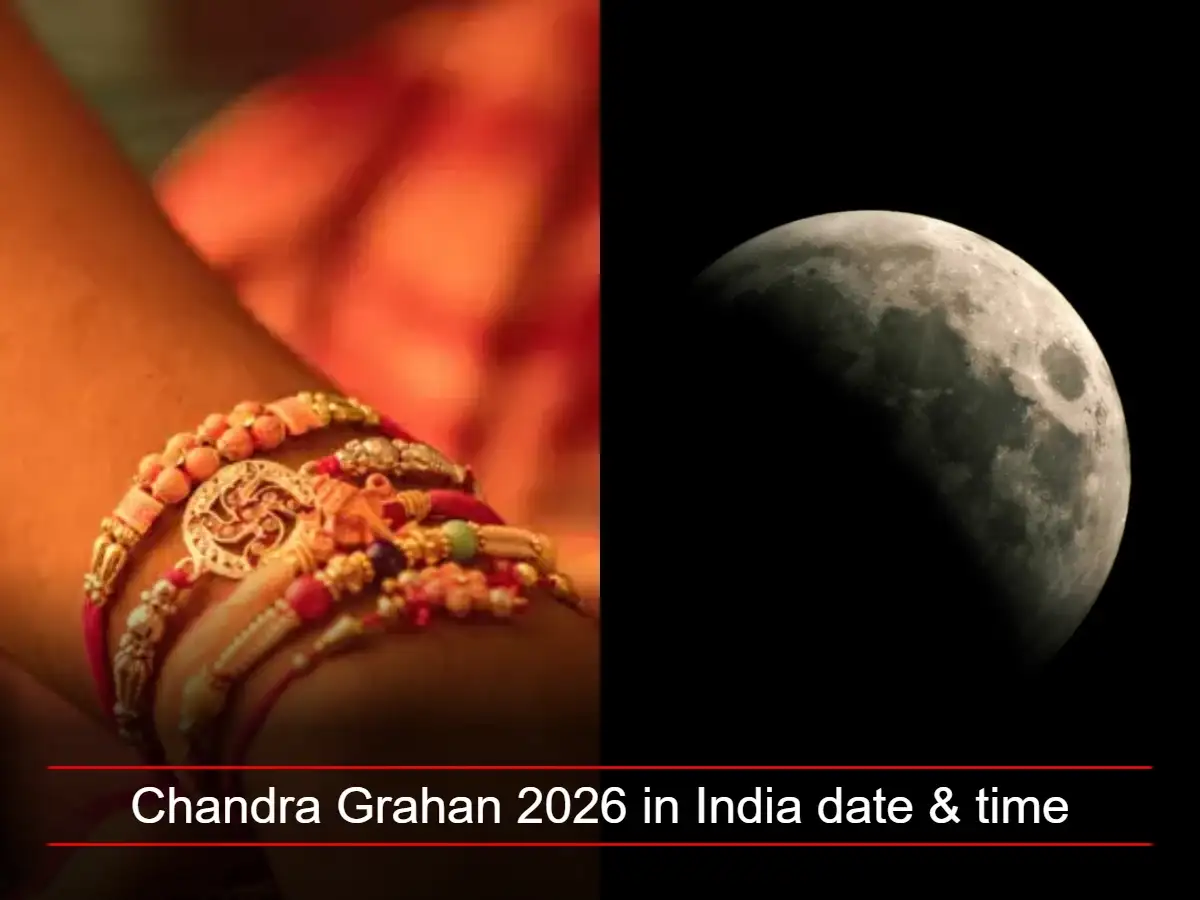
The last lunar eclipse of 2026 will take place on August 28, but people in India will not be able to see it. The event will be a deep partial lunar eclipse, with nearly 93–96 per cent of the Moon entering Earth’s darkest shadow at its peak. However, the eclipse will occur while the Moon is below the horizon in India.

The eclipse is also falling on Raksha Bandhan this year, making August 28 particularly significant for people following Hindu traditions. But there is an important point to remember: because the eclipse is not visible from India, the usual Sutak Kaal associated with a visible lunar eclipse does not apply here, according to the traditional visibility-based practice.
Also Read: Raksha Bandhan 2026 Date and Time: Is Rakhi on August 27 or 28? Check tying shubh muhurat and bhadra timings

Chandra Grahan 2026 date in India

The lunar eclipse will take place on Friday, August 28, 2026. Astronomically, it is a partial lunar eclipse, not a total eclipse. At maximum eclipse, a very large portion of the Moon will be inside Earth's umbral shadow. NASA has listed the deep partial lunar eclipse among the major skywatching events for August 2026.

Although the date is August 28 in India, much of the eclipse will be visible from other parts of the world during their local night.

Chandra Grahan 2026 time in India

The eclipse timings, converted to Indian Standard Time, are:

  • Penumbral eclipse begins: around 6:54 AM
  • Partial eclipse begins: around 8:04 AM
  • Maximum eclipse: around 9:43 AM
  • Partial eclipse ends: around 11:22 AM
  • Penumbral eclipse ends: around 12:32 PM

These are the astronomical timings in IST. They do not mean that people in India will be able to watch the eclipse at these times. The Moon will already have set before the eclipse begins in India.

Will August 28 Chandra Grahan be visible in India?

No. The August 28, 2026 lunar eclipse will not be visible from India.

This is because the eclipse takes place during daytime hours in India, when the Moon is below the horizon. Cities including Delhi, Mumbai, Kolkata, Chennai and Bengaluru will not get a direct view of the eclipse.

The eclipse will instead be visible across large parts of North America, Central America and South America, while parts of Europe and Africa will also get views depending on their location and local timing.

For skywatchers in India, online livestreams will therefore be the practical way to follow the event.

Is there Sutak Kaal on August 28?

This is likely to be one of the biggest questions around the eclipse because it coincides with Raksha Bandhan.

In traditional Hindu practice, Sutak is generally observed when an eclipse is visible at a particular location. Since the August 28 lunar eclipse will not be visible from India, the traditional visibility-based calculation means Sutak Kaal will not apply in India.

Therefore, there is no need to treat the astronomical eclipse timings in IST as a Sutak period in India.

Different religious traditions and Panchangs can follow their own rules, so people who follow a particular family or regional tradition may choose to consult their local Panchang.

Chandra Grahan and Raksha Bandhan 2026

The eclipse is coinciding with Raksha Bandhan on August 28. The coincidence has created confusion over whether the eclipse will affect Rakhi celebrations. Since the eclipse is not visible in India, reports based on traditional visibility rules say that it will not create a Sutak restriction for celebrations in the country.

However, Raksha Bandhan timings can also depend on factors such as Bhadra and the local Panchang. These calculations are separate from whether the lunar eclipse itself can be seen from India.

Chandra Grahan 2026 do’s and don’ts

There are two different things to keep in mind here: astronomical facts and religious traditions. From a scientific point of view, a lunar eclipse does not require people to stop eating, cooking, sleeping or carrying out normal activities. A lunar eclipse is simply the result of Earth coming between the Sun and Moon and casting its shadow on the lunar surface.

Also Read: Milad un Nabi 2026 date in India: Check if school, college, bank, office holiday is in your state

Some Hindu traditions, however, prescribe certain practices during an eclipse or Sutak. These can include:

Traditional practices followed by some families

  • Taking a bath before or after the eclipse.
  • Chanting mantras or praying during the eclipse.
  • Donating food, clothes or other items after the eclipse.
  • Cleaning the home after the eclipse.
  • Observing fasting according to one's religious tradition.
  • Avoiding certain religious activities during Sutak, depending on local customs.

These are religious and cultural practices, not scientific requirements .

Why will the Moon turn reddish?

During a deep lunar eclipse, the Moon can take on a reddish or coppery appearance. This happens because sunlight passing through Earth's atmosphere is scattered and refracted towards the Moon. The atmosphere filters much of the shorter blue light while allowing more red and orange light to reach the lunar surface.

That is why deeply eclipsed parts of the Moon can sometimes resemble a “Blood Moon” , even though the August 2026 event remains a partial lunar eclipse rather than a total one.

Chandra Grahan 2026

Date: August 28, 2026

Day: Friday

Type: Deep partial lunar eclipse

Maximum eclipse: Around 9:43 AM IST

Eclipse ends: Around 12:32 PM IST

Visible in India: No

Sutak in India: Not applicable under the traditional visibility-based rule

Raksha Bandhan: August 28, 2026

So, while August 28 will bring a striking lunar eclipse to millions of people across the world, observers in India will have to rely on online coverage. For those celebrating Raksha Bandhan, the eclipse's lack of visibility in India also means there is no eclipse-related Sutak window to disrupt the festival under the traditional rule followed in many Indian calendars.

Sign up to read this article
Read news from 100's of titles, curated specifically for you.
Already a member? Sign in here
Related Stories
Top stories on inkl right now
One subscription that gives you access to news from hundreds of sites
Already a member? Sign in here
Our Picks
Fourteen days free
Download the app
One app. One membership.
100+ trusted global sources.