
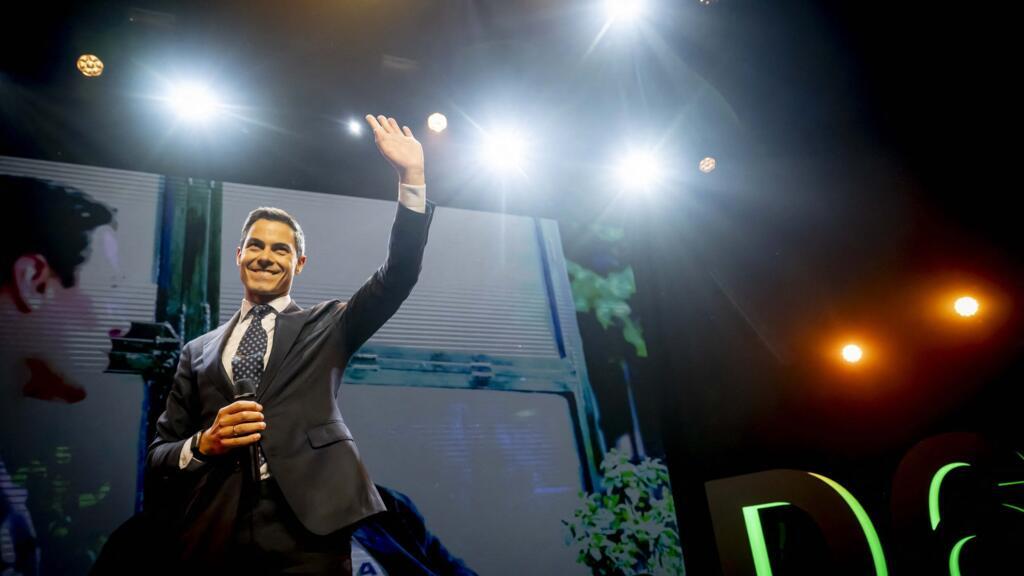
The centrist Democrats 66 (D66) have taken a slim lead in the Dutch parliamentary election, according to exit polls, narrowly ahead of the far-right Party for Freedom (PVV) in a tightly contested race that could reshape the country’s political landscape.
The current tally shows a 1700-vote gap between the centrist liberal D66 and the far-right PVV, with each party looking likely to win 26 seats in a close fight.

Having processed 98.6% of the vote, projections indicate that both the centrist liberal D66 and the far-right PVV will be the major winners. However, in the current scenario the PVV will be down from 37 seats, while D66 will gain 17.
By 5 o'clock in the morning, the margin between the parties stood at just over 2,000 votes.
This represents a substantial shift from the previous evening. An Ipsos I&O poll published shortly after voting ended on Wednesday night had projected D66 to win 27 seats, with Geert Wilders' PVV close behind on 25 and the liberal-conservative People's Party for Freedom and Democracy (VVD) on 23.
The left-green alliance GL-PvdA is forecast to secure 20 seats and the Christian Democrats (CDA) 19, which would be a considerable gain.

'Great day for democracy'
In a polling station in Rijswijk, a suburb of The Hague, Sven van den Berg led his team of volunteers in counting the votes after the polls closed at 21:00.
In total, he said around 850 people turned up to vote during the day, which was a little bit more than last time. “It was a great day for democracy,” one of the vote counters told RFI.

Meanwhile, at a jubilant gathering in Leiden, D66 leader Rob Jetten told supporters that the early figures showed “a vote of confidence in openness, in Dutch democracy, and in the future of Europe.”
Jetten, 38, has campaigned on a pro‑EU and progressive ticket, promising a coalition that would “restore pragmatism and stability” to Dutch politics.

Dutch voters cast ballots amid discontent over politics and stalled promises
All four parties in the governing coalition – the PVV, VVD, New Social Contract (NSC) and Farmer-Citizen Movement (BBB) – are projected to lose ground. Wilders reacted on X. “The electorate has spoken. We remain the second and perhaps even the largest party in the Netherlands," he wrote.
Among the smaller parties, JA21 is expected to move from one seat to nine, while Thierry Baudet’s Forum for Democracy (FVD) is expected to go from three to six seats. BBB was projected to fall back to four from seven, and the Socialist Party (SP) slipped to three from five. NSC, which entered parliament in 2023 with 20 seats, is now projected to lose all representation.
Other minor movements include the return of the pensioners’ party 50Plus with two seats, and small shifts affecting Christian Union (CU) at two, Volt at one, and Denk, the Party for the Animals (PvdD) and the orthodox SGP all holding steady on three.

According to Ipsos I&O, about 80,000 voters took part in the nationwide “shadow election” at 65 polling stations, completing anonymised replicas of the real ballot. The firm emphasised that the exit poll serves only as an indication: in exceptional circumstances, the final tally could differ by as many as three seats.
Turnout was estimated at 76.3 percent, slightly down from 77.7 percent in 2023. Early official results were expected overnight, with smaller municipalities reporting first.
For much of Europe, the Dutch result is being watched as a barometer of the far right’s resilience after recent electoral surges in Italy, France and Austria. Whether Jetten’s centrist revival can hold when full counts arrive remains uncertain, but for the first time in years, the political tide in The Hague may be moving against Wilders.







