Get all your news in one place.
100's of premium titles.
One app.
Start reading
The Conversation
The Conversation
Andrew Feinberg, Professor of Biomedical Engineering, Johns Hopkins University

Cancer evolution is mathematical – how random processes and epigenetics can explain why tumor cells shape-shift, metastasize and resist treatments

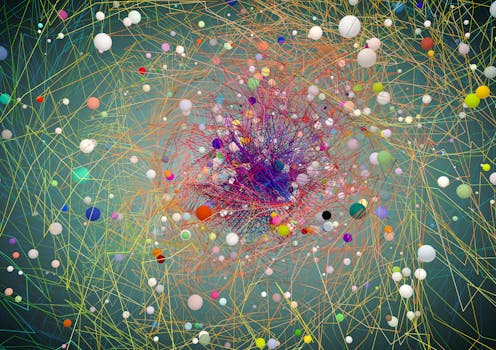
Stochasticity is everywhere -- and finding the order in disorder can unlock new ways to understand biology. Erlon Silva - TRI Digital/Moment via Getty Images

Cancer is often seen as a disease that arises from genetic mutations causing cells to divide uncontrollably and invade other parts of the body. But the spread of cells away from their origins is actually a normal process in some cases. The embryo burrows into the uterus during early pregnancy. Immune cells spread from lymph nodes to sites of infection to attack the invading bacteria. And germ cells migrate to where the gonad will be during early human development.

Cancer is not a uniform disease. Rather, cancer is a disease of phenotypic plasticity, meaning tumor cells can change from one form or function to another. This includes reverting to less mature states and losing their normal function, which can result in treatment resistance, or changing their cell type altogether, which facilitates metastasis.
Sign up to read this article
Read news from 100's of titles, curated specifically for you.
Already a member? Sign in here
Related Stories
Top stories on inkl right now
One subscription that gives you access to news from hundreds of sites
Already a member? Sign in here
Our Picks
Fourteen days free
Download the app
One app. One membership.
100+ trusted global sources.