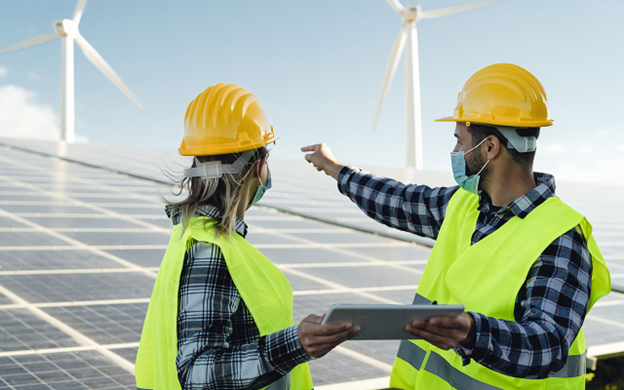
Canada’s economic transition is producing something more tangible than climate rhetoric. Across the Prairies, Ontario, and the country’s fast-growing digital infrastructure sector, renewable energy, battery manufacturing, grid modernization, and AI-linked construction are creating jobs tied to real projects, real facilities, and real local demand.
The shift is not abstract for workers deciding where to build a career or for communities trying to attract long-term investment. It shows up in trade, engineering, operations, software, construction, and maintenance. The strongest signal is not a headline about anxiety. It is a growing list of projects that need people to design, build, connect, operate, and improve them.
Prairie Projects Are Turning Clean Energy Into Local Work
The Prairies are often discussed as a proving ground for Canada’s energy future, but the more immediate story is employment. In Alberta alone, PrairiesCan said in March 2025 that more than $8.3 million was being invested across 13 projects expected to support about 240 jobs, with the goal of helping businesses and communities capitalize on clean technology growth.
Natural Resources Canada has also backed clean electricity projects in Alberta with more than $175 million across 12 projects, explicitly linking those investments to good jobs tied to producing and storing clean electricity. That turns the clean-energy conversation into work for technicians, project managers, electricians, construction crews, and local suppliers.
Ontario’s Battery Build-Out Is Creating Industrial Jobs With Staying Power
Ontario’s battery push has moved beyond announcements and into operating facilities and active hiring. In March 2026, Ontario marked the grand opening of NextStar Energy’s 4.23 million-square-foot Windsor plant, describing it as Canada’s first commercial-scale advanced battery manufacturing facility and saying it will create up to 2,500 direct jobs.
At the same time, PowerCo Canada’s battery plant in St. Thomas has been recruiting for chemists, information technology professionals, engineers, and sustainability experts, showing how battery manufacturing now spans factory-floor roles and high-skill technical careers. That mix matters because future-proof work is not limited to one credential path or one kind of worker.
Grid Modernization Is Quietly Expanding the Work Behind the Transition
Grid modernization rarely gets the same public attention as a giant factory opening, yet it may be one of the most durable sources of employment in the transition economy. Energy Ontario’s December 2025 report states that grid modernization creates direct economic benefits through jobs in grid development, construction, engineering, and operations, beyond the activity generated by traditional grid build-out.
Ontario’s Independent Electricity System Operator also describes roles on the front line of the province’s energy transition, linking electricity supply planning, contract management, and market expertise to the system that must support electrification.
For many Canadians, the same phone that serves up news about new clean-energy jobs also holds everyday digital pastimes, from streaming apps to the occasional glance at a Canadian online casino overview, just one more regulated entertainment option that sits quietly in the background while the real story is how the economy evolves.
AI Infrastructure Is Adding a New Layer of Construction and Tech Employment
Canada’s AI build-out is creating another category of future-oriented work, especially where data-center infrastructure intersects with power, construction, and advanced computing. In January 2026, the federal government launched a process to support sovereign large-scale AI data centers, with proposals aimed at projects exceeding 100 megawatts. That is a strong signal that Canada expects physical AI infrastructure, not just software ambition.
The federal government also finalized support for Cohere’s $725 million compute project, tied to the development of a new multi-billion-dollar AI data center in Canada. These projects create demand for electricians, cooling and power specialists, civil contractors, network engineers, data-center operators, and software talent working around the facilities themselves.
The Opportunity Is Broader Than One Industry or One Province
What makes this moment more durable than a passing boom is the variety of roles being pulled into it. The Canadian Renewable Energy Association says there is a growing need for skilled workers in wind, solar, energy storage, and related clean technologies, and it now operates Clean Energy Jobs Canada to connect employers with job seekers.
The jobs visible today range from renewable energy analysts and project managers to automation technicians and energy engineers. Battery plants need manufacturing staff and chemists. Grid modernization needs planners and operators. AI infrastructure needs construction crews and digital specialists. That spread reduces the risk that the transition becomes a narrow story benefiting only one region or one kind of worker.
Why This Shift Feels More Grounded Than the Usual Economic Narrative
The hopeful part of Canada’s green-job story is not that every project will move on schedule or that every clean-tech investment will unfold perfectly. It is that the employment base is already becoming more concrete and diversified. Some projects can stall, as shown by Honda Canada’s two-year pause on its planned C$15 billion EV investment, even though no job losses were expected at its current Alliston plant of 4,200 workers.
But that setback sits alongside battery openings, Prairie clean-tech funding, grid work, and a fresh federal push on AI data centers. The bigger pattern is an economy creating practical jobs tied to infrastructure people can see, build, and maintain.