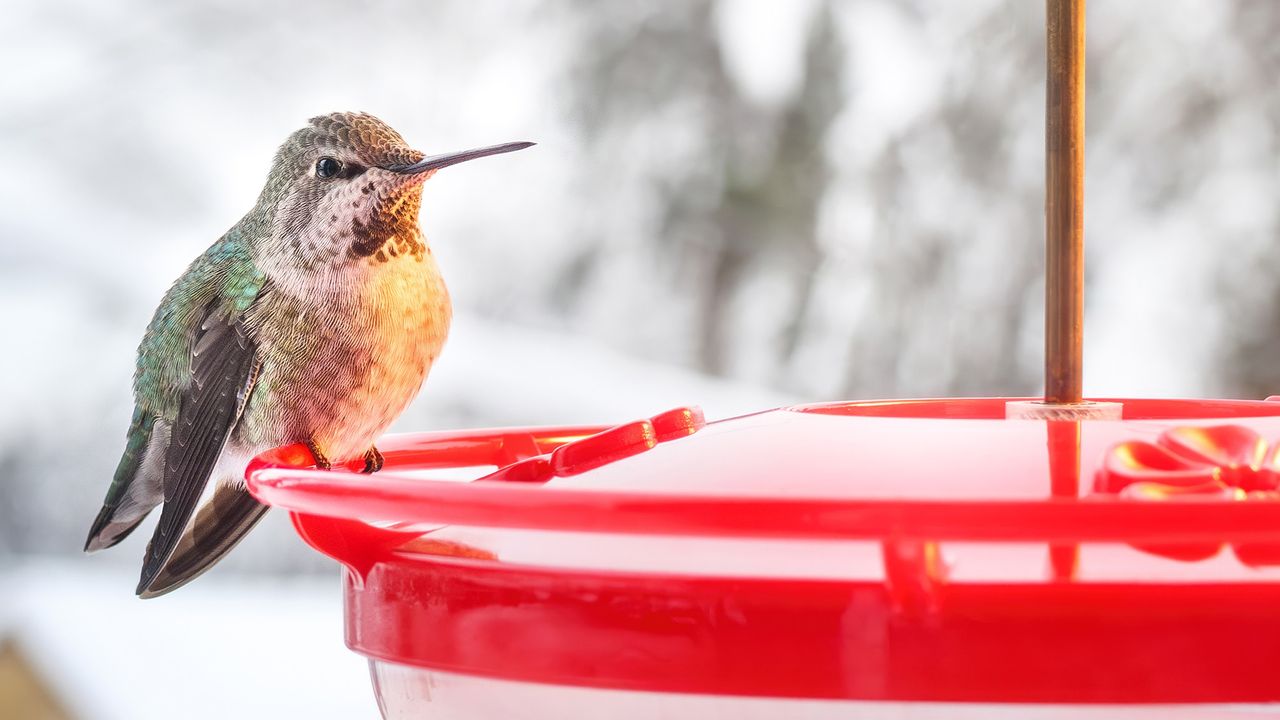
With winter fast approaching, you may be wondering if you can take down your hummingbird feeder. But before you remove the precious hummingbird’s food source, you first need to make sure of one thing.
Hummingbirds are migratory, and they fly south to warmer climes in the cold season; however, while they make their long journey, they’ll appreciate a source of nutrients to boost their energy. So whether you leave your hummingbird feeder out over winter as a food source will depend on where you live.

Keeping your hummingbird feeder out will ensure the delicate birds get all the nutrition they need. “During normal daytime hours, most hummingbirds must feed every 10–15 minutes and cannot safely go more than a few hours without food,” says Crystal Health, a veterinarian and hummingbird enthusiast.
Below, we help you determine if it's safe to store your hummingbird feeder for the winter, or if you should leave it out for your little friends.
Locations where hummingbirds need feeding in winter

West Coast
If you live on the West Coast, including California, Washington, Oregon, and Baja California, Health says you should leave your hummingbird feeder up all year. Anna’s hummingbirds stay in these areas all winter, and she adds that there is also an increasing winter presence of Rufous and Allen’s over the cold period, too.
Southwest
In Arizona, New Mexico, and West Texas, you can expect to see the Anna, Costa and the occasional Black-chinned hummingbird throughout the year.
Gulf Coast
Around Texas, Louisiana, Mississippi and the Florida Panhandle and Peninsula, you will find the Rufous, Black-chinned, Ruby-throated, Calliope and the Broad-tailed hummingbird. Health explains that the Ruby-throated hummingbird is common in Florida, and it is a good reason to leave a feeder up all year.
Non-coastal areas of Southern U.S. states
However, whether you leave a hummingbird feeder up during winter is not so clear-cut if you live in Georgia, South Carolina, Tennessee, Arkansas, or Oklahoma. Health says that some late migrants may still be present in December in some places, so it’s worth keeping an eye out to see if they pay a visit.
If you don’t already have a smart hummingbird feeder, it could be a good time to get one. A smart feeder will allow you to see if the birds have visited even when you’re not around.
Do hummingbirds feed during migration?

Before hummingbirds migrate, they take on a lot of fuel, and according to Health, they double their body weight. “A 3-gram hummingbird could put on 1-2 grams of fat,” she says.
Although that seems like a minuscule amount to us, it’s a significant increase for these tiny creatures. And she adds that apart from the Ruby-throated hummingbird, which does not eat, drink or rest during the long 18-24-hour flight, others will stop to eat along the way.
Will leaving a hummingbird feeder up stop them from migrating?
Food isn’t a motivator to keep hummingbirds where they are, so leaving your feeder up won’t deter them from migrating. Health explains, “The drive to migrate is motivated by day length, hormonal changes, and all food availability in the entire winter.”
When should you take your feeder down during bird migration?
If you’re in an area where hummingbirds migrate to warmer climes, Maria Kincaid, Ornithology Research Specialist at FeatherSnap, says you should take your feeder down 2-4 weeks after your breeding birds have left. “This ensures that you’ve got food available for any birds that are migrating through the area as they move to their wintering habitats.”
Where is the best place for a hummingbird feeder in winter?

“Feeders should be left up anywhere there are hummingbirds present,” says Kincaid, which she adds is usually the Southwestern U.S. and along the Gulf Coast.
Health advises that they are best placed 10-15 feet away from trees or other plants. “This prevents them from being attacked in places where predators like cats can hide,” she says, and recommends placing them high enough so cats can’t reach them, and where other birds nest and might want to defend their territory.
How to keep your hummingbird feeder clean?
“Hummingbird feeder maintenance is incredibly important, no matter what time of year you’ve got your feeder out,” says Kincaid. “Feeders should be cleaned regularly, every 1-2 days in warmer weather, and every 3-4 days when it’s cooler out, or any time the nectar becomes discolored in any way.”
Why should you clean your feeder so regularly? “Hummingbird nectar spoils quickly, and mold or fungus growth in the nectar can be harmful to them.”
And she recommends cleaning your feeder with a mix of water and dishwasher liquid, then rinsing it thoroughly. “If sanitizing with a 10% bleach solution, let it set for 10 minutes and then rinse thoroughly again. Let it dry completely before refilling,” she suggests.
She also recommends using a vinegar solution as an anti-bacterial wash, but it doesn’t sanitize the way that bleach does.
What is the perfect nectar recipe for hummingbirds in winter?

Although you might assume that hummingbirds need a richer nectar source in winter for added energy, it is not the case. Mary Mack Gray, Ornithologist and expert at Birdbuddy says, “The ratio is the same for summer and winter: 1 part sugar to 4 parts water (e.g., 1 cup of sugar with 4 cups of warm water).”
Does it ever get too cold to leave a feeder out?
Leaving a feeder out when temperatures drop to freezing could damage your feeder, says Kincaid. “If you live in an area where you have hummingbirds but also near-freezing temperatures, consider a hummingbird feeder heater, or take in your feeder when temperatures drop below freezing, and put it back out as soon as you can,” she advises.