
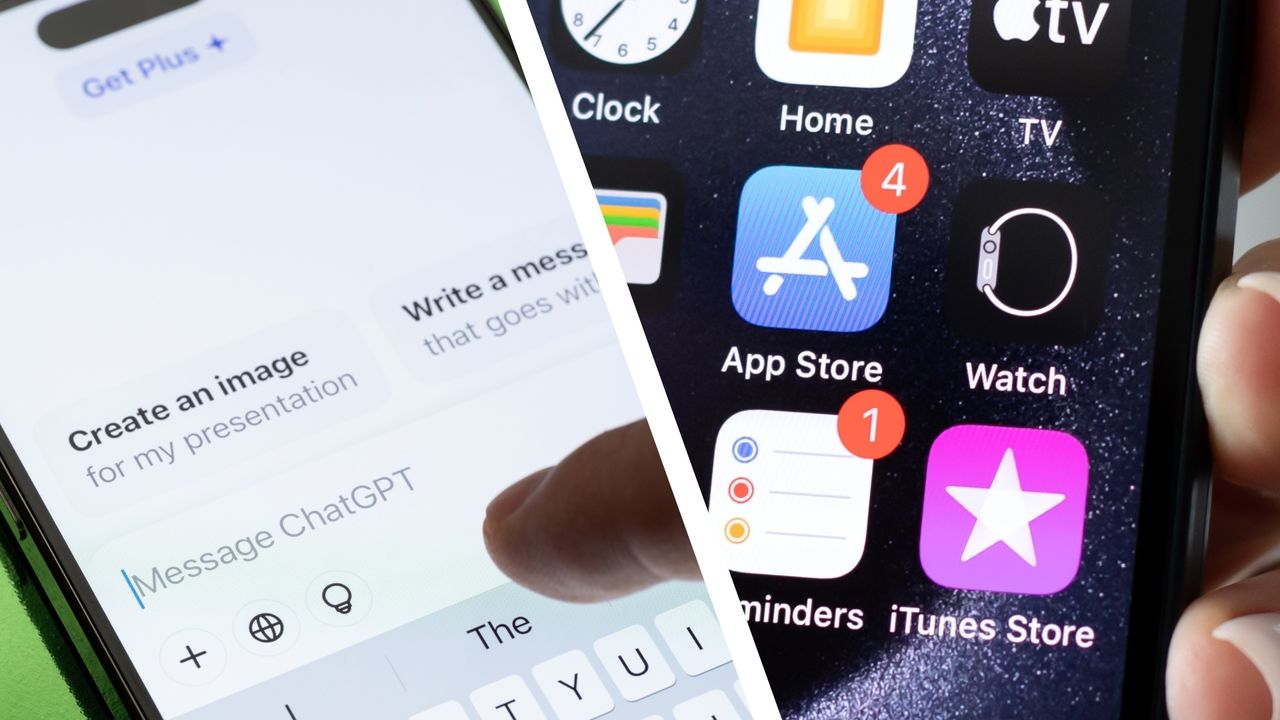
Apple and OpenAI are currently engaged in a legal battle. Apple alleges that OpenAI stole trade secrets and poached employees.
But the two companies have always had a complicated relationship. They partnered in 2024 to bring ChatGPT to Apple devices, but Apple chose Google's Gemini rather than OpenAI for Siri. Then OpenAI acquired io, the hardware startup founded by former Apple design chief Jony Ive, and promised a future hardware device, powered by AI.

All of this has prompted speculation about what Apple is worried about if OpenAI makes hardware, too. We can't know the company's motivations and the specifics of the case are still unfolding. But it got me thinking, what if your phone stopped being a collection of apps and instead revolved around AI?
If AI became the main interface, which apps would disappear and which would survive? And would a phone controlled through ChatGPT actually be practical?
So I decided to find out based on the current tech we have. For a day, whenever I reached for an app, I'd try ChatGPT first instead. If it could do the job, great it passed the test. If it couldn't, it would fail.
There were some obvious things I missed out from the start. ChatGPT isn't connected to my email, it can't open WhatsApp for me and it doesn't have access to my wallet, so those wouldn’t be part of the test. But there were plenty of everyday tasks that felt like fair game.
1. Stopwatch
I use the stopwatch in my iPhone's Clock app constantly throughout the day. When I'm working, cooking or exercising, it's one of the simplest ways I've found to keep me on track as a freelancer. When you can set your own schedule, it's way too easy to disappear down a research rabbit hole and lose an hour.
I asked ChatGPT to start a stopwatch. It said it couldn't measure elapsed time, although it could estimate the time based on message timestamps if I later asked it to stop. Instead, it suggested I use my phone's built-in Clock app.
Result: fail
2. Alarm
Strangely, I don't use alarms as much as stopwatches. But if I only have 25 minutes to spare, whether that’s for cleaning or working on a personal writing project, I'll sometimes set one to keep myself focused.
Would ChatGPT do any better here? Well, at first it looked promising. It created a scheduled task to notify me after 10 minutes. I checked that notifications were enabled, put my phone down and carried on working.
When I realized at least 15 minutes had passed, I checked the chat. Sure enough, ChatGPT had posted a message saying the time was up, but it hadn't actually alerted me. Later, I discovered it had also sent an email but it had landed in my spam folder. This one was a fail too in my book.
Result: fail
3. Word games
I love the word games in the New York Times app, home to addictive puzzles like Wordle and Connections. One of my current favorites is Spelling Bee. You're given a handful of letters and then have to make as many words as possible. It's one of my favorite ways to warm up my brain before I start writing.
Could ChatGPT recreate it? Surprisingly, yes. It generated a set of letters, understood the rules and kept track of the words I found. In terms of pure functionality, it worked.
But what it couldn't recreate was the experience. The New York Times app is beautifully simple, with an interface designed around the game. Playing through a chat window felt really clunky and annoying by comparison. The whole point of this game is I'm focusing on the letters and words, I don't want a constant back and forth with ChatGPT about the words.
So I'm calling this a partial success. Yes, ChatGPT replaced the mechanics of the game, but not the experience. And after a few rounds, I knew which version I'd rather use every day.
Result: partial pass
4. Star gazing
The Sky Guide app is one of my all-time favorites, especially its augmented reality mode. Turn on your phone's location and compass, point it at the night sky and it instantly tells you what you're looking at, whether that's constellations, planets, bits of debris, or the ISS. It's incredible.
Could ChatGPT replace it? Well, sort of. If you upload a photo of the night sky, ChatGPT can usually identify the constellations. But there are caveats. The image needs to be clear, the stars need to be visible and you're relying on a single snapshot. Whereas Sky Guide works continuously as you move your phone around the sky.
This was another reminder that knowledge doesn't necessarily bring you a good experience. Because yes, ChatGPT knows about constellations. But Sky Guide lets you explore them. You can point your phone in any direction, tap on a star or planet and instantly get more information about it without having to keep asking questions. It's a much more intuitive way to learn.
Result: partial pass
5. Weather
Telling me what to expect from the weather forecast for the day turned out to be one of ChatGPT's strongest categories.
The forecast was accurate and pulled from a reliable source, so I trusted the information it gave me. I did find myself asking follow-up questions for things like the hourly forecast and the chance of rain, which would have taken a single tap in a dedicated weather app.
It knew the answers and I trusted them, but getting to them was much slower. That's why I'm generously calling this one a pass.
Result: pass
6. Guided meditation
I have a few favorite apps I use for guided meditations and have some saved in Spotify too. So I wondered whether ChatGPT could take over that role.
For this test, I switched on voice mode and asked it to guide me through a short meditation. Now, technically it did that. But in practice it wasn't even remotely relaxing.
Thanks to a recent update, the voice had odd intonation, frequent vocal fry and distracting little "ums", "ahs" and "let me sees" throughout that constantly pulled me out of the experience. At one point it even told me to breathe in, then never got around to telling me to breathe out.
By the logic of how I graded the other tests, this one should have been a partial pass. It did what I asked, right? But because I had to stop using it out of irritation and came away from the mediation feeling actively more stressed, it's going down as a fail for me.
Result: fail
7. Calculator
ChatGPT doesn't have a great track record of counting things, so I was wary about using it as a calculator. I asked it to do some massive sums for me and it got all of them right.
It did pause a few times with a "let me think" message, so I wasn't getting the instant response I'd expect from a calculator. But the delay was only a few seconds, and the answers were correct.
Once again, I found myself missing the simplicity of an app. Typing numbers into a calculator is faster than turning them into a conversation. But ChatGPT did work as a capable stand-in.
Result: pass
8. Movie recommendations
I love Letterboxd. I log every film I watch, browse other people's lists and regularly discover new films through recommendations.
Now, there was never a chance ChatGPT could replace the logging side of the app. It can't update my Letterboxd diary or plug me into that community. But recommendations are one of the main reasons I use it, so I wondered how well ChatGPT would do.
I asked it to recommend films similar to some of my favorites, then spent the next few evenings watching its suggestions to really test them. And, to my surprise, it did an excellent job.
Then again, that perhaps isn't all that surprising. We know LLMs are trained on huge amounts of publicly available text, especially discussions reviews and recommendations from where film fans gather online, like Reddit. But whatever the reason, the recommendations felt well matched to my taste.
What I missed wasn't the recommendations themselves, but the social side of Letterboxd. I do enjoy seeing what friends had watched, reading reviews and stumbling across unexpected lists. So, for me, ChatGPT can't replace Letterboxd, but for simply finding something to watch, it did well.
Result: pass
9. Maps
I rely on my Maps app both for planning journeys in advance and for live navigation. So I asked ChatGPT the best way to get from my home to the airport the following day.
At first, it handled the request well. It laid out the different travel options clearly under headings and the advice looked really sensible. It even cited sources from places like Rome2Rio and The Trainline.
Then things got unnecessarily complicated. At the end of those suggestions it asked what time my flight was so it could tailor the recommendations. But when I told it, it started creating a scheduled task instead. I didn't want a reminder, so I had to cancel that, explain what I actually meant and steer the conversation back to route planning.
Eventually, it gave me the information I wanted. But the Maps app would have got me there in a fraction of the time, without all the back and forth.
It also can't replace what I actually use Maps for the most, which is live, turn-by-turn navigation.
Result: partial pass
10. Food delivery
ChatGPT obviously can't deliver food, but I wondered whether it could replace the part of the app I probably spend the longest on, which is deciding what to eat.
It got off to a surprisingly good start. It asked about my preferences, budget and location, then narrowed down the options and even presented them neatly on a map.
The recommendations themselves looked really good. They're all local places I already really liked to eat at. But there was just one problem. Every restaurant it suggested was closed. Even the map it generated had "closed" written beneath each one.
After a bit of back and forth, it said they weren't shut, eventually acknowledged that they were and suggested a different set of places instead.
Unfortunately, those weren't much use either. They were small independent cafés and restaurants that don't appear on food delivery apps. I wouldn't expect ChatGPT to know exactly which businesses partner with which delivery services, but it did highlight the gap between recommending somewhere to eat and actually helping me make a decision about where I could order from.
Result: fail
11. Language learning
I still very reluctantly use Duolingo and have recently started trialling a few other language learning apps to polish my Spanish.
I asked ChatGPT to help me improve my Spanish for an upcoming trip and it suggested role-play ordering food in a café so I could practise.
We switched to voice mode and at first it felt genuinely fun. It held a natural back-and-forth conversation and felt much closer to speaking to a real person than working through a series of multiple-choice questions like in Duolingo.
But it was also noticeably glitchier than a dedicated language app thanks to that recent voice update. There were odd pauses in the conversation, and at one point it repeatedly kept marking one of my answers as incorrect when it wasn't. Shortly afterwards, the exercise just stopped working altogether after a bizarre "ummmmm" from ChatGPT.
When it was working, I actually enjoyed the experience more than using an app like Duolingo. But if I'm trying to learn a language properly, I also want something that's reliable.
Result: partial pass
12. Plant identification
I love identifying things I see in nature, like bird song with the Merlin app. But I most often rely on plant identifying apps when I'm walking to take a quick snap of a leaf or flower then find out more about it.
ChatGPT was really effective at doing this. I took pictures of leaves, trees, flowers and bushes. I was a little wary about the results at first because I know that ChatGPT tends to make guesses about things rather than admitting it doesn't know. But I did fact check all of the results and everything seemed accurate.
Again, I missed some of the simple, additional features in dedicated apps. But it was surprisingly effective.
Result: pass
Can AI really replace your apps?
Before drawing too many conclusions, it's worth pointing out that a true AI-native phone wouldn't just be ChatGPT running as another app like it was in this experiment. It would probably be integrated into the operating system. Which would mean it could access things like your calendars, timers, navigation and settings. So many of the tasks ChatGPT failed at here might become a whole lot easier with an AI-first phone.
This experiment was based on whether AI could replace the apps on my phone. What I found was that it replaces a specific kind of app. Well, sort of.
If an app's main job is providing information, explaining something or answering questions, AI is already a fairly capable alternative. Plant identification, travel advice, calculations and general knowledge all felt natural.
But if an app exists to perform an action quickly, like starting a timer, setting an alarm, finding restaurants for getting food delivered, opening a map, AI still has a long way to go. Those tasks depend on deeper integration with the device and a different way of working, not just how smart it is.
There are some big trade-offs, too. Dedicated apps often rely on specialist databases and expertise, while AI can still present incorrect answers confidently or fail to make its uncertainty clear. For example, when I was trying to identify a plant I felt wary because I'd generally trust an app built with the input of botanists over a chatbot.
And, as you could probably tell from my mounting frustration, a huge sticking point for me was also realizing how much I missed the interface of many apps.
For me, a well-designed app is always a better way to explore information than a conversation. I don't think everything should, or even can, be done through chat, despite that being the direction many AI companies seem to be heading. In fact, it showed me that a conversational interface can be more work rather than less.
It's impossible to know exactly what Apple and OpenAI's long-term plans are. But I can imagine a future where knowledge apps increasingly merge into AI, while utility apps remain part of the operating system itself.
If that happens, we may stop thinking about which app to open and simply ask AI instead. But for that future to actually catch one, I'd want stronger guarantees around accuracy, better integration with trusted sources and the option to step outside the chat interface more often.