
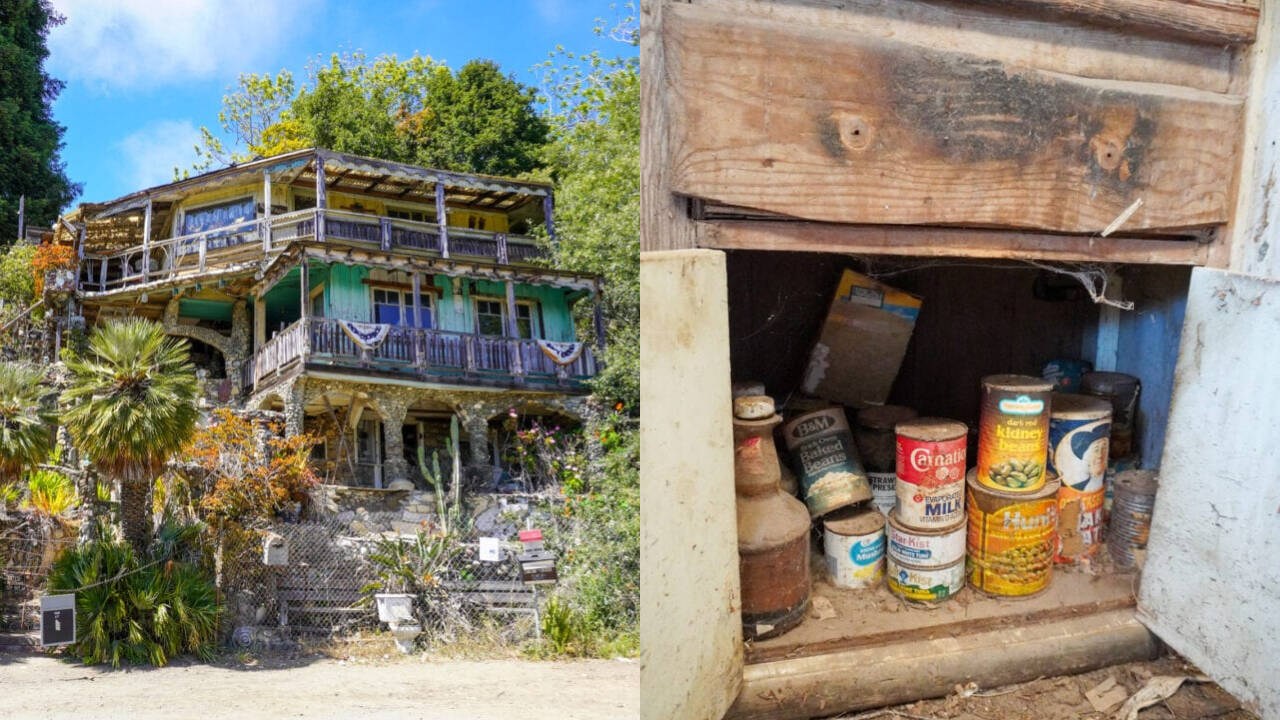
Once, along California’s rugged Central Coast, there was still room for people who wanted to live differently. Away from polished streets and grand estates, the landscape attracted eccentrics, dreamers and determined outsiders who built their own worlds with whatever they could find. One of the strangest and most enduring of those worlds began with a garbage collector, a hillside and a simple one-room shack. According to a Los Angeles Times report, in 1928, Art Beal, an eccentric American folk artist purchased about an acre and a half of pine-covered hillside in Cambria for just $500. Beal, who had worked hauling materials to the nearby construction site of William Randolph Hearst’s magnificent estate, had no interest in replicating Hearst’s grand architecture. For the next five decades, Beal transformed his modest shack into what became known as Nitt Witt Ridge, an extraordinary structure assembled largely from discarded and salvaged materials. His philosophy was simple, never pay for anything except cement. As a garbage collector, Beal had access to an almost limitless supply of things other people had thrown away. He saw possibilities where others saw rubbish. Nitt Witt Ridge eventually grew up the steep hillside in a chaotic maze of eight or nine levels, with rooms, terraces and passageways seemingly emerging wherever Beal found space.
Get breaking news anytime, anywhere. Download the TOI app now!















