As you cut into a delicious and juicy orange or add fresh lemon juice to your breakfast plate, it is hard to imagine how many steps there have been between its growth and finally ending up on your kitchen table. Citrus fruit is a common part of many diets. Unfortunately, while these fruits are being grown in the beautiful orchards, there exists a silent and well-organised army that fights a battle against us and our fruit supplies worldwide.
Get breaking news anytime, anywhere. Download the TOI app now!

The trouble started back in the early 1900s when a tiny, unassuming creature accidentally arrived on the shores of California. The Argentine ant, an invasive species known for its aggressive nature and complex social networks, slipped into the country undetected, likely hiding inside cargo shipments. Over the decades, these tiny pests have managed to conquer massive stretches of agricultural land. To understand exactly how these invaders alter our farms, we can look at a study published in the journal Insects . This research, authored by Vera Zina, Manuela Branco, and José Carlos Franco, examines how these ants can disrupt the natural balance within citrus ecosystems and contribute to pest outbreaks.
The paper compared invaded and uninvaded citrus orchards in southern Portugal over two years, using principal response curve analysis to track seasonal shifts in canopy-foraging ants. In invaded orchards, native ant numbers fell by 44% and their frequency by 76%, and the authors found the strongest disruption in spring and summer, when the Argentine ant dominated 80% of the community.
In a healthy orchard environment, many native insects collaborate to maintain a balance in pest populations. Ladybirds, lacewings, and helpful native ants behave as security guards who protect the trees from any destructive pests. Once Argentine ants move into this habitat, they can take over by displacing local insects. Not only do they live within the soil, but they also climb up to the trunk of the citrus trees to totally dominate the canopy by displacing all local insect populations.
The toxic relationship costs millions of pounds.
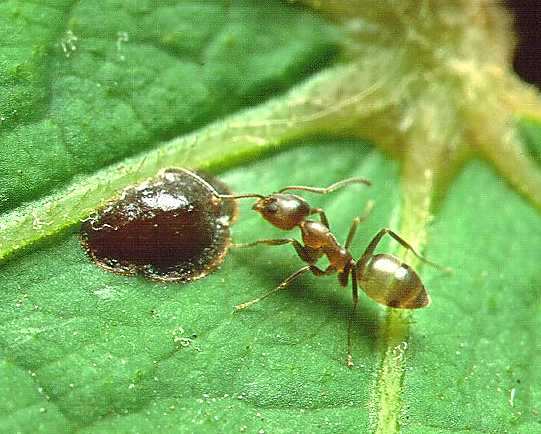
While the threat that comes from Argentine ants is not directly related to their diet, the dangerous aspect lies within the highly profitable relationship they form with other destructive species. In fact, Argentine ants are crazy about something sweet to eat, which is a sticky liquid substance known as honeydew. Honeydew is secreted by various pests, including aphids and other hemipterans.
Instead of eating the aphids, the Argentine ants treat them like prized farm animals. The ants actively guard the aphid colonies against natural predators like ladybirds and parasitic wasps. If a ladybird lands on a citrus leaf to feed on aphids, the ants may attack and drive it away. In exchange for this round-the-clock bodyguard service, the aphids willingly secrete sweet honeydew for the ants to carry back to their nests.
With ants protecting them, aphid populations can grow rapidly. With no natural enemies to keep their numbers down, they grow in numbers by the millions. They suck all of the energy from the citrus trees, resulting in curled leaves, weakened branches, and premature fruit dropping. This association can cost citrus growers significant money each year.
Restoring balance to our favourite fruit orchards
Controlling this agricultural catastrophe requires a new approach to food safety from scientists and farmers. The first instinct when faced with an infestation used to be spraying the whole orchard with chemicals. However, the problem with such an approach is that it not only causes more damage but does nothing to those ants hidden in the underground nests.
The insights from modern agricultural research suggest that the secret to saving our citrus fruits lies in breaking up the relationship between the ants and the aphids. Instead of targeting the aphids directly, forward-thinking farmers are now focusing their efforts on blocking the ants from entering the trees in the first place. By applying sticky, non-toxic barriers around the bases of the tree trunks, workers can physically prevent the Argentine ants from climbing up into the canopy.
Once the ants have been separated from their aphids, nature manages to revert to its usual balance surprisingly fast. Without ant protection, aphid colonies are more vulnerable to local predators. This method does not require any strong insecticides to be used, which makes our methods of growing fruits much healthier and environmentally friendly.