Get all your news in one place.
100's of premium titles.
One app.
Start reading
The Economic Times
The Economic Times

Caffeine clash: Starbucks slayer now brews a global coffee blend

Luckin Coffee is looking to the Gulf for its next growth engine. The Chinese coffee chain is considering expansion into Gulf countries, bringing a company that has already overwhelmed Starbucks in China into a very different competitive arena.

Luckin has just opened its 100th Singapore store and secured a $1 billion investment involving Abu Dhabi sovereign wealth fund Mubadala. After rebuilding itself from an accounting scandal that once seemed capable of killing the company, Luckin is now trying to establish whether a model perfected in China can become a global coffee business and challenge its much bigger competitor Starbucks outside the home territory.

The Gulf is the next test

The Middle East is not an entirely new idea for Luckin. The company had explored entering the Middle East and India in 2019, but those plans never materialised before the accounting scandal derailed its international ambitions.

Now the circumstances are favourable. Luckin has more than 36,000 stores in China and Hong Kong and more than 38,000 globally across China, Singapore, Malaysia and the US. Chairman David Li told CNBC in a interview on Monday that Gulf countries are among the markets it is examining. Ina separate interaction, CEO Jinyi Guo told CNBC that repeat coffee consumption and growing demand for lower-sugar, health-focused beverages are reasons for the Middle East's appeal.

Also read | Inside McDonald's push to have AI price your Big Mac

The Mubadala connection makes the timing especially interesting. In September, Mubadala agreed to invest in a vehicle holding a 9.3% economic interest in Luckin in a transaction valued at about $1 billion. Reuters reported that the deal gives Mubadala a board seat while Centurium Capital, Luckin's controlling shareholder, retains about 48% of the voting rights through super-voting shares.

Singapore offers the first piece of evidence that Luckin's model can travel. The company opened its 100th Singapore store on Monday, three years after entering the market. It says more than 1.9 million customers have transacted there and describes Singapore as its second-largest coffee chain by store count.

But Singapore is still a relatively friendly test. It is geographically close to China, has a large Chinese population and a consumer market accustomed to app-based services. The Gulf will require more localisation.

How Luckin beat Starbucks in China

Luckin's victory over Starbucks was not achieved by copying Starbucks more cheaply. Founded in 2017, Luckin built its network around takeaway and delivery rather than the café experience. Customers order through an app, pay digitally and collect their drinks from relatively compact stores. That reduces the need for expensive seating areas and allows outlets to be placed closer to offices, residential neighbourhoods and transport hubs.

The app also became a powerful customer-acquisition tool. Discounts, coupons and constantly changing promotions encouraged frequent purchases. Luckin could use transaction data to understand what customers were buying and rapidly alter its menu.

Also read | From pickups to idle plants: automakers seek lifeline from defence boom

Standard Luckin coffees in China have sold often well below comparable Starbucks drinks. The menu also embraced flavours and formats that reflected China's rapidly evolving beverage market.

Starbucks had entered China in 1999 and spent years establishing coffee as an urban lifestyle product. Luckin arrived when Chinese consumers were already comfortable with mobile ordering, food delivery and highly promotional beverage chains. It therefore did not need to persuade customers to adopt a new digital behaviour but just attached coffee to an existing one.

The store numbers tell the story, but not the whole story

By the end of 2025, Luckin had 31,048 stores globally, including 30,000-plus in China and Hong Kong. It added 8,708 stores during that year alone. Its 2025 revenue reached RMB49.29 billion, or $7.03 billion, up 43% from the previous year.

Starbucks had about 8,000 stores in China when its new partnership with Boyu Capital took effect in April 2026. Starbucks plans to eventually take that number to 20,000 with Boyu. Reuters reported that Starbucks' Chinese market share had fallen from 34% in 2019 to 14% in 2024 as lower-priced domestic chains gained ground.

Luckin has therefore built roughly four times Starbucks' Chinese store footprint. But store counts can obscure the much bigger difference between the companies as Luckin is a mere upstart in comparison to Starbucks.

Starbucks generated $37.18 billion in global revenue in fiscal 2025, more than five times Luckin's $7.03 billion. Starbucks also had nearly 41,000 stores globally at the end of that fiscal year.

Luckin has effectively caught up with Starbucks in physical footprint though most of its stores are in China in comparison to Starbucks' footprint in nearly 80 countries and it remains a much smaller business in revenue. That is partly a consequence of its low-price, high-volume model. It also shows why defeating Starbucks in China does not mean that Luckin has become a global contender too.

Two very different ideas of coffee

Starbucks makes money from coffee, but it also sells the environment around it. Its stores are designed as places to sit, meet, work and linger. That creates a different revenue proposition from Luckin's quick grab-and-go model. Starbucks can support higher prices because the customer is buying more than the drink.

This difference became particularly visible in China. Reuters reported that Starbucks' China business generated around $3.1 billion in sales in 2025. Luckin's China sales were already slightly above $3.6 billion for the fiscal year ending in February.

Starbucks has now adjusted rather than abandoned its model in China. Its deal with Boyu gives the Chinese investor 60% of the local retail business while Starbucks retains 40% and continues licensing its brand and intellectual property. The partnership is intended to improve hyper-localisation and take the network from about 8,000 stores towards 20,000.

In other words, Starbucks is responding to Luckin by becoming more locally embedded rather than simply trying to become another Luckin.

If Luckin goess to the Gulf, a customer there may appreciate its price, speed and digital convenience, but Starbucks already has decades of brand recognition and a well-established café proposition in many international markets. Luckin will have to demonstrate that its format creates habitual demand rather than simply attracting customers through introductory discounts.

When the Nasdaq scandal almost destroyed Luckin's reputation

Luckin's current expansion ambitions are all the more remarkable because the company once appeared to have destroyed its credibility. It listed on Nasdaq in 2019 after presenting itself as one of China's most promising consumer companies. In April 2020, Luckin disclosed that employees had fabricated about $340 million in 2019 sales.

The scandal led to an investigation, the removal of executives and Luckin's delisting from Nasdaq in June 2020. Later that year the company agreed to pay the US Securities and Exchange Commission $180 million to settle accounting-fraud charges.

Centurium Capital, which had invested in the company before the scandal, eventually took control in 2022. Under the restructured ownership, Luckin rebuilt its store network, improved its financial performance and returned to rapid expansion.

The Mubadala investment is another sign that the post-scandal company has attracted serious institutional backing. It does not erase what happened in 2020, but it demonstrates how dramatically the operating business has recovered.

Can Luckin thrive away from home turf?

That will be the central question behind Luckin's Gulf push. Its first overseas markets have been relatively close to the Chinese consumer environment. Singapore has allowed extensive menu localisation. The company has launched more than 130 products there, including pandan, brown sugar and Milo variants. It has also adapted to Singapore's Nutri-Grade rules.

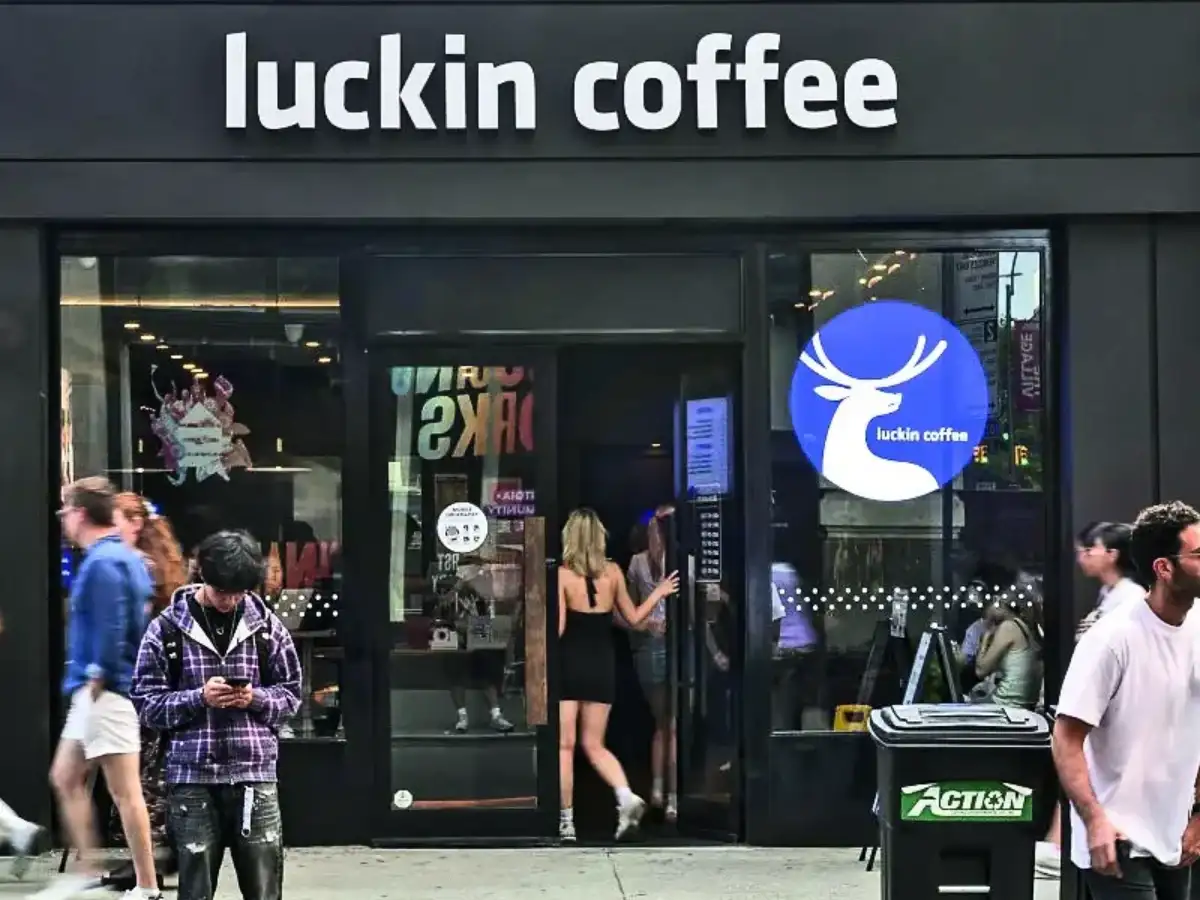
The US is a harder test. Luckin opened its first two New York stores in 2025 and has been slowly building a presence there. The company is competing not only with Starbucks but with an entrenched independent coffee culture.

The Gulf will present another set of conditions. High purchasing power could make price less decisive than it is in China, while local tastes and established café cultures could make localisation essential. Luckin's willingness to modify its menu is useful, but the economics of opening thousands of small stores in a new region will have to be demonstrated.

There is also the question of brand meaning. Starbucks arrived in China carrying an established global identity. Luckin is attempting the reverse journey. But Luckin's international proposition may not be overtly Chinese. It is based on convenience, affordability, digital ordering and product novelty. The Gulf will show how far that proposition travels.

Luckin has already proved that it can beat Starbucks when the battlefield rewards low prices, rapid expansion and digital convenience. Its next challenge is to prove that those strengths remain powerful when the battlefield changes. That's what would make the Middle East expansion more consequential than another batch of new stores. It is the next test of whether Luckin has built a Chinese coffee champion or a genuinely global one.

Sign up to read this article
Read news from 100's of titles, curated specifically for you.
Already a member? Sign in here
Related Stories
Top stories on inkl right now
One subscription that gives you access to news from hundreds of sites
Already a member? Sign in here
Our Picks
Fourteen days free
Download the app
One app. One membership.
100+ trusted global sources.