Get all your news in one place.
100's of premium titles.
One app.
Start reading
The Conversation
The Conversation
Politics
Christopher P. Davey, Charles E. Scheidt Visiting Assistant Professor of Genocide Studies and Prevention, Clark University

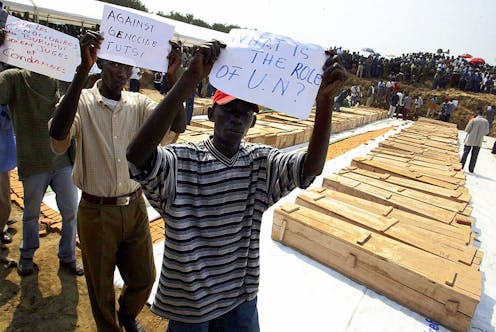
Burundi's Gatumba massacre offers a window into the past and future of the DRC conflict

Men hold up protest signs in front of the coffins of DRC refugees killed in August 2004 in Gatumba, Burundi. Simon Maina/AFP via Getty Images

For nearly three decades, the Democratic Republic of Congo (DRC) has been embroiled in violence. Millions of people have been killed and an estimated 5.6 million others displaced by civil wars, local feuds and cross-border conflicts. The neighbouring countries of Uganda, Burundi and Rwanda have been locked into this ongoing cycle, too.

The First Congo War began in 1996, with a coalition of the DRC’s neighbours supporting a rebel group that toppled the dictator Mobutu Sese Seko. Laurent Kabila was installed as head of state in 1997. A year later, however, a bloodier war began amid violent jostling for power and influence.
Sign up to read this article
Read news from 100's of titles, curated specifically for you.
Already a member? Sign in here
Related Stories
Top stories on inkl right now
One subscription that gives you access to news from hundreds of sites
Already a member? Sign in here
Our Picks
Fourteen days free
Download the app
One app. One membership.
100+ trusted global sources.