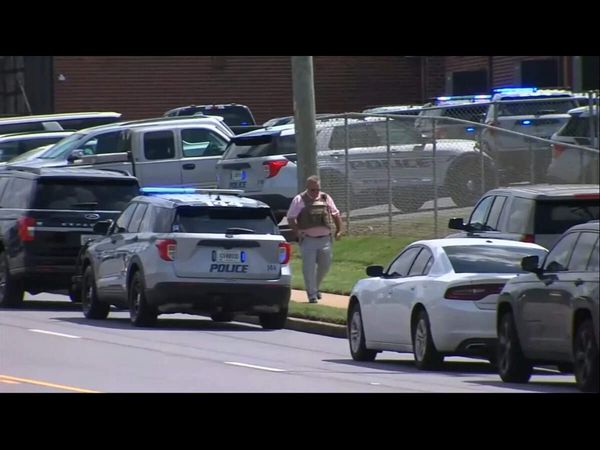
Live facial recognition technology has been deployed at London Bridge station as part of a six-month pilot launched by British Transport Police.
The force said the trial will test how the technology operates in a “railway setting” and follows months of planning and research aimed at improving public safety.
The operation began at London Bridge on Tuesday afternoon, with details of future LFR deployments to be published online in advance.
It will be deployed across several London stations.
Chief Superintendent Chris Casey, BTP’s senior officer overseeing the project, said: “The project team have spent a significant amount of time working closely with partners including Network Rail, the Department for Transport and the Rail Delivery Group to get us to this stage.
“I want to reiterate that this is a trial of the technology to assess how it performs in a railway setting.
“The initiative follows a significant amount of research and planning, and forms part of BTP’s commitment to using innovative technology to make the railways a hostile place for individuals wanted for serious criminal offences, helping us keep the public safe.
“The cameras work by scanning faces and comparing them to a watchlist of offenders wanted for serious offences. If there’s a match, then the system generates an alert. An officer will review it and carry out further checks to determine if the person is a suspect and if they need to take further action.”
The use of live facial recognition (LFR) cameras, which scan people’s faces and compare them to a watch list, has already proven successful on London’s streets.
Metropolitan Police said there had been over 1,400 LFR arrests since the technology was first introduced, with more than 1,000 people charged or cautioned.
But concerns have been raised by civil liberties group, Big Brother Watch, that LFR could be used in arbitrarily or in a discriminatory way.
It comes as Home Secretary Shabana Mahmood recently defended her plans to extend facial recognition to police forces across England and Wales, despite a consultation on its use not being complete.
LFR has an exceptionally low false alert rate and the technology has proven to be both effective and accurate, according to the Met Police.
It has now been used to scan more than three million faces with there only being a false alert in 0.0003% of cases.
Chief Supt Casey reiterated that passengers who do not wish to be scanned by live facial recognition will be able to use alternative routes.
Images of anyone not on the authorised database will be deleted immediately and permanently, he added.
“We want to make the trial as effective as it can be and we welcome your feedback. You can scan the QR codes on the posters and tell us your thoughts,” he added.