Get all your news in one place.
100’s of premium titles.
One app.
Start reading
Reason
Reason
Jacob Sullum

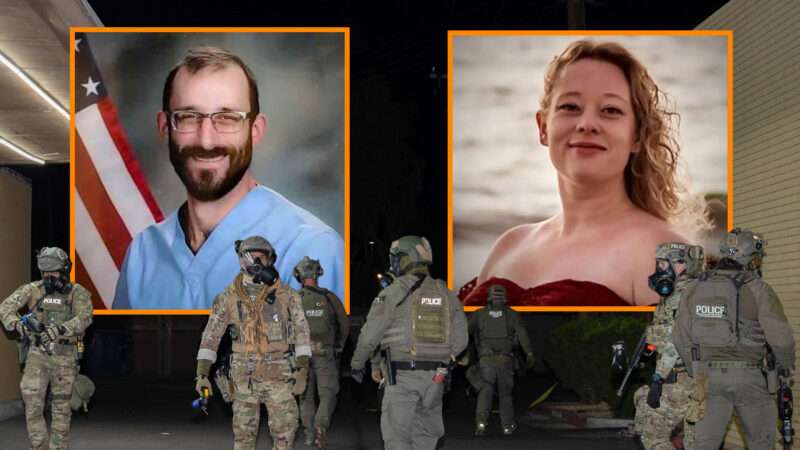
Border Patrol Agents Started the Scuffle That Led to Alex Pretti's Death

During the encounter that culminated in Minneapolis protester Renee Good's death on January 7, Immigration and Customs Enforcement (ICE) agents senselessly escalated a situation that could have been resolved peacefully. Something similar happened on Saturday morning, when U.S. Border Patrol agents fatally shot Alex Pretti, another Minneapolis protester.

According to a statement that the Department of Homeland Security (DHS) issued that morning, those agents were arresting "an illegal alien wanted for violent assault" when Pretti "approached" them "with a 9 mm semi-automatic handgun." The officers "attempted to disarm" him, according to DHS, "but the armed suspect violently resisted." DHS described "a situation where an individual wanted to do maximum damage and massacre law enforcement."
That gloss was contradicted by bystander videos of the incident, which show that Pretti, who had a carry permit, never drew his pistol, which the agents did not see until after they had tackled him. He was holding a cellphone in one hand, while his other hand was empty. DHS Secretary Kristi Noem nevertheless falsely claimed that Pretti was "brandishing" the gun, which she said showed he was "wishing to inflict harm on these officers."

Since Pretti did not actually threaten the Border Patrol agents with a gun, what prompted them to grab and restrain him? The videos show that Pretti initially was standing in the middle of the street, directing traffic while holding his cellphone to record an interaction between the agents and a few protesters. After an agent pepper-sprayed protesters and pushed a woman to the ground, Pretti stepped between the agent and the woman, "briefly putting his hand on the agent's waist," as The New York Times describes it. The agent responded with pepper spray, which Pretti tried to block with his hand. Then Pretti began helping the woman to her feet, which prompted the agents to tackle him. He was dead within half a minute.

Although Noem claimed Pretti "attacked those officers," it sure looks like the agents are the ones who started the fight. "Where did he assault [a] federal officer in any of the video that you have seen?" CNN's Dana Bash asked Border Patrol Commander at Large Gregory Bovino on Sunday. "It looked to us from every angle, sir, that he was approached by them when he was helping another individual who was pushed down. What evidence do you have that he was assaulting any law enforcement?"

It seems clear that Bovino had no such evidence. "Dana, we don't need a suspect's help in an active law enforcement scene," he said. "We don't need his help. We didn't ask his help."

By trying to help the woman who had been pushed to the ground, Bovino implied, Pretti was committing a crime. He cited 18 USC 111, which applies to someone who "forcibly assaults, resists, opposes, impedes, intimidates, or interferes with" federal law enforcement officers who are engaged in "the performance of official duties." But the videos do not show Pretti "forcibly" doing anything, let alone attacking the agents, before they decided to take him down.

In a sworn statement, a witness confirmed that Pretti was "just trying to help a woman get up" when "they took him to the ground." Before "the agents pulled the man [to] the ground," the witness said, "I didn't see him touch any of them—he wasn't even turned toward them. It didn't look like he was trying to resist, just trying to help the woman up."

DHS, which includes ICE and the Border Patrol, emphasizes that its employees "may use force only when no reasonably effective, safe, and feasible alternative appears to exist and may use only the level of force that is objectively reasonable in light of the facts and circumstances confronting [the officer] at the time force is applied." The policy adds that "when feasible, prior to the application of force, [officers] must attempt to identify themselves and issue a verbal warning to comply with [their] instructions." Yet the videos show the agents immediately responding to Pretti's intervention with force.

Because "respect for human life" is a guiding principle, the DHS policy says, officers should be "proficient in a variety of techniques that could aid them in appropriately resolving an encounter," including "de-escalation tactics." De-escalation, DHS explains, is "the use of communication or other techniques during an encounter to stabilize, slow, or reduce the intensity of a potentially violent situation without using physical force, or with a reduction in force."

In the CNN interview, Bovino claimed the agents followed that policy when they confronted Pretti. "De-escalation techniques were utilized during this action," he said. Those techniques, he added, included "physically trying to remove them from that law enforcement scene" and "the use of pepper spray."

The two methods that Bovino described as "de-escalation techniques," both of which involved assaulting Pretti and the other protesters, seem like exactly the opposite. And although the videos confirm that Pretti "resisted" after the agents grabbed him, their quick resort to that supposed "de-escalation technique" was rash in the circumstances, since Pretti was not engaged in violence until it was thrust upon him.

After the agents restrained Pretti, one of them noticed his gun. "He's got a gun!" he exclaimed. "He's got a gun! He's got a gun! He's got a gun!" At this point, the agents had both of Pretti's arms pinned down. Immediately after one of the agents removed Pretti's gun from its holster and carried it away, another agent shot Pretti in the back four times at close range. After Pretti collapsed to the ground, two agents fired six more rounds into his prone, motionless body from a distance.

The agents who shot Pretti, in short, seem to have panicked after hearing that he had a gun, even though they themselves never actually saw it. Later, an agent asked where Pretti's gun was, suggesting he did not realize it had already been removed. But whether or not the agents who fired their guns understood that Pretti had been disarmed, none of them faced an imminent threat when they shot him, and the final six rounds are especially hard to understand, let alone justify.

The parsing of those shots presumably will be the main focus of the internal investigation that DHS has promised. "We have an investigation that is going to answer those questions," Bovino said on CNN. "How many shots were fired? Who fired shots?…Where were the guns located? All those questions are going to be answered in the investigation."

Noem and Bovino himself have already prejudged the outcome of that investigation, preemptively exonerating the agents and placing the blame for Pretti's death squarely on him. "The victims are the Border Patrol agents," Bovino told Bash. But even if we could trust DHS to conduct a thorough and dispassionate review of its employees' conduct, the questions go beyond who fired when and why. A complete accounting would also ask how Pretti ended up under a pile of Border Patrol agents to begin with and whether a calmer response could have avoided the lethal outcome of that unnecessary assault.

The post Border Patrol Agents Started the Scuffle That Led to Alex Pretti's Death appeared first on Reason.com.

Sign up to read this article
Read news from 100’s of titles, curated specifically for you.
Already a member? Sign in here
Related Stories
Top stories on inkl right now
One subscription that gives you access to news from hundreds of sites
Already a member? Sign in here
Our Picks
Fourteen days free
Download the app
One app. One membership.
100+ trusted global sources.