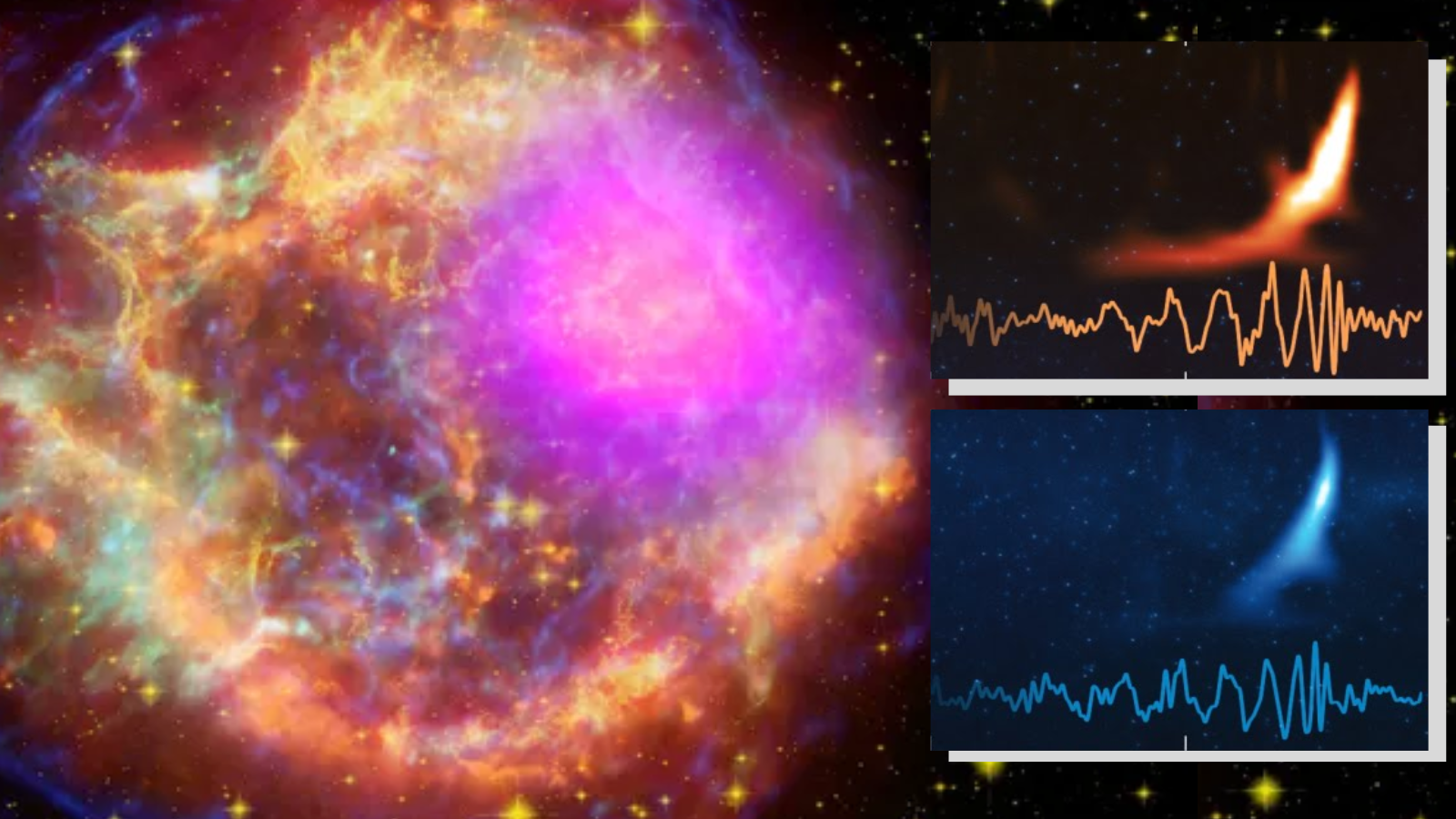
New research suggests that this current generation of gravitational wave detectors could "hear" the most energetic core-collapse supernovas at distances thousands of times greater than currently possible, as far as 65 million light-years away, beyond the Milky Way and as distant as the Virgo cluster. If possible, this could help scientists determine if the massive dying star that launches the detected supernova leaves a black hole or a neutron star in its wake.
Since the first detection of tiny ripples in spacetime called "gravitational waves" from collisions and mergers of black holes and neutron stars, the U.S.-based Laser Interferometer Gravitational-Wave Observatory (LIGO), Italy's Virgo and Japan's Kamioka Gravitational Wave Detector (KAGRA) have opened up an entirely new window on the cosmos and have created a powerful new form of astronomy that allows scientists to "hear" some of the cosmos' most violent events.