
Get all your news in one place.
100’s of premium titles.
One app.
Start reading
LiveScience
LiveScience
Harry Baker

Bizarre, UFO-like halo of red light appears over small Italian town — for the second time in 3 years

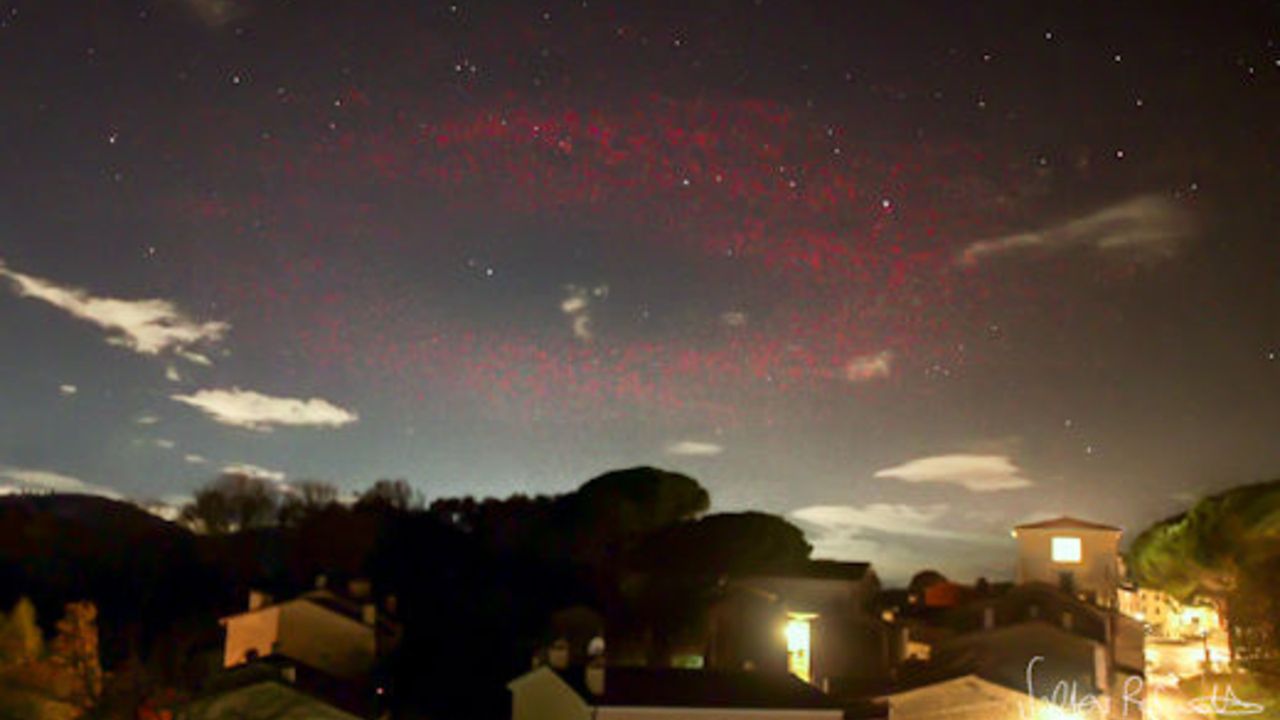
A photograph of a blurry red ring of light in the night sky above a town in Italy.

A striking new photo shows an eerie, UFO-like halo of red light seemingly hovering over a tiny town in the foothills of the Italian Alps.

The eye-catching image is remarkably reminiscent of another photo, taken in March 2023, which captured a near-identical red ring that briefly appeared over the same place.

Nature photographer Valter Binotto captured both of the rings over Possagno, a small town of around 2,200 people in northern Italy. The latest luminous halo was snapped on Nov. 17 at around 10:45 p.m. local time, and it appears to be slightly fainter than the one from two and a half years ago.

The red rings are actually examples of a rare lightning-related phenomenon dubbed "emission of light and very low-frequency perturbations due to electromagnetic pulse sources," or ELVEs, which occur during particularly intense thunderstorms, Spaceweather.com reported.

People rarely notice ELVEs because they are almost impossible to see with the naked eye. They flash in the sky for around one thousandth of a second, which is around 100 times quicker than it takes to blink. Therefore, photographers like Binotto either have to get really lucky or come equipped with special devices attached to their cameras to spot them.

The recent ELVE was almost identical to another red ring that appeared above Possagno on March 27, 2023. However, the previous event produced a much more vibrant hue. (Image credit: Valter Binotto)

ELVEs form when powerful lightning bolts shoot electromagnetic pulses (EMPs) up toward space, where they collide with the ionosphere — the ionized part of the upper atmosphere that stretches between 50 and 400 miles (80 and 644 kilometers) above the ground. Once there, they excite nitrogen molecules, which briefly give off red light, similar to how auroras form. (Although red auroras are the result of oxygen, not nitrogen.)

"The red ring marks the spot where the EMP hit Earth's ionosphere," Binotto told Spaceweather.com. In this case, the EMP was released by a lightning bolt with an electrical current of approximately 303 kilo-amperes, which is between 10 and 30 times higher than an average thunderstorm discharge, he added.

Given the rarity of ELVEs, which were discovered only in the 1990s from photos taken by NASA's space shuttles, you may be wondering what is so special about Possagno that causes these rings to appear there so often. And the answer is: nothing.

Instead, these photos are merely the result of Binotto's skill and experience in photographing ELVEs, and it is only a coincidence that he happened to take them both from the same place.

ELVEs are massive and appear high up in the atmosphere, meaning that they can be photographed from anywhere within a radius spanning hundreds of miles. In the latest photo, for example, the ELVE resulted from a thunderstorm near Vernazza, around 185 miles (300 km) south of Possagno. The 2023 ring was triggered by a storm near Ancona, around 174 miles (280 km) southeast of the northern town (see below).

The latest red halo likely spanned around 125 miles (200 km) across and appeared at an altitude of around 60 miles (100 km) above the ground, according to Spaceweather.com.

The ELVEs visible above Possagno have nothing to do with the town itself. This map shows where the 2023 ELVE was located relative to Possagno. (Image credit: Valter Binotto)

ELVEs, sprites and gigantic jets

ELVES are just one of several rare optical phenomena that are collectively known as transient luminous events (TLEs), which are all linked to specific types of lightning strikes.

Other TLEs include red "jellyfish" sprites, made of zig-zagging plasma tendrils that streak through the ionosphere, and upward-shooting "gigantic jets," which are towering blue-colored lights that can often be seen from space.

The electrical fields of ELVEs can also act as particle accelerators, creating X-rays, relativistic electrons and "terrestrial gamma ray flashes," according to the National Oceanic and Atmospheric Administration. These secondary effects pose no risk to people on the ground, but remain of great interest to scientists who can use them as a proxy for studying powerful cosmic rays.

However, it is unclear if the ELVES photographed by Binotto produced any of these effects.

Sign up to read this article
Read news from 100’s of titles, curated specifically for you.
Already a member? Sign in here
Related Stories
Top stories on inkl right now
One subscription that gives you access to news from hundreds of sites
Already a member? Sign in here
Our Picks
Fourteen days free
Download the app
One app. One membership.
100+ trusted global sources.